
Tulipa montana
A small wild tulip with deep red blooms from the mountains of Iran and Turkmenistan
Tulipa montana is a short, perennial tulip that grows from bulbs in the highlands of Iran and Turkmenistan. Its flowers are usually a rich red, sometimes yellow, with a dark blotch at the center. People value it for its striking color and its possible link to ancient texts.
- Grows wild in the mountains of Iran and Turkmenistan
- Usually has deep red flowers, but yellow forms also occur
- Blooms from early spring to early summer
- Described by botanist John Lindley in 1827
What does Tulipa montana look like?
Tulipa montana is a small tulip species that grows up to 20 cm tall. Its leaves have a bluish-grey tint. The flowers are cup-shaped and most often appear in shades of red, from bright scarlet to deep crimson, though yellow forms can also be found in the wild. Each bloom has a dark greenish-black patch at its center and yellow-tipped anthers, making the flower stand out against its mountain surroundings.
Where does Tulipa montana come from?
This tulip is native to the mountainous regions of Iran and Turkmenistan, and may also be found in parts of Iraq near the Caspian Sea. The name 'montana' comes from Latin, meaning 'of the mountains.' It was first collected in Persia in 1826 and formally described by botanist John Lindley in 1827. Its natural habitat is rocky slopes and hillsides at higher elevations.
When and how Tulipa montana blooms
Tulipa montana grows from a bulb and emerges early in the year. It usually flowers in spring, around April, but in some places like America, it can bloom as late as July. The plant prefers rocky soils and cooler mountain climates. It can be grown from bulbs planted in autumn, following the natural cycle of wild tulips.
How Tulipa montana is used
There is no record in the sources of Tulipa montana being widely used in gardens or for decoration. Its main significance comes from its natural beauty in the wild and its possible connection to ancient stories. Some people grow it for its unusual color and form among tulip species.
Kinds of Tulipa montana
Most Tulipa montana plants have deep red flowers, but yellow-flowered forms also exist in the wild. The species is considered one of the smaller tulips, and its striking color makes it stand out among other mountain tulips.
What Tulipa montana means
Tulipa montana has attracted attention for its vivid appearance and because some have suggested it could be linked to flowers mentioned in old religious texts. Its main cultural value lies in its beauty and its place among wild tulips of the region.
Questions people ask about Tulipa montana
Where does Tulipa montana come from?
Tulipa montana is native to the mountain regions of Iran and Turkmenistan, and may also be found in parts of Iraq near the Caspian Sea.
What does Tulipa montana look like?
It is a short tulip, up to 20 cm tall, with bluish-grey leaves and cup-shaped flowers that are usually deep red, though yellow forms are also found. The flowers have a dark blotch in the center and yellow anthers.
When does Tulipa montana flower?
It blooms in early spring, around April, but can flower as late as July in some regions.
Is Tulipa montana used for anything special?
The sources do not mention any widespread use for decoration or in gardens. Its main value is as a wildflower and for its possible historical significance.
Does Tulipa montana have any special meaning?
Some have connected it to flowers mentioned in ancient religious texts, but its main importance is as a striking wild tulip of the region.
Good reading and sources
- Tulipa montana (15)Royal Horticultural Society, Article
- Plants of the World OnlineRoyal Botanic Gardens, Kew, Plant database
- Where it has been recordedGBIF, Plant database
- Sightings and photos by naturalistsiNaturalist, Plant database
- Tulipa montana on WikipediaEncyclopedia
- More photos on Wikimedia CommonsPhotos
- Wikidata recordOpen data
The facts on this page come from the Wikipedia article "Tulipa montana", written by its contributors and used under the CC BY-SA 4.0 licence, and from its Wikidata record (CC0). Phool rewrote the text in its own words, with AI assistance, and compares every page with the article to make sure no passage is copied. It may be reused under the same CC BY-SA 4.0 licence with a link back.
It may contain mistakes. It is not medical or foraging advice: many flowers are poisonous, and traditional uses are reported, not recommended. If something is wrong, tell us. Last refreshed 2026-10-03.
Others in the family Liliaceae
The whole family LilyLilium
Tall bulb flowers with large, colourful blooms in many gardens and cultures
Lilium · Wildflower
LilyLilium
Tall bulb flowers with large, colourful blooms in many gardens and cultures
Lilium · Wildflower
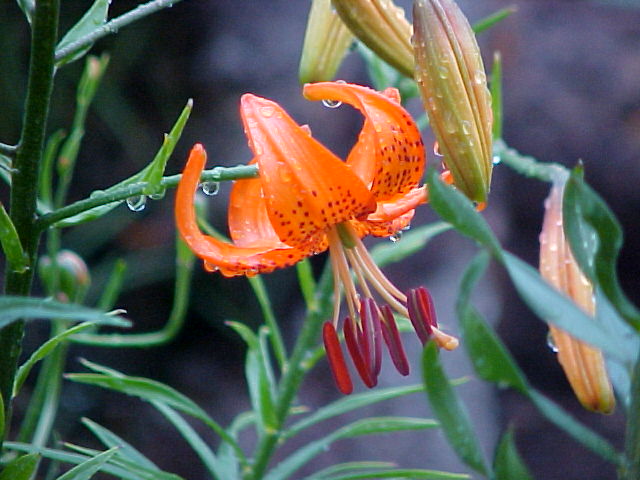 Lilium davidii
A tall Asian lily with edible bulbs and orange recurved flowers
🇨🇳 China and 1 more · Wildflower
Lilium davidii
A tall Asian lily with edible bulbs and orange recurved flowers
🇨🇳 China and 1 more · Wildflower
 Chinese LilyLilium brownii
A wild and cultivated lily from China with edible bulbs
🇨🇳 China and 3 more · Wildflower
Chinese LilyLilium brownii
A wild and cultivated lily from China with edible bulbs
🇨🇳 China and 3 more · Wildflower
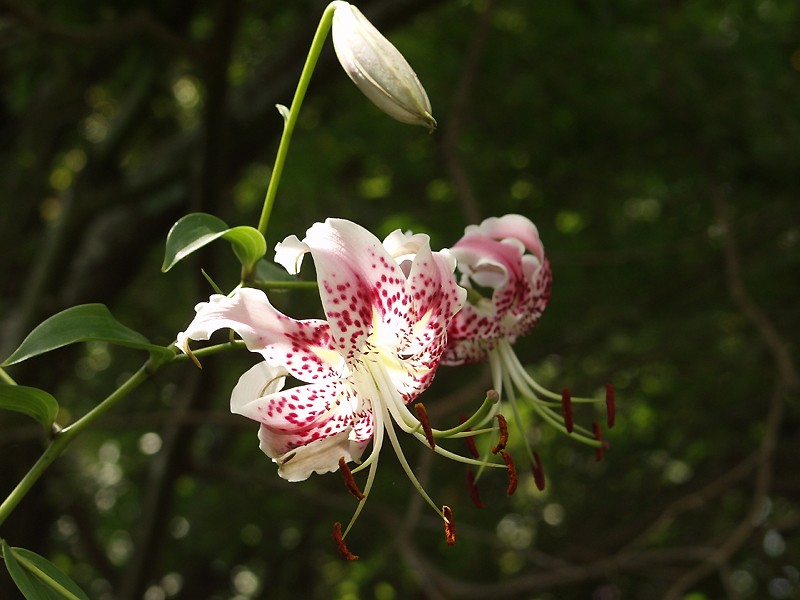 Lilium speciosum
A late-summer lily with fragrant white to pink flowers from East Asia
🇯🇵 Japan and 2 more · Wildflower
Lilium speciosum
A late-summer lily with fragrant white to pink flowers from East Asia
🇯🇵 Japan and 2 more · Wildflower
More from Iran
All the flowers of Iran AlmondPrunus amygdalus
A Mediterranean tree grown for its fragrant spring flowers and edible seeds
🇮🇷 Iran and 6 more · Flowering tree
AlmondPrunus amygdalus
A Mediterranean tree grown for its fragrant spring flowers and edible seeds
🇮🇷 Iran and 6 more · Flowering tree
 TulipTulipa
Spring-blooming bulbs with showy, cup-shaped flowers in many colours
🇳🇱 Netherlands and 7 more · Wildflower
TulipTulipa
Spring-blooming bulbs with showy, cup-shaped flowers in many colours
🇳🇱 Netherlands and 7 more · Wildflower
 JasmineJasminum
A group of fragrant shrubs and vines with white or yellow star-shaped flowers
🇵🇰 Pakistan and 7 more · Wildflower
JasmineJasminum
A group of fragrant shrubs and vines with white or yellow star-shaped flowers
🇵🇰 Pakistan and 7 more · Wildflower
 Wild cherryPrunus avium
A tall flowering tree native to Europe, grown for its sweet fruit and spring blossom
🇮🇹 Italy and 6 more · Flowering tree
Wild cherryPrunus avium
A tall flowering tree native to Europe, grown for its sweet fruit and spring blossom
🇮🇹 Italy and 6 more · Flowering tree