
Morris & Co.
Handcrafted floral wallpapers, textiles, and stained glass from Victorian Britain
Morris & Co. was a British firm known for its hand-crafted wallpapers, textiles, stained glass, and furnishings, founded by William Morris and associates in 1861. Drawing on medieval and natural motifs, especially flowers, their designs shaped church and home decoration in the Arts and Crafts era and remain influential today.
- Founded by William Morris and Pre-Raphaelite artists in 1861
- Famous for hand-printed floral wallpapers and textiles
- Supplied the Winter Palace in St. Petersburg with "Garden Tulip" wallpaper
- Revived traditional dyeing and weaving techniques
- Stained glass windows installed in churches across Britain
What is Morris & Co.?
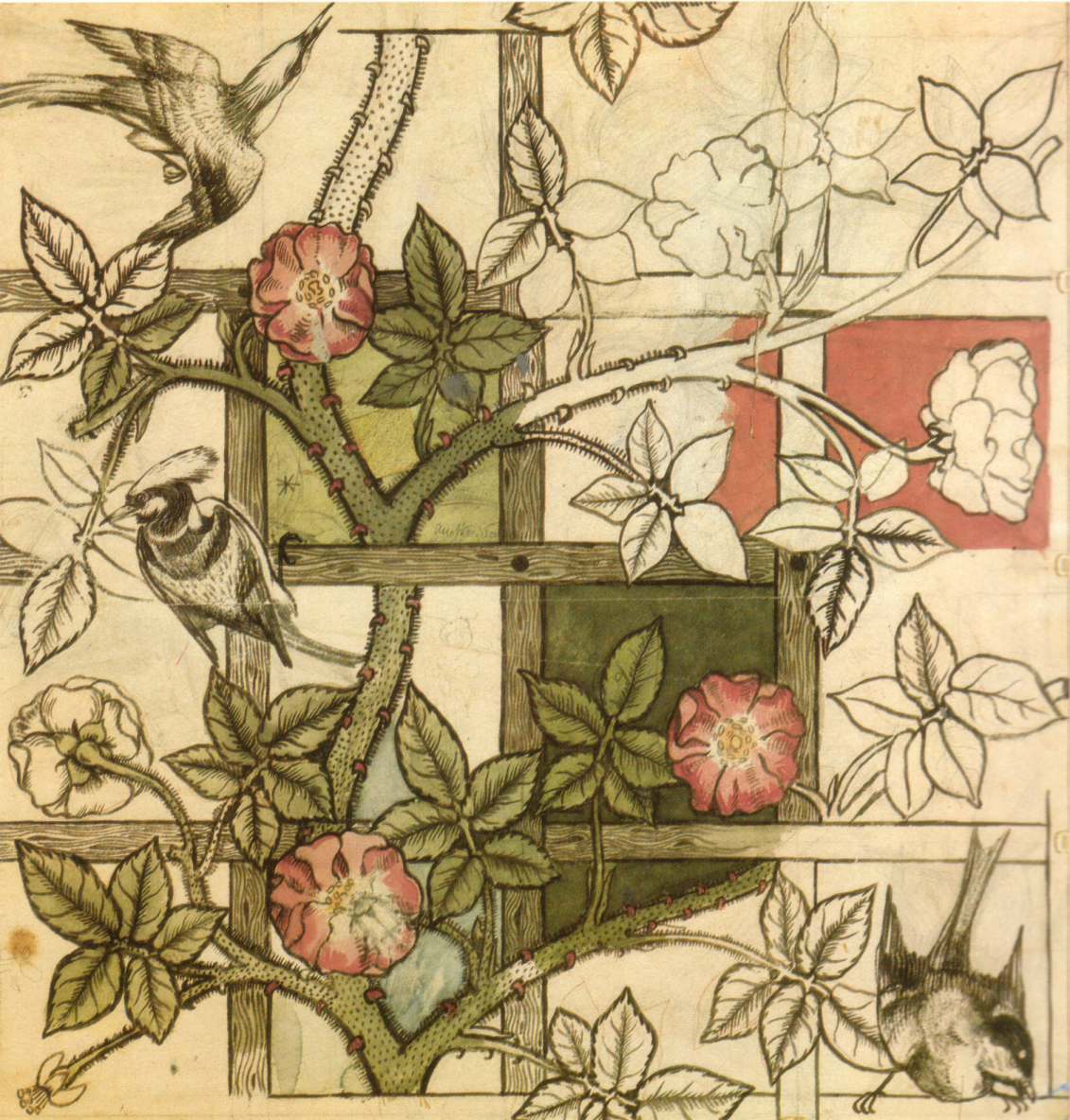
Morris & Co. created wallpapers, textiles, stained glass, tapestries, and furniture, often decorated with repeating floral and plant patterns. Their designs feature stylized flowers, leaves, and branches, sometimes with birds or medieval figures. Wallpapers and fabrics were typically hand-printed using woodblocks, giving rich color and detail. Stained glass windows made for churches and homes showed intricate scenes and natural motifs. The overall look is lush, detailed, and rooted in nature.
Where does Morris & Co. come from?
Founded in London in 1861 by William Morris and fellow artists, Morris & Co. began as Morris, Marshall, Faulkner & Co. The firm drew inspiration from medieval art and traditional handcrafts, aiming to revive the beauty and skill of earlier decorative arts. Early work focused on church decoration, especially stained glass, but soon expanded to secular interiors. Morris himself revived old dyeing techniques and preferred hand-printing over industrial methods. The company’s influence peaked during the Arts and Crafts Movement in the late 19th century.
How Morris & Co. is made
Wallpapers and fabrics were designed with repeating patterns, often featuring flowers and foliage. These were printed by hand using carved woodblocks and natural dyes. Stained glass was crafted for churches and private homes, with designs drawn by artists and assembled by skilled workers. Tapestries and embroideries were woven or stitched in workshops, sometimes based on medieval stories or legends. The firm’s products were made in London and later at the Merton Abbey Works, using traditional techniques.



When and where Morris & Co. is used
Morris & Co. designs decorated churches, public buildings, and private homes, especially in Britain. Their stained glass windows were installed in many churches, while wallpapers, textiles, and carpets became popular in secular interiors. The firm’s work was commissioned for royal palaces, museums, and country houses. Today, original and reproduction Morris & Co. patterns are still used in home decoration, and their historic interiors can be seen in museums and preserved houses.
Forms of Morris & Co.
Many designers contributed to Morris & Co., including William Morris, John Henry Dearle, and others. Patterns ranged from simple trellises to elaborate floral scenes. Some designs, like the "Garden Tulip" wallpaper, became famous through royal commissions. Tapestries often depicted Arthurian legends or angels. Over time, Dearle and other designers developed their own styles, though their work was often attributed to Morris. Today, Morris & Co. patterns are still produced under license.
What Morris & Co. means
Morris & Co. played a key role in the Arts and Crafts Movement, which valued handcraft and natural beauty over industrial production. Their floral designs became symbols of this movement and influenced decorative arts worldwide. The firm’s work is associated with a return to traditional skills and respect for nature. Some patterns, like those used in the Russian Winter Palace, have become cultural icons. Morris & Co. interiors are preserved in museums and historic houses.
The flowers of Morris & Co.


Questions people ask about Morris & Co.
What is Morris & Co. best known for?
Morris & Co. is best known for its handcrafted wallpapers, textiles, and stained glass, especially those featuring repeating floral and plant patterns inspired by medieval and natural themes.
Where did Morris & Co. originate?
Morris & Co. was founded in London, United Kingdom, in 1861 by William Morris and a group of artists associated with the Pre-Raphaelite Brotherhood.
What flowers and plants appear in Morris & Co. designs?
Their designs often feature stylized tulips, olive branches, fruit, and various flowers and leaves, arranged in repeating patterns for wallpapers and textiles.
How were Morris & Co. wallpapers and fabrics made?
Wallpapers and fabrics were hand-printed using carved woodblocks and natural dyes, a process that allowed for rich colors and detailed patterns, in contrast to industrial roller printing.
What is the cultural significance of Morris & Co.?
Morris & Co. was central to the Arts and Crafts Movement, promoting handcraft, traditional skills, and natural motifs. Their floral designs became influential symbols of this movement.
Good reading and sources
- Encyclopaedia BritannicaArticle
- Curtains, wellies, nuclear subs and a tsar’s palace: how William Morris mania swept the worldThe Guardian, Article
The facts on this page come from the Wikipedia article "Morris & Co.", written by its contributors and used under the CC BY-SA 4.0 licence, and from its Wikidata record (CC0). Phool rewrote the text in its own words, with AI assistance, and compares every page with the article to make sure no passage is copied. It may be reused under the same CC BY-SA 4.0 licence with a link back.
It may contain mistakes. If something is wrong, tell us. Last refreshed 2026-10-03.
More of the same kind
 Decoration
Nageirebana抛入花
A free-form ikebana style using tall vases and no flower holders
Arrangement
Decoration
Nageirebana抛入花
A free-form ikebana style using tall vases and no flower holders
Arrangement
 Decoration
Bonsai盆栽
The Japanese art of shaping miniature trees in shallow pots
🇯🇵 Japan and 7 more · Art or design
Decoration
Bonsai盆栽
The Japanese art of shaping miniature trees in shallow pots
🇯🇵 Japan and 7 more · Art or design
 Decoration
Tokonoma床の間
A Japanese alcove for displaying scrolls and flower arrangements
🇯🇵 Japan · Arrangement
Decoration
Tokonoma床の間
A Japanese alcove for displaying scrolls and flower arrangements
🇯🇵 Japan · Arrangement
 Decoration
Sōgetsu草月流
A modern school of Japanese ikebana open to all materials and styles
🇯🇵 Japan · Arrangement
Decoration
Sōgetsu草月流
A modern school of Japanese ikebana open to all materials and styles
🇯🇵 Japan · Arrangement
More from the United Kingdom
All the flowers of the United Kingdom Decoration
Advent wreathAdventskranz
A ring of evergreens and candles marking each week of Advent
🇩🇪 Germany and 2 more · Worn flowers, Nov to Dec
Decoration
Advent wreathAdventskranz
A ring of evergreens and candles marking each week of Advent
🇩🇪 Germany and 2 more · Worn flowers, Nov to Dec
 Decoration
BeltaneBealtaine / Là Bealltainn / Boaltinn
The Gaelic May Day festival with bonfires and yellow flower decorations
🇮🇪 Ireland and 1 more · Custom, May
Decoration
BeltaneBealtaine / Là Bealltainn / Boaltinn
The Gaelic May Day festival with bonfires and yellow flower decorations
🇮🇪 Ireland and 1 more · Custom, May
 Decoration
Heraldic rose
A stylized five-petaled rose used as a symbol in coats of arms and badges
🇬🇧 United Kingdom and 3 more · Art or design
Decoration
Heraldic rose
A stylized five-petaled rose used as a symbol in coats of arms and badges
🇬🇧 United Kingdom and 3 more · Art or design
 Decoration
Boutonnière
A single flower worn on a suit or tuxedo lapel for formal occasions
🇬🇧 United Kingdom · Worn flowers
Decoration
Boutonnière
A single flower worn on a suit or tuxedo lapel for formal occasions
🇬🇧 United Kingdom · Worn flowers