
Love-lies-bleeding
Amaranthus caudatus, family Amaranthaceae
Tall Andean plant with long, drooping red or white flower clusters
Love-lies-bleeding (Amaranthus caudatus) is a tall annual from the Andes, grown for its dramatic, hanging flower spikes that can be red, white, or black. Its seeds and leaves are eaten in South America and beyond, and the plant is valued for its nutrition and as a natural dye.
- Grown in the Andes for thousands of years
- Long, drooping flower clusters in red, white, or black
- Seeds and leaves are both edible
- Red varieties used for natural food dye
- Known as kiwicha in South America
What does Love-lies-bleeding look like?
Love-lies-bleeding is a striking annual that can reach up to 2.5 meters tall. Its most noticeable feature is the long, rope-like flower heads, called panicles, which can hang down as much as 90 centimeters. These flower clusters are densely packed and appear in shades of deep red, white, or sometimes black. The plant has broad leaves and a sturdy central stem, with smaller branches and leaves spreading out from the base. The seeds are tiny, shiny, and packed inside small fruits within the flower clusters.
Where does Love-lies-bleeding come from?
This plant comes from the high valleys of the Andes, especially in Peru, Ecuador, and northern Argentina. It has been grown for thousands of years by local peoples, including the Inca. Love-lies-bleeding is one of the few amaranths that can thrive at high altitudes, above 2,500 meters. Although its use declined after the arrival of the Spanish, it has remained important in Andean farming and is now grown in other parts of the world, including China, India, Kenya, and Mexico.
When and how Love-lies-bleeding blooms
Love-lies-bleeding is planted at the start of the rainy season, either by sowing seeds directly or by transplanting seedlings. It grows best in full sun and mild climates, with well-drained, fertile soil. The plant matures in 4 to 10 months depending on altitude and climate. Traditional Andean farmers often grow it without irrigation or fertilizer. Harvesting is done before the plant is fully mature; the stems are cut, dried, and the seeds are separated by threshing and sieving.


How Love-lies-bleeding is used
The seeds and leaves of love-lies-bleeding are eaten in many countries. In South America, the seeds are ground into flour, popped like popcorn, or cooked into porridge. In Mexico, they are used in sweets called alegria, while in India, similar treats called ladoos are made. The plant is also used as animal feed after the seeds are removed. In Peru, the red varieties provide a natural food dye. Its high nutritional value makes it important for both traditional and modern diets.
Kinds of Love-lies-bleeding
Several local names exist for this plant, such as kiwicha in Quechua and qamasa in Aymara. There are different varieties with flower spikes in red, white, or black. The red forms are rich in natural pigments called betacyanins. Amaranthus caudatus is closely related to other amaranths, such as A. cruentus, which is more common in Central America.
What Love-lies-bleeding means
In Victorian flower symbolism, love-lies-bleeding was linked to hopeless love or lost opportunities, inspired by its dramatic, blood-like flower clusters. The plant is a traditional crop in the Andes and remains a symbol of local food heritage. Its seeds are valued for their nutrition, and the plant is sometimes used as a regional emblem.
Questions people ask about Love-lies-bleeding
Where does love-lies-bleeding come from?
Love-lies-bleeding is native to the high Andes, especially in Peru, Ecuador, and northern Argentina. It has been grown in these regions for thousands of years.
What does love-lies-bleeding look like?
It is a tall plant with broad leaves and long, hanging flower spikes that can be red, white, or black. The flower clusters are dense and rope-like, making the plant very noticeable.
How is love-lies-bleeding used?
The seeds are eaten as cereal, ground into flour, or made into sweets. The leaves are also edible. In Peru, the red flowers are used to make a natural dye, and the leftover plant material is fed to animals.
What does love-lies-bleeding symbolise?
In Victorian times, it was a symbol for lost love or unattainable hopes, inspired by its dramatic, drooping red flower spikes.
Is love-lies-bleeding grown outside South America?
Yes, it is now cultivated in countries such as China, India, Kenya, and Mexico, as well as in its native Andes.
Good reading and sources
- Encyclopaedia BritannicaArticle
- USDA Plants DatabaseUS Department of Agriculture, Article
- Amaranthus caudatus | love-lies-bleedingRoyal Horticultural Society, Article
- Plants of the World OnlineRoyal Botanic Gardens, Kew, Plant database
- Where it has been recordedGBIF, Plant database
- Sightings and photos by naturalistsiNaturalist, Plant database
- Amaranthus caudatus on WikipediaEncyclopedia
- More photos on Wikimedia CommonsPhotos
- Wikidata recordOpen data
The facts on this page come from the Wikipedia article "Amaranthus caudatus", written by its contributors and used under the CC BY-SA 4.0 licence, and from its Wikidata record (CC0). Phool rewrote the text in its own words, with AI assistance, and compares every page with the article to make sure no passage is copied. It may be reused under the same CC BY-SA 4.0 licence with a link back.
It may contain mistakes. It is not medical or foraging advice: many flowers are poisonous, and traditional uses are reported, not recommended. If something is wrong, tell us. Last refreshed 2026-10-03.
Others in the family Amaranthaceae
The whole family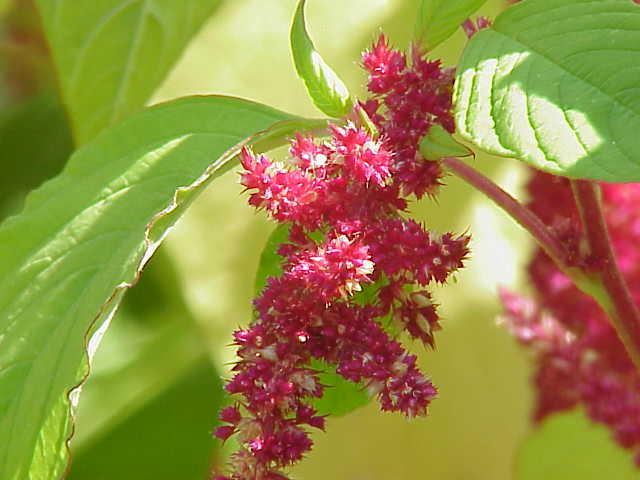 AmaranthAmaranthus
A tall, colourful plant grown for its flowers, leaves and edible seeds
🇲🇽 Mexico and 7 more · Wildflower
AmaranthAmaranthus
A tall, colourful plant grown for its flowers, leaves and edible seeds
🇲🇽 Mexico and 7 more · Wildflower
 Bassia scoparia
A bushy annual with red autumn leaves, used for brooms and as a food garnish
🇨🇳 China and 3 more · Wildflower
Bassia scoparia
A bushy annual with red autumn leaves, used for brooms and as a food garnish
🇨🇳 China and 3 more · Wildflower
 Globe amaranthGomphrena globosa
A round-flowered annual grown for its lasting, colorful blooms
🇬🇹 Guatemala and 4 more · Wildflower
Globe amaranthGomphrena globosa
A round-flowered annual grown for its lasting, colorful blooms
🇬🇹 Guatemala and 4 more · Wildflower
More from Peru
All the flowers of Peru CactusCactaceae
Succulent plants with spines, native to the Americas
🇲🇽 Mexico and 7 more · Wildflower
CactusCactaceae
Succulent plants with spines, native to the Americas
🇲🇽 Mexico and 7 more · Wildflower
 Thorn-appleDatura stramonium
A poisonous, night-blooming plant with trumpet-shaped white or violet flowers
🇨🇳 China and 7 more · Wildflower
Thorn-appleDatura stramonium
A poisonous, night-blooming plant with trumpet-shaped white or violet flowers
🇨🇳 China and 7 more · Wildflower
 PoinsettiaEuphorbia pulcherrima
The red-bracted shrub of Christmas displays, native to Mexico and Central America
🇲🇽 Mexico and 8 more · Wildflower
PoinsettiaEuphorbia pulcherrima
The red-bracted shrub of Christmas displays, native to Mexico and Central America
🇲🇽 Mexico and 8 more · Wildflower
 MarigoldTagetes
A group of bright annual and perennial flowers known worldwide as marigolds
🇲🇽 Mexico and 7 more · Wildflower
MarigoldTagetes
A group of bright annual and perennial flowers known worldwide as marigolds
🇲🇽 Mexico and 7 more · Wildflower