
Brodiaea
A group of corm-growing lily-like flowers from western North America
Brodiaea is a genus of herbaceous perennial plants that grow from corms and produce clusters of blue to purple flowers on leafless stems. Native to the Pacific coast of North America, especially California, they bloom in early summer and are sometimes grown in gardens or dried for decoration.
- Grows from a corm and blooms in early summer
- Flowers appear in rounded clusters on bare stems
- Most species are found only in California
- Scientific name Brodiaea is officially conserved
- Some species are endangered due to limited habitat
What does Brodiaea look like?
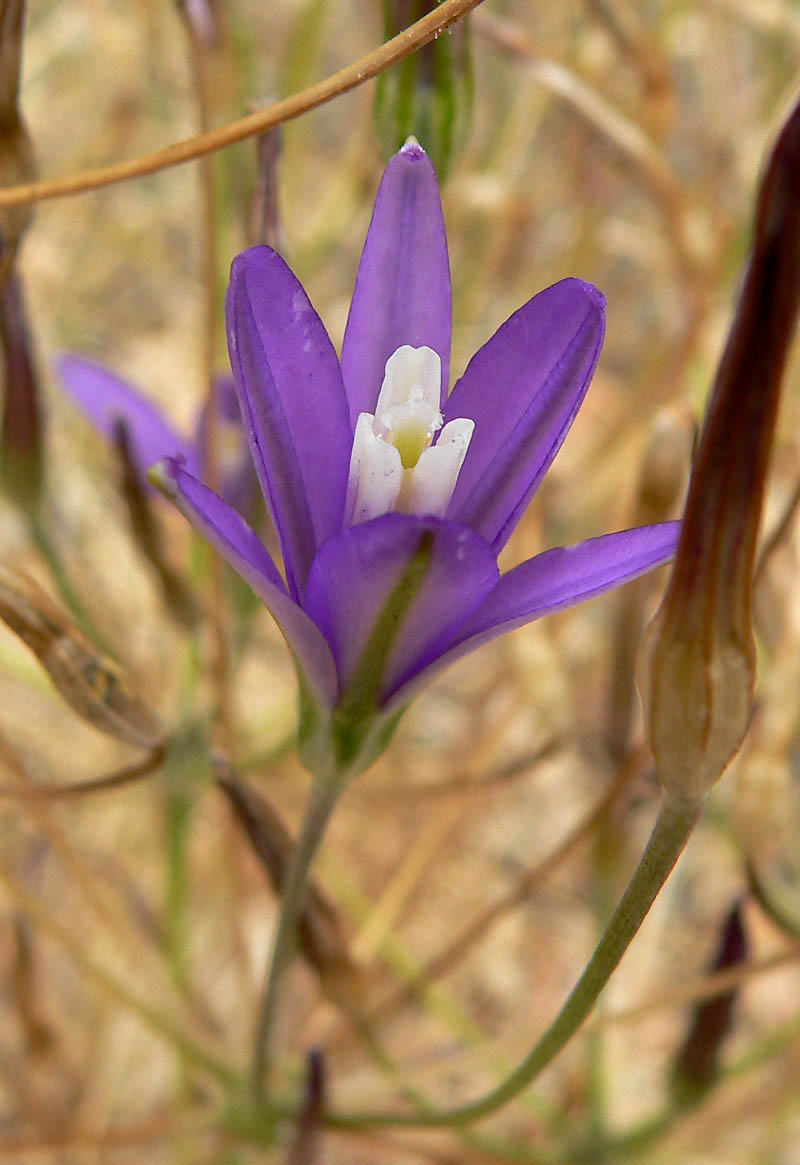
Brodiaea plants grow from underground corms and send up narrow leaves close to the ground. Their bare flowering stalks hold clusters of flowers called umbels. Each flower has six petal-like parts that are blue or purple, fused at the base into a short tube with spreading tips. Inside, there are three regular stamens and three sterile ones that look like tiny petals.
Where does Brodiaea come from?
First collected near the Strait of Georgia in 1792 by Archibald Menzies, Brodiaea was later named by James Edward Smith in 1810 after Scottish botanist James Brodie. An earlier name, Hookera, was set aside to avoid confusion with a moss genus, making Brodiaea a conserved scientific name. The plants are native only to western North America.
When and how Brodiaea blooms
These perennials emerge from corms each year. They form a few slender leaves and then send up smooth, leafless stems topped with rounded clusters of flowers. They thrive in sunny spots and often grow in soils with unusual chemistry, such as serpentine. Some species flower in early summer, later than many spring bulbs.


How Brodiaea is used
Gardeners plant Brodiaea species like B. californica and B. coronaria for their late-spring to early-summer blooms. The larger flower heads can be dried and kept as winter decorations. Smaller kinds are suited to bulb frames or alpine houses, where their delicate forms can be appreciated up close.
Kinds of Brodiaea
The genus includes about 18 accepted species, most found only in California. Brodiaea pallida, for example, survives in just two locations on the Tuolumne–Calaveras county line. Plants once placed here, such as those now in Dichelostemma and Triteleia, are no longer considered true Brodiaea.
What Brodiaea means
Brodiaea’s scientific name was the subject of an early botanical dispute, resolved by conserving Smith’s name over Salisbury’s Hookera. Several species are rare due to their restricted habitats, especially on serpentine soils. Though not tied to festivals or faiths, they are valued in native plant gardening and conservation.
Questions people ask about Brodiaea
Where does Brodiaea come from?
It is native to the Pacific coast of North America, from British Columbia through California to Baja California in Mexico.
What do Brodiaea flowers look like?
They have blue to purple flowers in clusters, each with six petal-like parts joined at the base and three small sterile stamens inside.
Is Brodiaea used in gardens?
Yes, species like B. californica and B. coronaria are grown in sunny spots and extend the flowering season into early summer.
Why is it called Brodiaea?
James Edward Smith named it in 1810 after Scottish botanist James Brodie; the name was later conserved over an earlier one to avoid confusion.
Are any Brodiaea species rare?
Yes, several are endangered, such as B. pallida, which is known from only two sites in California’s Sierra foothills.
Good reading and sources
- Index Nominum Genericorum (ING), Botany, Smithsonian InstitutionSmithsonian, Article
- USDA Plants DatabaseUS Department of Agriculture, Article
- Plants of the World OnlineRoyal Botanic Gardens, Kew, Plant database
- Where it has been recordedGBIF, Plant database
- Sightings and photos by naturalistsiNaturalist, Plant database
The facts on this page come from the Wikipedia article "Brodiaea", written by its contributors and used under the CC BY-SA 4.0 licence, and from its Wikidata record (CC0). Phool rewrote the text in its own words, with AI assistance, and compares every page with the article to make sure no passage is copied. It may be reused under the same CC BY-SA 4.0 licence with a link back.
It may contain mistakes. It is not medical or foraging advice: many flowers are poisonous, and traditional uses are reported, not recommended. If something is wrong, tell us. Last refreshed 2026-10-03.
Others in the family Asparagaceae
The whole family Lily-of-the-valleyConvallaria majalis
A woodland plant with sweet-scented white bell flowers in late spring
🇫🇮 Finland and 4 more · Wildflower
Lily-of-the-valleyConvallaria majalis
A woodland plant with sweet-scented white bell flowers in late spring
🇫🇮 Finland and 4 more · Wildflower
 HyacinthHyacinthus
A spring-blooming bulb with fragrant, colourful flower spikes
🇹🇷 Turkey and 7 more · Bulb flower
HyacinthHyacinthus
A spring-blooming bulb with fragrant, colourful flower spikes
🇹🇷 Turkey and 7 more · Bulb flower
 Yucca
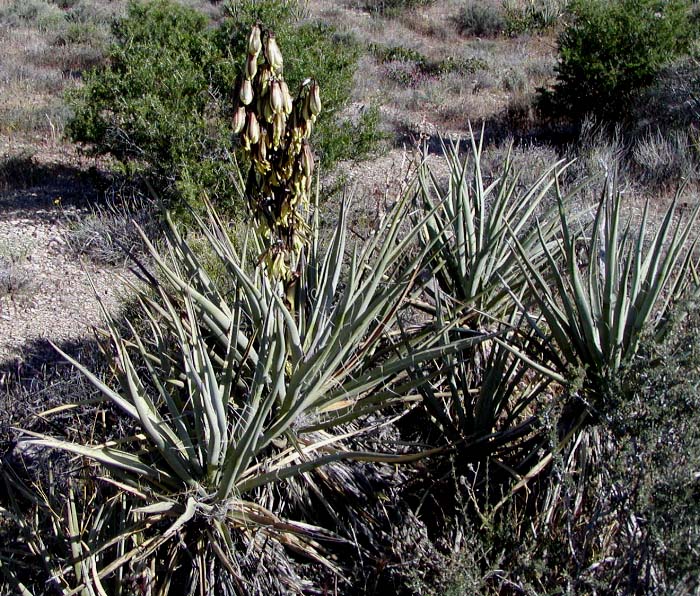
Dry-climate plants with pointed leaves and clusters of creamy white flowers
🇲🇽 Mexico and 4 more · Wildflower
Yucca
Dry-climate plants with pointed leaves and clusters of creamy white flowers
🇲🇽 Mexico and 4 more · Wildflower
 Ornithogalum thyrsoides
A white, long-lasting bulb flower from South Africa’s Cape Province
🇿🇦 South Africa · Bulb flower
Ornithogalum thyrsoides
A white, long-lasting bulb flower from South Africa’s Cape Province
🇿🇦 South Africa · Bulb flower
More from the United States
All the flowers of the United States PeachPrunus persica
A flowering fruit tree from China, grown for its pink blossoms and sweet fruit
🇨🇳 China and 7 more · Flowering tree
PeachPrunus persica
A flowering fruit tree from China, grown for its pink blossoms and sweet fruit
🇨🇳 China and 7 more · Flowering tree
 AlmondPrunus amygdalus
A Mediterranean tree grown for its fragrant spring flowers and edible seeds
🇮🇷 Iran and 6 more · Flowering tree
AlmondPrunus amygdalus
A Mediterranean tree grown for its fragrant spring flowers and edible seeds
🇮🇷 Iran and 6 more · Flowering tree
 CactusCactaceae
Succulent plants with spines, native to the Americas
🇲🇽 Mexico and 7 more · Wildflower
CactusCactaceae
Succulent plants with spines, native to the Americas
🇲🇽 Mexico and 7 more · Wildflower
 Chrysanthemum菊花
Autumn-blooming flower with thousands of varieties, cherished in East Asia and beyond
🇨🇳 China and 6 more · Wildflower
Chrysanthemum菊花
Autumn-blooming flower with thousands of varieties, cherished in East Asia and beyond
🇨🇳 China and 6 more · Wildflower