
Sasanqua camellia
Camellia sasanqua, family Theaceae
In its own language: 茶梅
An evergreen shrub with winter flowers and fragrant petals, native to southern Japan
Sasanqua camellia is an evergreen shrub or small tree from southern Japan and the Ryukyu Islands. It produces white, pink, or red flowers from autumn into spring, often with a pleasant scent. People grow it for gardens, hedges, bonsai, and its seeds, which yield oil used in cooking and industry.
- Native to southern Japan and the Ryukyu Islands
- Flowers from autumn through spring, often with a pleasant scent
- Seeds yield oil used in cooking and industry
- Leaves can be brewed as a tea substitute
- Widely grown for gardens, hedges, and bonsai
What does Sasanqua camellia look like?
Sasanqua camellia grows as a dense shrub or small tree, often reaching up to 6 meters tall, though wild plants can be taller. Its leaves are dark green, shiny, and have fine teeth at the edges. The flowers appear singly at the ends or sides of branches, measuring about 5 to 7.5 centimeters across. Wild plants have white petals, but cultivated forms show pink, red, or mixes of these colors, sometimes with many petals. Many varieties have a light fragrance.
Where does Sasanqua camellia come from?
This camellia is native to the southern parts of Japan, including Shikoku, Kyushu, and the Ryukyu Islands. It has been grown in China since at least the Tang dynasty, where it was called 'sea red.' Japanese growers first raised it for oil, then as a garden plant from the early 1600s. The species was formally described in 1784 by Carl Peter Thunberg after his visit to Japan. It reached Europe in the late 1800s, though earlier imports were often a different species.
When and how Sasanqua camellia blooms
Sasanqua camellia flowers from autumn through spring, depending on the variety. It grows well in sun or partial shade and tolerates both heat and some drought. The plant prefers slightly acidic, well-drained soil but is adaptable. Most plants are started from cuttings taken during the rainy season, though grafting is also used. It can be grown as a hedge, specimen shrub, bonsai, or even in containers.


How Sasanqua camellia is used
People value sasanqua camellia for its flowers in gardens, as hedges, and for bonsai. The seeds are pressed for oil, which is used in cooking and other industries. The leaves can be brewed as a tea substitute. In the past, oil cake from the seeds was used to manage fish in ponds. The flowers are sometimes used in perfumes, and extracts have been studied for their antimicrobial properties.
Kinds of Sasanqua camellia
Cultivars are grouped by when they bloom and their flower form. The Sasanqua Group is closest to wild plants, with single, fragrant flowers in autumn. The Hiemalis Group blooms later, with double or semi-double flowers, mostly in pink or red. Vernalis Group hybrids flower into spring and have traits from both sasanqua and Camellia japonica. There is also a group with larger leaves and small white flowers, influenced by Camellia oleifera.
What Sasanqua camellia means
In China, sasanqua camellia was praised in poetry for blooming when few other flowers do. Japanese gardens often feature it for its seasonal color, and it appears in tea ceremony and flower arranging. The plant is not threatened in the wild and is widely grown in East Asia and beyond. Its winter blossoms are seen as a sign of elegance and renewal.
Where Sasanqua camellia is used and seen
 Tsuruma ParkNagoya’s city park known for cherry blossoms and a historic fountain tower
 Kunming Botanical GardenA major botanical garden and plant research centre in Kunming, Yunnan, China
 Hong Kong Zoological and Botanical GardensA historic garden and zoo in Central, Hong Kong with themed plant collections
 New Orleans Botanical GardenA public garden in City Park with themed plant collections and art deco features
 Dandenong Ranges Botanic GardenA cool-climate garden in the hills near Melbourne, famous for rhododendrons and cherry blossom
 Hunter Valley GardensA vast themed garden and event venue in Pokolbin, New South Wales
 Mendocino Coast Botanical GardensA coastal garden in Mendocino County, California with ocean views and diverse plantings
 Sim's Park, CoonoorA century-old botanical garden in the Nilgiri hills of Tamil Nadu
Questions people ask about Sasanqua camellia
Where does Sasanqua camellia come from?
It is native to southern Japan, including the regions of Shikoku, Kyushu, and the Ryukyu Islands, and has a long history of cultivation in both Japan and China.
What does Sasanqua camellia look like?
It is an evergreen shrub or small tree with glossy dark green leaves and flowers that can be white, pink, red, or bicolored. The flowers are usually 5 to 7.5 centimeters across and may have a light fragrance.
How is Sasanqua camellia used?
People grow it for its ornamental flowers, as hedges or bonsai, and for its seeds, which are pressed to make oil used in cooking and industry. The leaves can also be used as a tea substitute.
Does Sasanqua camellia have any cultural meaning?
In China and Japan, it is admired for blooming in the colder months when few other flowers are out. It appears in poetry, gardens, and traditional arts such as the tea ceremony and flower arranging.
Are there different types of Sasanqua camellia?
Yes, there are several groups based on flowering time and flower form, including single, double, and hybrid types, with a range of colors from white to pink and red.
Good reading and sources
- USDA Plants DatabaseUS Department of Agriculture, Article
- IUCN Red List of Threatened SpeciesIUCN Red List, Article
- Plants of the World OnlineRoyal Botanic Gardens, Kew, Plant database
- Where it has been recordedGBIF, Plant database
- Sightings and photos by naturalistsiNaturalist, Plant database
- Camellia sasanqua on WikipediaEncyclopedia
- More photos on Wikimedia CommonsPhotos
- Wikidata recordOpen data
The facts on this page come from the Wikipedia article "Camellia sasanqua", written by its contributors and used under the CC BY-SA 4.0 licence, and from its Wikidata record (CC0). Phool rewrote the text in its own words, with AI assistance, and compares every page with the article to make sure no passage is copied. It may be reused under the same CC BY-SA 4.0 licence with a link back.
It may contain mistakes. It is not medical or foraging advice: many flowers are poisonous, and traditional uses are reported, not recommended. If something is wrong, tell us. Last refreshed 2026-10-03.
Others in the family Theaceae
The whole family Camellia
Evergreen shrubs and trees with showy blooms, best known for tea and garden flowers
🇨🇳 China and 6 more · Garden flower
Camellia
Evergreen shrubs and trees with showy blooms, best known for tea and garden flowers
🇨🇳 China and 6 more · Garden flower
 Camellia reticulata
Tall pink-flowered camellia from Yunnan, grown for gardens and tea oil
🇨🇳 China · Flowering tree
Camellia reticulata
Tall pink-flowered camellia from Yunnan, grown for gardens and tea oil
🇨🇳 China · Flowering tree
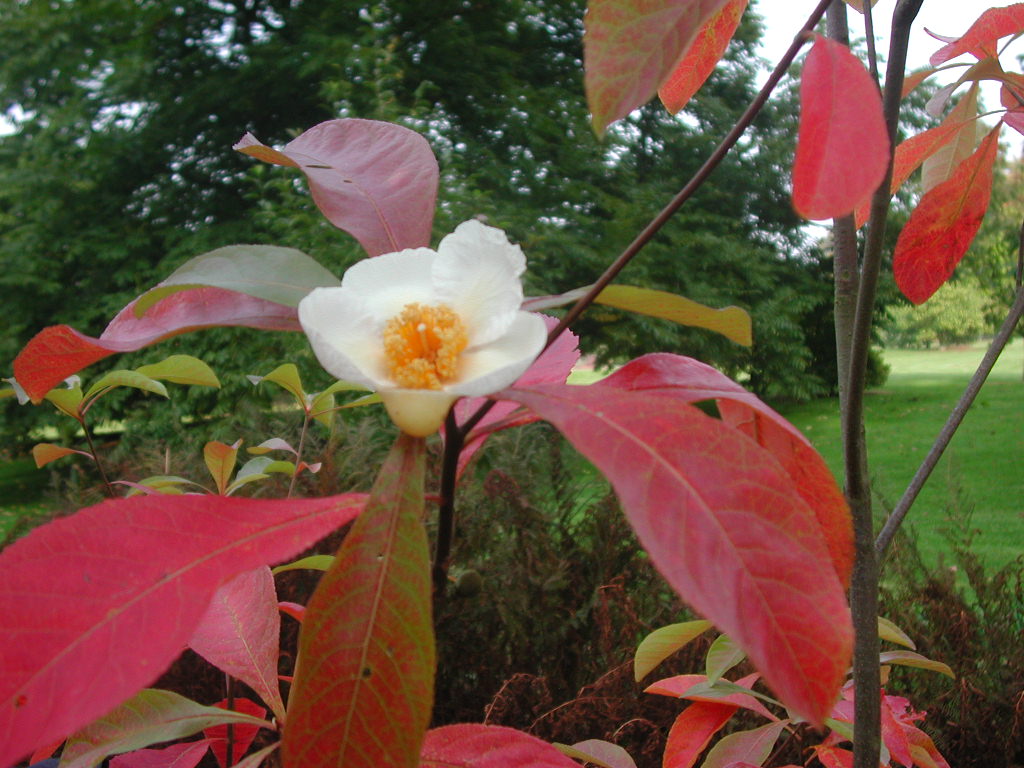 Franklin treeFranklinia alatamaha
A rare flowering tree once native to Georgia, now extinct in the wild
🇺🇸 United States · Flowering tree
Franklin treeFranklinia alatamaha
A rare flowering tree once native to Georgia, now extinct in the wild
🇺🇸 United States · Flowering tree
 Camellia amplexicaulisHải đường
A pink-flowered camellia tree once found in Vietnam’s forests
🇻🇳 Vietnam · Flowering tree
Camellia amplexicaulisHải đường
A pink-flowered camellia tree once found in Vietnam’s forests
🇻🇳 Vietnam · Flowering tree
More from Japan
All the flowers of Japan PeachPrunus persica
A flowering fruit tree from China, grown for its pink blossoms and sweet fruit
🇨🇳 China and 7 more · Flowering tree
PeachPrunus persica
A flowering fruit tree from China, grown for its pink blossoms and sweet fruit
🇨🇳 China and 7 more · Flowering tree
 Chrysanthemum菊花
Autumn-blooming flower with thousands of varieties, cherished in East Asia and beyond
🇨🇳 China and 6 more · Wildflower
Chrysanthemum菊花
Autumn-blooming flower with thousands of varieties, cherished in East Asia and beyond
🇨🇳 China and 6 more · Wildflower
 Sacred lotusNelumbo nucifera
The pink aquatic flower sacred in Asia and grown for food, worship and beauty
🇮🇳 India and 7 more · Water flower
Sacred lotusNelumbo nucifera
The pink aquatic flower sacred in Asia and grown for food, worship and beauty
🇮🇳 India and 7 more · Water flower
 Wild cherryPrunus avium
A tall flowering tree native to Europe, grown for its sweet fruit and spring blossom
🇮🇹 Italy and 6 more · Flowering tree
Wild cherryPrunus avium
A tall flowering tree native to Europe, grown for its sweet fruit and spring blossom
🇮🇹 Italy and 6 more · Flowering tree