
Clerodendrum splendens
A tropical African climber with vivid scarlet flower clusters
Clerodendrum splendens is a climbing evergreen plant from tropical West Africa. It features large clusters of bright red flowers in summer and is grown for its striking appearance, often needing winter protection in cooler climates.
- Native to tropical Western Africa, including Gabon
- Produces clusters of bright scarlet flowers in summer
- Evergreen climber that can reach over 3 metres
- Needs protection from cold in temperate climates
What does Clerodendrum splendens look like?
Clerodendrum splendens is an evergreen vine that can reach at least 3 metres in height. Its stems twine around supports, and in summer it produces large, branching clusters of vivid scarlet flowers. The leaves stay green year-round, and the plant’s showy blooms make it a popular choice for decorative gardens where a splash of red is wanted.
Where does Clerodendrum splendens come from?
This species is native to tropical regions of Western Africa, including Gabon and Guangdong. It grows wild in warm, humid environments. Over time, its striking flowers led to its introduction into gardens outside its native range, especially in places where gardeners can provide the warmth it needs.
When and how Clerodendrum splendens blooms
Clerodendrum splendens blooms in the summer, producing its bright red flowers in loose, upright clusters. In temperate regions, it is often grown under glass or in greenhouses to protect it from cold, as it does not tolerate temperatures below 10°C. It is usually propagated from cuttings or seeds and trained to climb supports.
How Clerodendrum splendens is used
Gardeners grow this plant mainly for its ornamental value, using it to cover trellises, walls, or fences. Its vivid flowers add colour to gardens during the summer months. In regions with cold winters, it is often kept in conservatories or indoors to ensure it survives through the colder season.
Kinds of Clerodendrum splendens
Within the genus Clerodendrum, there are several species with similar climbing habits and colourful flowers, but Clerodendrum splendens is especially valued for its intense scarlet blooms. Other species in the group may have different flower colours or growth forms.
What Clerodendrum splendens means
Clerodendrum splendens is grown in gardens for its decorative flowers and climbing habit. It has become a favourite among ornamental climbers in suitable climates. Its visual appeal has earned it recognition from horticultural societies, reflecting its popularity in cultivation.
Questions people ask about Clerodendrum splendens
Where does Clerodendrum splendens come from?
Clerodendrum splendens is native to tropical regions of Western Africa, including Gabon, where it grows in warm, humid conditions.
What does the plant look like?
It is an evergreen climber that can grow over 3 metres tall, with twining stems and large clusters of vivid scarlet flowers that appear in summer.
How is Clerodendrum splendens used?
This plant is mainly grown as an ornamental climber in gardens, valued for its bright red flowers and ability to cover trellises or fences.
Does it need special care in cooler climates?
Yes, in regions where temperatures fall below 10°C, it must be grown under glass or indoors during winter to protect it from the cold.
Is Clerodendrum splendens known by other names?
Yes, it is also called glory tree and flaming glorybower.
Good reading and sources
- Clerodendrum splendensRoyal Horticultural Society, Article
- Plants of the World OnlineRoyal Botanic Gardens, Kew, Plant database
- Where it has been recordedGBIF, Plant database
- Sightings and photos by naturalistsiNaturalist, Plant database
- Clerodendrum splendens on WikipediaEncyclopedia
- More photos on Wikimedia CommonsPhotos
- Wikidata recordOpen data
The facts on this page come from the Wikipedia article "Clerodendrum splendens", written by its contributors and used under the CC BY-SA 4.0 licence, and from its Wikidata record (CC0). Phool rewrote the text in its own words, with AI assistance, and compares every page with the article to make sure no passage is copied. It may be reused under the same CC BY-SA 4.0 licence with a link back.
It may contain mistakes. It is not medical or foraging advice: many flowers are poisonous, and traditional uses are reported, not recommended. If something is wrong, tell us. Last refreshed 2026-10-03.
Others in the family Lamiaceae
The whole family RosemarySalvia rosmarinus
A fragrant evergreen shrub with needle-like leaves and purple, blue, or white flowers
🇪🇸 Spain and 5 more · Flowering shrub
RosemarySalvia rosmarinus
A fragrant evergreen shrub with needle-like leaves and purple, blue, or white flowers
🇪🇸 Spain and 5 more · Flowering shrub
 Salvia
A vast group of aromatic herbs and shrubs known for their flowers and uses
Salvia · Wildflower
Salvia
A vast group of aromatic herbs and shrubs known for their flowers and uses
Salvia · Wildflower
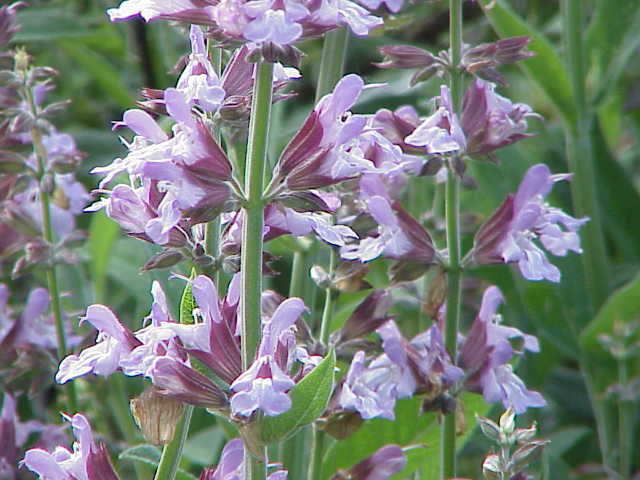 Common sageSalvia officinalis
A Mediterranean herb with grey-green leaves and blue to purple flowers
🇨🇳 China and 1 more · Herb or useful flower
Common sageSalvia officinalis
A Mediterranean herb with grey-green leaves and blue to purple flowers
🇨🇳 China and 1 more · Herb or useful flower
 Holy basilOcimum tenuiflorum
A fragrant herb central to Hindu worship and Southeast Asian cooking
🇲🇲 Myanmar and 6 more · Herb or useful flower
Holy basilOcimum tenuiflorum
A fragrant herb central to Hindu worship and Southeast Asian cooking
🇲🇲 Myanmar and 6 more · Herb or useful flower
More from Gabon
All the flowers of Gabon PomegranatePunica granatum
A shrub with bright red flowers and a fruit full of edible seeds
🇮🇷 Iran and 9 more · Flowering shrub
PomegranatePunica granatum
A shrub with bright red flowers and a fruit full of edible seeds
🇮🇷 Iran and 9 more · Flowering shrub
 OleanderNerium oleander
A showy, evergreen shrub with clusters of pink, white or red flowers
🇲🇦 Morocco and 8 more · Flowering shrub
OleanderNerium oleander
A showy, evergreen shrub with clusters of pink, white or red flowers
🇲🇦 Morocco and 8 more · Flowering shrub
 Sensitive PlantMimosa pudica
A touch-sensitive plant whose leaves fold up when disturbed
🇧🇷 Brazil and 8 more · Wildflower
Sensitive PlantMimosa pudica
A touch-sensitive plant whose leaves fold up when disturbed
🇧🇷 Brazil and 8 more · Wildflower
 Bay laurelLaurus nobilis
Evergreen tree with aromatic leaves used as bay leaf in cooking
🇬🇷 Greece and 9 more · Flowering tree
Bay laurelLaurus nobilis
Evergreen tree with aromatic leaves used as bay leaf in cooking
🇬🇷 Greece and 9 more · Flowering tree