
Purple coneflower
Echinacea purpurea, family Asteraceae
A North American wildflower with purple-pink petals and a spiny central cone
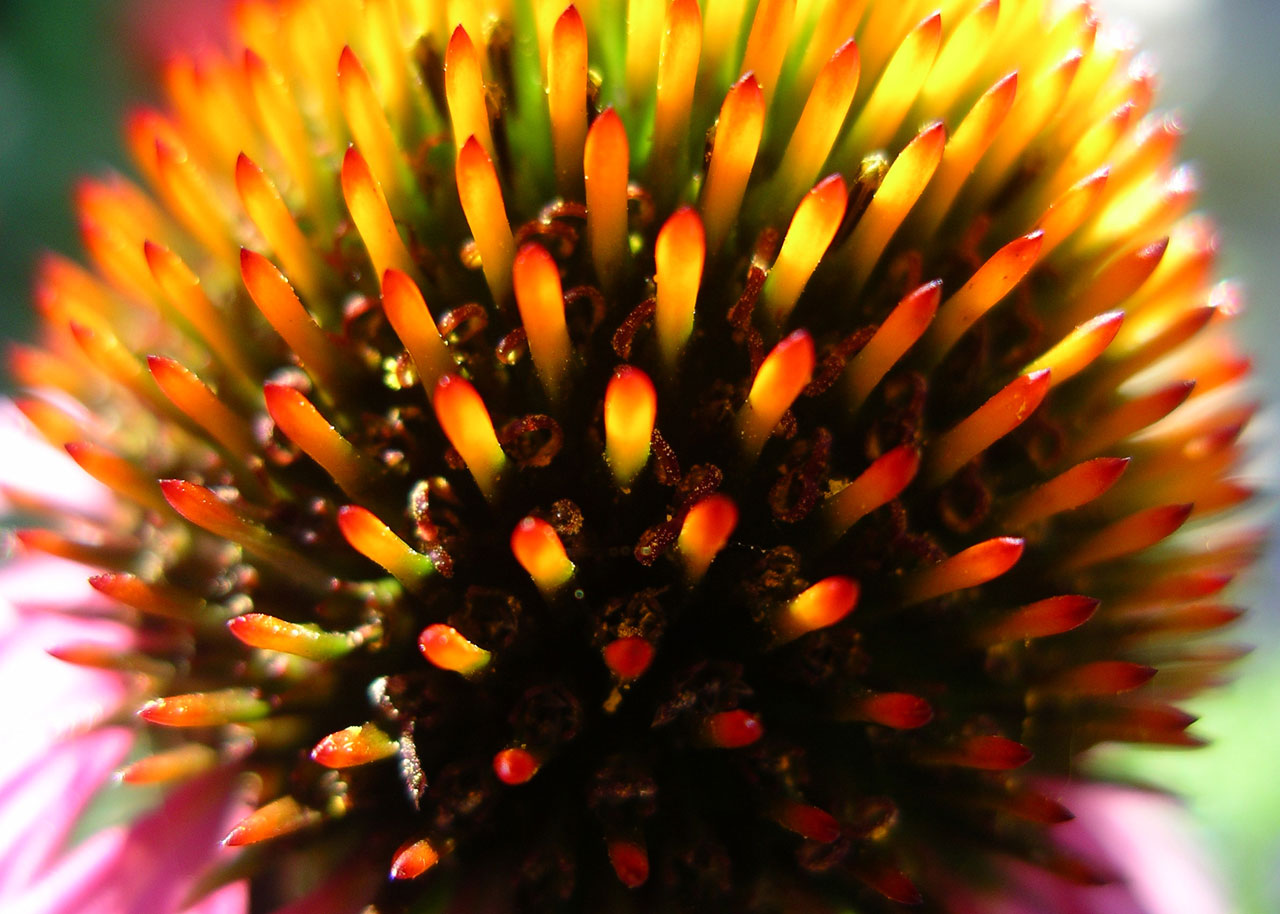
Purple coneflower is a perennial plant native to eastern North America, especially common in the Ozarks, Mississippi Valley, and Ohio Valley. It has a domed, spiny central cone surrounded by purple or pink petals, and is grown as an ornamental flower in gardens and for bouquets.
- Native to eastern North America, especially the Ozarks and Mississippi Valley
- Flower heads have a spiny central cone and purple or pink petals
- Attracts bees, butterflies, and finches to gardens
- Used in traditional Native American medicine
- Grown as an ornamental and for fresh bouquets
What does Purple coneflower look like?
Purple coneflower is a perennial herb that grows up to 120 cm tall and 25 cm wide. Its flower heads are made up of a domed, spiny central cone covered in small yellow florets, surrounded by a ring of purple or pink petal-like florets. The leaves are oval to lance-shaped, with toothed edges, and the plant forms clumps. The flower heads are 7 to 15 cm across and attract butterflies and bees.
Where does Purple coneflower come from?
Echinacea purpurea is native to eastern North America, especially the Ozarks, Mississippi Valley, and Ohio Valley. It grows wild in dry open woods, prairies, and barrens. The name Echinacea comes from the Greek for 'spiny one', referring to the flower's central cone. The species was first described in the 18th century and has undergone several name changes before being settled as Echinacea purpurea.
When and how Purple coneflower blooms
Purple coneflower blooms from summer into autumn, depending on climate. It prefers well-drained soil and full sun but can tolerate some shade and drought. It is grown from seed or by dividing clumps, root cuttings, or basal cuttings. Seeds germinate best after a period of cold or temperature fluctuation. Gardeners grow it for borders, beds, and cut flowers.



How Purple coneflower is used
People grow purple coneflower as an ornamental plant in gardens and use its flowers in fresh bouquets. Native Americans have used it in traditional medicine for various ailments. The plant attracts many pollinators, including bees and butterflies, and birds such as finches eat its seeds.
Kinds of Purple coneflower
Many cultivars have been developed for garden use, selected for flower quality and plant form. Notable cultivars include 'Ruby Giant' and 'Elbrook', which have received awards for their garden performance. Wild plants usually have purple petals, but some variation in color exists.
What Purple coneflower means
Purple coneflower is valued for its role in gardens and as a source of nectar for pollinators. It is also notable in traditional medicine, especially among Native American peoples. Its spiny cone has influenced its scientific name and its common names. The plant is not listed as endangered and is widely cultivated.
Questions people ask about Purple coneflower
Where does purple coneflower come from?
Purple coneflower is native to eastern North America, especially regions like the Ozarks, Mississippi Valley, and Ohio Valley. It grows wild in dry open woods, prairies, and barrens.
What does the flower look like?
It has a domed, spiny central cone covered in small yellow florets, surrounded by a ring of purple or pink petal-like florets. The flower heads are 7 to 15 cm across.
How is purple coneflower used?
It is grown as an ornamental plant in gardens, used in fresh bouquets, and has a history of use in traditional Native American medicine.
What wildlife does purple coneflower attract?
The flowers attract many pollinators, including bees and butterflies, and birds such as finches eat the seeds.
What does the name Echinacea mean?
Echinacea comes from the Greek for 'spiny one', referring to the spiny appearance of the flower's central cone.
Good reading and sources
- Echinacea purpurea 'Ruby Giant'Royal Horticultural Society, Article
- USDA Plants DatabaseUS Department of Agriculture, Article
- Plants of the World OnlineRoyal Botanic Gardens, Kew, Plant database
- Where it has been recordedGBIF, Plant database
- Sightings and photos by naturalistsiNaturalist, Plant database
- Echinacea purpurea on WikipediaEncyclopedia
- More photos on Wikimedia CommonsPhotos
- Wikidata recordOpen data
The facts on this page come from the Wikipedia article "Echinacea purpurea", written by its contributors and used under the CC BY-SA 4.0 licence, and from its Wikidata record (CC0). Phool rewrote the text in its own words, with AI assistance, and compares every page with the article to make sure no passage is copied. It may be reused under the same CC BY-SA 4.0 licence with a link back.
It may contain mistakes. It is not medical or foraging advice: many flowers are poisonous, and traditional uses are reported, not recommended. If something is wrong, tell us. Last refreshed 2026-10-03.
Others in the family Asteraceae
The whole family Common sunflowerHelianthus annuus
A tall annual plant grown for its large yellow flower heads and edible seeds
🇨🇦 Canada and 4 more · Wildflower
Common sunflowerHelianthus annuus
A tall annual plant grown for its large yellow flower heads and edible seeds
🇨🇦 Canada and 4 more · Wildflower
 Asteraceae
The vast family of daisies, asters, and sunflowers with star-like flower heads
Asteraceae · Wildflower
Asteraceae
The vast family of daisies, asters, and sunflowers with star-like flower heads
Asteraceae · Wildflower
 DandelionTaraxacum
A yellow-flowered perennial found in fields, lawns, and gardens worldwide
Taraxacum · Wildflower
DandelionTaraxacum
A yellow-flowered perennial found in fields, lawns, and gardens worldwide
Taraxacum · Wildflower
 Dahlia
A bushy perennial with tuberous roots and bright, star-shaped blooms
🇲🇽 Mexico and 1 more · Garden flower
Dahlia
A bushy perennial with tuberous roots and bright, star-shaped blooms
🇲🇽 Mexico and 1 more · Garden flower
More from the United States
All the flowers of the United States PeachPrunus persica
A flowering fruit tree from China, grown for its pink blossoms and sweet fruit
🇨🇳 China and 7 more · Flowering tree
PeachPrunus persica
A flowering fruit tree from China, grown for its pink blossoms and sweet fruit
🇨🇳 China and 7 more · Flowering tree
 AlmondPrunus amygdalus
A Mediterranean tree grown for its fragrant spring flowers and edible seeds
🇮🇷 Iran and 6 more · Flowering tree
AlmondPrunus amygdalus
A Mediterranean tree grown for its fragrant spring flowers and edible seeds
🇮🇷 Iran and 6 more · Flowering tree
 CactusCactaceae
Succulent plants with spines, native to the Americas
🇲🇽 Mexico and 7 more · Wildflower
CactusCactaceae
Succulent plants with spines, native to the Americas
🇲🇽 Mexico and 7 more · Wildflower
 Chrysanthemum菊花
Autumn-blooming flower with thousands of varieties, cherished in East Asia and beyond
🇨🇳 China and 6 more · Wildflower
Chrysanthemum菊花
Autumn-blooming flower with thousands of varieties, cherished in East Asia and beyond
🇨🇳 China and 6 more · Wildflower