
Kamchatka fritillary
Fritillaria camschatcensis, family Liliaceae
A dark, nodding wildflower with a strong scent from northern Asia and North America
Kamchatka fritillary is a wildflower found in far northern parts of Asia and North America. Its drooping, deep brown or purple flowers have a strong, unpleasant smell and grow atop leafy stems, while its bulbs form small rice-like bulblets.
- Flowers are deep brown to purple and hang downward
- Bulbs form small, rice-like bulblets at the base
- Grows wild in northern Japan, Russia, Alaska, and the Pacific Northwest
- Flowers have a strong, foul scent that attracts flies
What does Kamchatka fritillary look like?
This plant grows from a bulb with thick, fleshy scales, much like garlic. Its upright stem can reach up to 60 cm and is ringed with long, narrow leaves. At the top, the plant bears one or more flowers that hang downward. These blossoms are dark brownish purple or greenish brown, sometimes marked with yellow, and give off a strong, unpleasant odor. The flowers are pollinated by flies attracted to their scent.
Where does Kamchatka fritillary come from?
Kamchatka fritillary is native to cold, northern regions stretching from the Russian Far East and northern Japan across to Alaska, British Columbia, and parts of the Pacific Northwest in the United States. The plant’s name refers to the Kamchatka Peninsula, one of the areas where it is found. Its rice-like bulblets at the roots have led to several of its common names.
When and how Kamchatka fritillary blooms
The plant grows from bulbs that develop clusters of small, rice-shaped bulblets around their base. It emerges in cool climates, sending up leafy stems in spring or early summer. Flowers appear at the top of the stem, hanging down and releasing a foul scent to attract pollinators. It is not widely cultivated and is mostly found in the wild.


![[Hokkaido, Japan / 北海道] Japanese Name: キバナクロユリ, 黄花黒百合 Distribution: Russian Far East to N. & C. Japan and NW. U.S.A. (31 AMU KAM KHA KUR MAG PRM SAK 38 JAP 70 ALU ASK 71 BRC 73 ORE WAS) Lifeform: Bulb geophyte Basionym L](https://thumb.wikimedia.org/wikipedia/commons/thumb/b/b8/Fritillaria_camschatcensis_fma._flavescens_%28L.%29_Ker_Gawl.%2C_Bot._Mag._30_t._1216_%281809%29_%2849974232206%29.jpg/960px-Fritillaria_camschatcensis_fma._flavescens_%28L.%29_Ker_Gawl.%2C_Bot._Mag._30_t._1216_%281809%29_%2849974232206%29.jpg)

How Kamchatka fritillary is used
There are no widely recorded uses for Kamchatka fritillary in gardens or ceremonies, and the sources do not mention it as a food or medicine. Its main interest lies in its unusual appearance and its adaptation to northern climates, where it grows in damp meadows and open woods.
Kinds of Kamchatka fritillary
This species is known by several names, such as black lily and rice lily, but the sources do not describe any distinct varieties or cultivated forms. The rice-like bulblets are a notable feature that sets it apart from other fritillaries.
What Kamchatka fritillary means
Kamchatka fritillary is not listed as a national or state symbol, nor is it tied to particular festivals or religious practices in the sources. Its dark, nodding flowers and strong smell make it a curiosity among wildflowers of the northern regions.
Questions people ask about Kamchatka fritillary
Where does Kamchatka fritillary grow naturally?
It is found in northern Japan, the Russian Far East, Alaska, British Columbia, and parts of the Pacific Northwest in the United States.
What do the flowers of Kamchatka fritillary look like?
The flowers are dark brownish purple or greenish brown, sometimes with yellow mottling, and they hang down from the top of the stem.
Why is it called rice lily or Indian rice?
These names come from the small, rice-shaped bulblets that form around the plant’s roots.
Does Kamchatka fritillary have a scent?
Yes, its flowers produce a strong, unpleasant smell that attracts flies for pollination.
Is Kamchatka fritillary used for any special purpose?
The sources do not mention any traditional or ceremonial uses for this plant.
Good reading and sources
- Chocolate lilyUS Department of Agriculture, Article
- Fritillaria camschatcensisRoyal Horticultural Society, Article
- Plants of the World OnlineRoyal Botanic Gardens, Kew, Plant database
- Where it has been recordedGBIF, Plant database
- Sightings and photos by naturalistsiNaturalist, Plant database
- Fritillaria camschatcensis on WikipediaEncyclopedia
- More photos on Wikimedia CommonsPhotos
- Wikidata recordOpen data
The facts on this page come from the Wikipedia article "Fritillaria camschatcensis", written by its contributors and used under the CC BY-SA 4.0 licence, and from its Wikidata record (CC0). Phool rewrote the text in its own words, with AI assistance, and compares every page with the article to make sure no passage is copied. It may be reused under the same CC BY-SA 4.0 licence with a link back.
It may contain mistakes. It is not medical or foraging advice: many flowers are poisonous, and traditional uses are reported, not recommended. If something is wrong, tell us. Last refreshed 2026-10-03.
Others in the family Liliaceae
The whole family TulipTulipa
Spring-blooming bulbs with showy, cup-shaped flowers in many colours
🇳🇱 Netherlands and 7 more · Wildflower
TulipTulipa
Spring-blooming bulbs with showy, cup-shaped flowers in many colours
🇳🇱 Netherlands and 7 more · Wildflower
 LilyLilium
Tall bulb flowers with large, colourful blooms in many gardens and cultures
Lilium · Wildflower
LilyLilium
Tall bulb flowers with large, colourful blooms in many gardens and cultures
Lilium · Wildflower
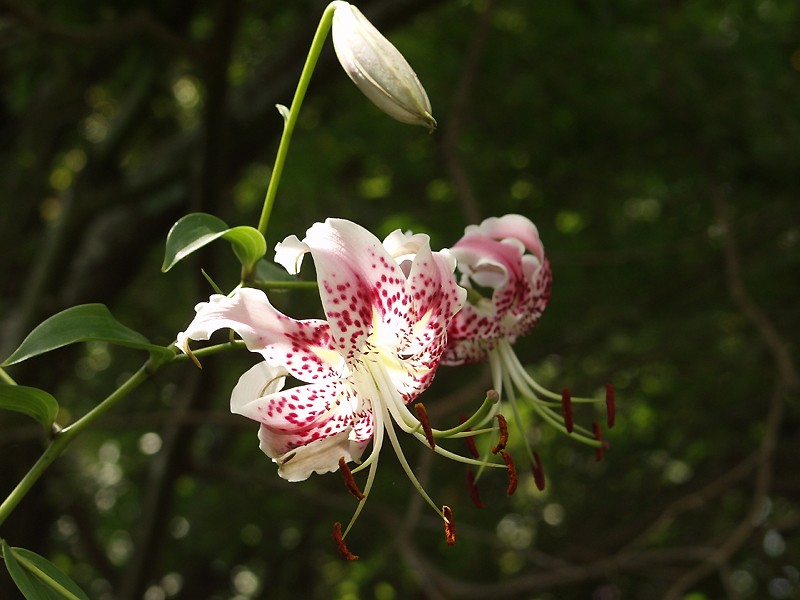 Lilium speciosum
A late-summer lily with fragrant white to pink flowers from East Asia
🇯🇵 Japan and 2 more · Wildflower
Lilium speciosum
A late-summer lily with fragrant white to pink flowers from East Asia
🇯🇵 Japan and 2 more · Wildflower
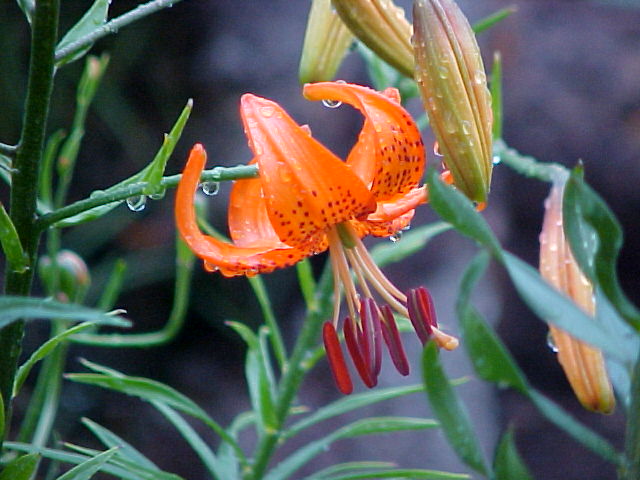 Lilium davidii
A tall Asian lily with edible bulbs and orange recurved flowers
🇨🇳 China and 1 more · Wildflower
Lilium davidii
A tall Asian lily with edible bulbs and orange recurved flowers
🇨🇳 China and 1 more · Wildflower
More from Japan
All the flowers of Japan BirchBetula
Slender trees with papery bark found across the northern world
🇨🇳 China and 7 more · Wildflower
BirchBetula
Slender trees with papery bark found across the northern world
🇨🇳 China and 7 more · Wildflower
 Chrysanthemum菊花
Autumn-blooming flower with thousands of varieties, cherished in East Asia and beyond
🇨🇳 China and 6 more · Wildflower
Chrysanthemum菊花
Autumn-blooming flower with thousands of varieties, cherished in East Asia and beyond
🇨🇳 China and 6 more · Wildflower
 Wild cherryPrunus avium
A tall flowering tree native to Europe, grown for its sweet fruit and spring blossom
🇮🇹 Italy and 6 more · Flowering tree
Wild cherryPrunus avium
A tall flowering tree native to Europe, grown for its sweet fruit and spring blossom
🇮🇹 Italy and 6 more · Flowering tree
 LindenTilia
Tall, broad-leaved trees with fragrant yellow flowers and heart-shaped leaves
🇨🇳 China and 7 more · Flowering tree
LindenTilia
Tall, broad-leaved trees with fragrant yellow flowers and heart-shaped leaves
🇨🇳 China and 7 more · Flowering tree