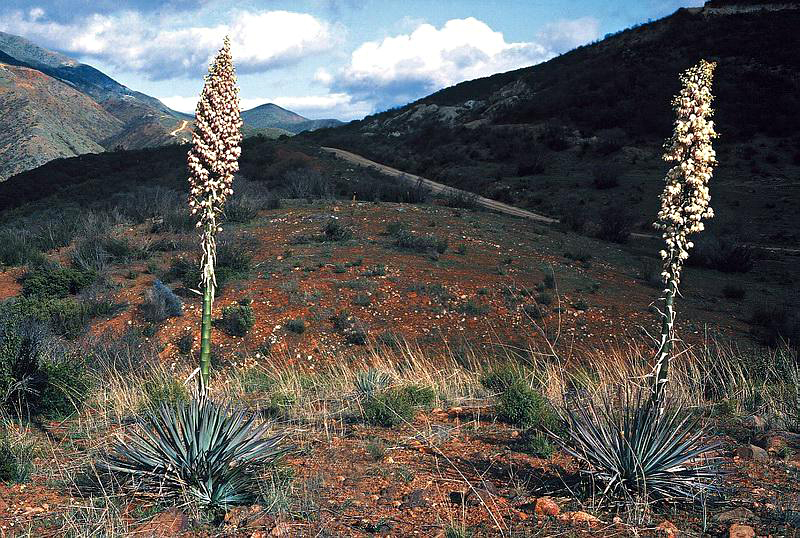
Chaparral yucca
Hesperoyucca whipplei, family Asparagaceae
A tall, spiky-leaved plant with dramatic white flower spikes from dry slopes
Chaparral yucca is a perennial plant found on rocky hillsides and slopes in southern California and Baja California. It forms a cluster of sharp, narrow leaves and sends up a tall stalk covered in fragrant, bell-shaped white to purple flowers. Native peoples have long used its fibers and edible parts.
- Grows a flower stalk up to 3 meters tall in spring
- Leaves end in sharp points and are edged with fine teeth
- Used by Native Americans for food and strong fibers
- Pollinated exclusively by the California yucca moth
What does Chaparral yucca look like?
Chaparral yucca grows as a clump of long, stiff, gray-green leaves, each ending in a sharp tip. The leaves are narrow and can be up to a meter long, with fine teeth along the edges. When mature, the plant sends up a tall, fast-growing stalk that can reach up to 3 meters, topped with hundreds of white to purplish, bell-shaped flowers. The flowers are strongly scented and form a dense cluster. After flowering, the plant produces dry, winged seed capsules.
Where does Chaparral yucca come from?
This plant is found on rocky slopes and washes in the dry regions of southern California and Baja California. It is the only wild member of its family in the Santa Monica Mountains. Botanists once grouped it with yuccas, but DNA studies have shown it belongs in its own genus, Hesperoyucca. The name honors Amiel Weeks Whipple, a 19th-century surveyor. Its common names refer to its tall, candle-like flower stalk and the sharpness of its leaves.
When and how Chaparral yucca blooms
Chaparral yucca takes several years to mature before it blooms, usually in spring. The flowering stalk grows rapidly, sometimes up to 25 centimeters a day, and can reach over 3 meters tall. After flowering, the main plant usually dies, but new shoots often sprout from the base. It thrives in dry, rocky soils and is sometimes grown in drought-tolerant gardens, though it is difficult to grow outside its native region.


How Chaparral yucca is used
Native peoples of the region have used chaparral yucca for thousands of years. The hearts of the plant were roasted and eaten, especially before the flower stalk developed. Seeds were ground into flour, and the stalk and flowers could also be cooked as food. The strong fibers from the leaves were processed for making cord, baskets, sandals, and nets. Today, it is sometimes planted in gardens for its dramatic appearance and drought resistance.
Kinds of Chaparral yucca
There are several recognized subspecies, some of which differ in their fruit or where they grow. One, Hesperoyucca newberryi, is found further east in Arizona and is sometimes considered a separate species. Botanists have debated how to classify these plants, with some treating them as varieties of Yucca.
What Chaparral yucca means
Chaparral yucca is well known for its relationship with the California yucca moth, which pollinates its flowers in a mutual exchange. The plant is a familiar sight in southern California's wild landscapes and has been a resource for local Native American groups for food and fiber. Its striking flower stalks have inspired its common names and made it a symbol of the chaparral.
Questions people ask about Chaparral yucca
Where does chaparral yucca come from?
Chaparral yucca grows wild on rocky slopes and hillsides in southern California and Baja California, especially in dry chaparral and oak woodland areas.
What does chaparral yucca look like?
It forms a cluster of long, stiff, gray-green leaves with sharp tips. In spring, it sends up a tall stalk covered in hundreds of white to purple, bell-shaped, fragrant flowers.
How have people used chaparral yucca?
Native peoples have roasted the plant's heart and stalk for food, ground its seeds into flour, and used its tough leaf fibers to make cord, baskets, and sandals.
What is special about its pollination?
Chaparral yucca relies on the California yucca moth for pollination. The moth lays eggs in the flowers and ensures pollination while providing food for its larvae.
Does it have any symbolic meaning?
Its tall, candle-like flower stalk has inspired common names, but the sources do not mention specific symbolic meanings beyond its role in local landscapes and traditions.
Good reading and sources
- USDA Plants DatabaseUS Department of Agriculture, Article
- IUCN Red List of Threatened SpeciesIUCN Red List, Article
- Hesperoyucca whippleiRoyal Horticultural Society, Article
- Plants of the World OnlineRoyal Botanic Gardens, Kew, Plant database
- Where it has been recordedGBIF, Plant database
- Sightings and photos by naturalistsiNaturalist, Plant database
- Hesperoyucca whipplei on WikipediaEncyclopedia
- More photos on Wikimedia CommonsPhotos
- Wikidata recordOpen data
The facts on this page come from the Wikipedia article "Hesperoyucca whipplei", written by its contributors and used under the CC BY-SA 4.0 licence, and from its Wikidata record (CC0). Phool rewrote the text in its own words, with AI assistance, and compares every page with the article to make sure no passage is copied. It may be reused under the same CC BY-SA 4.0 licence with a link back.
It may contain mistakes. It is not medical or foraging advice: many flowers are poisonous, and traditional uses are reported, not recommended. If something is wrong, tell us. Last refreshed 2026-10-03.
Others in the family Asparagaceae
The whole family Lily-of-the-valleyConvallaria majalis
A woodland plant with sweet-scented white bell flowers in late spring
🇫🇮 Finland and 4 more · Wildflower
Lily-of-the-valleyConvallaria majalis
A woodland plant with sweet-scented white bell flowers in late spring
🇫🇮 Finland and 4 more · Wildflower
 HyacinthHyacinthus
A spring-blooming bulb with fragrant, colourful flower spikes
🇹🇷 Turkey and 7 more · Bulb flower
HyacinthHyacinthus
A spring-blooming bulb with fragrant, colourful flower spikes
🇹🇷 Turkey and 7 more · Bulb flower
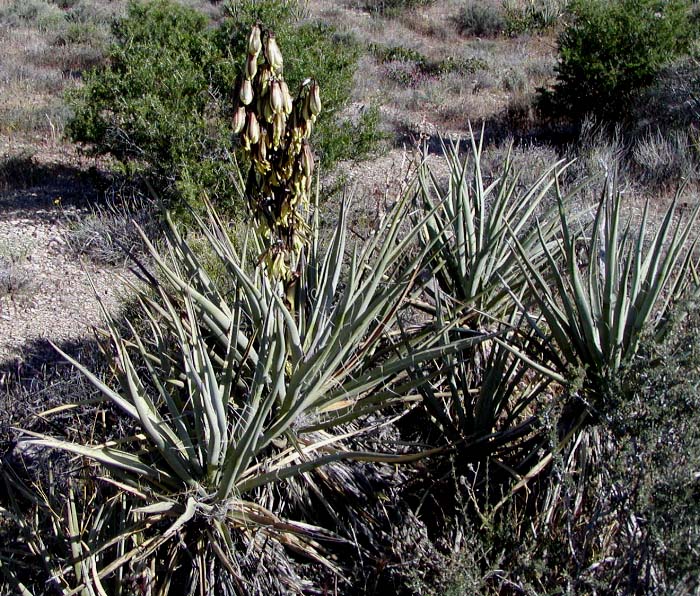 Yucca
Dry-climate plants with pointed leaves and clusters of creamy white flowers
🇲🇽 Mexico and 4 more · Wildflower
Yucca
Dry-climate plants with pointed leaves and clusters of creamy white flowers
🇲🇽 Mexico and 4 more · Wildflower
 Ornithogalum thyrsoides
A white, long-lasting bulb flower from South Africa’s Cape Province
🇿🇦 South Africa · Bulb flower
Ornithogalum thyrsoides
A white, long-lasting bulb flower from South Africa’s Cape Province
🇿🇦 South Africa · Bulb flower
More from the United States
All the flowers of the United States PeachPrunus persica
A flowering fruit tree from China, grown for its pink blossoms and sweet fruit
🇨🇳 China and 7 more · Flowering tree
PeachPrunus persica
A flowering fruit tree from China, grown for its pink blossoms and sweet fruit
🇨🇳 China and 7 more · Flowering tree
 AlmondPrunus amygdalus
A Mediterranean tree grown for its fragrant spring flowers and edible seeds
🇮🇷 Iran and 6 more · Flowering tree
AlmondPrunus amygdalus
A Mediterranean tree grown for its fragrant spring flowers and edible seeds
🇮🇷 Iran and 6 more · Flowering tree
 CactusCactaceae
Succulent plants with spines, native to the Americas
🇲🇽 Mexico and 7 more · Wildflower
CactusCactaceae
Succulent plants with spines, native to the Americas
🇲🇽 Mexico and 7 more · Wildflower
 Chrysanthemum菊花
Autumn-blooming flower with thousands of varieties, cherished in East Asia and beyond
🇨🇳 China and 6 more · Wildflower
Chrysanthemum菊花
Autumn-blooming flower with thousands of varieties, cherished in East Asia and beyond
🇨🇳 China and 6 more · Wildflower