
Mountain laurel
Kalmia latifolia, family Ericaceae
Evergreen shrub with pink or white star-shaped blooms from eastern North America
Mountain laurel is an evergreen shrub native to the forests and slopes of the eastern United States. It is known for its clusters of star-like flowers, which range from white to pink, and is the state flower of Connecticut and Pennsylvania. All parts of the plant are poisonous.
- State flower of Connecticut and Pennsylvania
- All parts of the plant are poisonous if eaten
- Flowers range from white to deep pink and maroon
- Supports butterflies and hummingbirds
- Dense thickets called 'laurel hells' in Appalachia
What does Mountain laurel look like?
Mountain laurel is a broad-leaved evergreen shrub that can reach heights between 3 and 9 meters. Its leaves are leathery, glossy, and dark green on top, with a lighter underside. The plant produces clusters of five-sided, cup-shaped flowers that open in late spring, showing shades from pale pink to white, with some cultivated varieties displaying deeper pink, red, or maroon. The flowers grow in dense groups, and the plant often forms large thickets in the wild.
Where does Mountain laurel come from?
This shrub is native to the forests and rocky hillsides of the eastern United States, where it grows from Maine in the north to Florida in the south, and west to Indiana and Louisiana. It was first described by Carl Linnaeus in 1753, drawing on earlier work by Mark Catesby. The name honors Pehr Kalm, a Finnish botanist. Mountain laurel has been cultivated in Europe since the 1700s for its decorative value.
When and how Mountain laurel blooms
Mountain laurel blooms in May and June. It thrives in acidic soils, often forming dense stands in oak-heath forests or on rocky slopes. The plant is usually grown from seed or cuttings and prefers well-drained, acidic ground. In the wild, it can grow as a shrub or, in the southern Appalachians, as a small tree. Gardeners value it for its evergreen leaves and showy flowers, and many cultivars have been bred for different flower colors and growth habits.


How Mountain laurel is used
People grow mountain laurel mainly for its ornamental flowers and evergreen foliage. It is the official state flower of Connecticut and Pennsylvania. Native Americans, including the Cherokee, used the plant in traditional remedies and for carving utensils. However, all parts of the plant are toxic to humans and animals, so it is not used for food. Its wood has been used for small crafts and household items.
Kinds of Mountain laurel
There are many named cultivars of mountain laurel, some bred for compact size or unique flower colors. Examples include 'Freckles' with spotted pink blooms, 'Little Linda' which is dwarf, and 'Olympic Fire' with red buds that open to pale pink. Breeding work has been especially active in Connecticut, with several varieties developed for gardens.
What Mountain laurel means
Mountain laurel is a symbol of the states of Connecticut and Pennsylvania, where it is celebrated as the state flower. Its dense thickets are a familiar feature in Appalachian forests, sometimes called 'laurel hells' due to their impenetrability. The plant is not related to true laurels, despite its common name. Its flowers are important for pollinators like butterflies and hummingbirds, and its unusual pollen catapulting mechanism has been studied by scientists.
Where Mountain laurel is used and seen

Where to see Mountain laurel

Questions people ask about Mountain laurel
Where does mountain laurel come from?
Mountain laurel is native to the eastern United States, growing in forests and on rocky slopes from Maine to Florida and west to Indiana and Louisiana.
What does mountain laurel look like?
It is an evergreen shrub with glossy, dark green leaves and clusters of star-shaped flowers that are usually pink or white, though some varieties have deeper shades.
Is mountain laurel poisonous?
Yes, all parts of the plant are toxic to people and animals if eaten, including the leaves, flowers, and pollen.
What is mountain laurel used for?
Mountain laurel is grown as an ornamental plant for its attractive flowers and foliage. It is also the state flower of Connecticut and Pennsylvania and has been used in traditional remedies and woodcraft.
Does mountain laurel have any special meaning?
It is a symbol of Connecticut and Pennsylvania, where it is the official state flower, and is valued for its beauty and presence in local landscapes.
Good reading and sources
- Encyclopaedia BritannicaArticle
- Kalmia latifolia 'Freckles'Royal Horticultural Society, Article
- IUCN Red List of Threatened SpeciesIUCN Red List, Article
- Plants of the World OnlineRoyal Botanic Gardens, Kew, Plant database
- Where it has been recordedGBIF, Plant database
- Sightings and photos by naturalistsiNaturalist, Plant database
- Kalmia latifolia on WikipediaEncyclopedia
- More photos on Wikimedia CommonsPhotos
- Wikidata recordOpen data
The facts on this page come from the Wikipedia article "Kalmia latifolia", written by its contributors and used under the CC BY-SA 4.0 licence, and from its Wikidata record (CC0). Phool rewrote the text in its own words, with AI assistance, and compares every page with the article to make sure no passage is copied. It may be reused under the same CC BY-SA 4.0 licence with a link back.
It may contain mistakes. It is not medical or foraging advice: many flowers are poisonous, and traditional uses are reported, not recommended. If something is wrong, tell us. Last refreshed 2026-10-03.
Others in the family Ericaceae
The whole family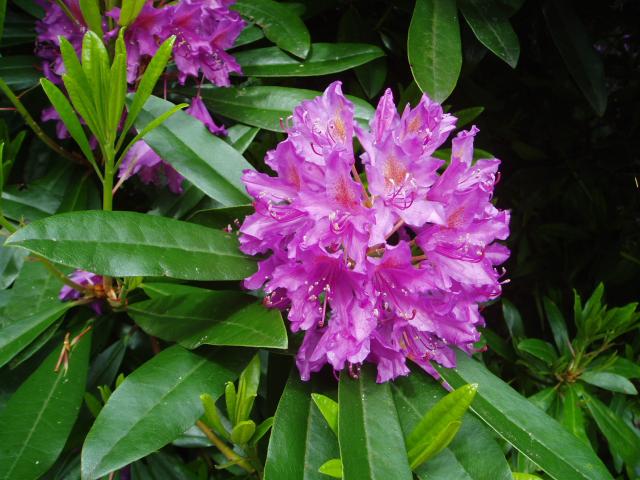 Rhododendron
A vast group of shrubs and trees with showy blooms in many colours
🇳🇵 Nepal and 4 more · Wildflower
Rhododendron
A vast group of shrubs and trees with showy blooms in many colours
🇳🇵 Nepal and 4 more · Wildflower
 Erica
Evergreen shrubs with tiny needle leaves and nodding flowers, known as heaths or heathers
🇿🇦 South Africa and 1 more · Wildflower
Erica
Evergreen shrubs with tiny needle leaves and nodding flowers, known as heaths or heathers
🇿🇦 South Africa and 1 more · Wildflower
 Common rhododendronRhododendron ponticum
A dense evergreen shrub with violet-purple flowers from Europe and the Caucasus
🇵🇹 Portugal and 6 more · Flowering shrub
Common rhododendronRhododendron ponticum
A dense evergreen shrub with violet-purple flowers from Europe and the Caucasus
🇵🇹 Portugal and 6 more · Flowering shrub
 Rhododendron keiskei
A low, spreading rhododendron with pale yellow spring flowers from Japan
🇯🇵 Japan · Flowering shrub
Rhododendron keiskei
A low, spreading rhododendron with pale yellow spring flowers from Japan
🇯🇵 Japan · Flowering shrub
More from the United States
All the flowers of the United States PeachPrunus persica
A flowering fruit tree from China, grown for its pink blossoms and sweet fruit
🇨🇳 China and 7 more · Flowering tree
PeachPrunus persica
A flowering fruit tree from China, grown for its pink blossoms and sweet fruit
🇨🇳 China and 7 more · Flowering tree
 AlmondPrunus amygdalus
A Mediterranean tree grown for its fragrant spring flowers and edible seeds
🇮🇷 Iran and 6 more · Flowering tree
AlmondPrunus amygdalus
A Mediterranean tree grown for its fragrant spring flowers and edible seeds
🇮🇷 Iran and 6 more · Flowering tree
 CactusCactaceae
Succulent plants with spines, native to the Americas
🇲🇽 Mexico and 7 more · Wildflower
CactusCactaceae
Succulent plants with spines, native to the Americas
🇲🇽 Mexico and 7 more · Wildflower
 Chrysanthemum菊花
Autumn-blooming flower with thousands of varieties, cherished in East Asia and beyond
🇨🇳 China and 6 more · Wildflower
Chrysanthemum菊花
Autumn-blooming flower with thousands of varieties, cherished in East Asia and beyond
🇨🇳 China and 6 more · Wildflower