
Gold Rayed Lily
Lilium auratum, family Liliaceae
In its own language: 山百合
Tall white lily with gold bands, native to Japan and prized for its large scented blooms
Gold Rayed Lily (Lilium auratum) is a striking lily native to Japan, known for its large white flowers with gold bands and orange spots. It is grown for its beauty, used in breeding, and its bulbs are traditionally eaten in Japan and China.
- Native to Japan and called yamayuri in Japanese
- Large white flowers with gold bands and orange spots
- Strongly scented blooms, up to 20 per plant
- Bulbs traditionally eaten in Japan and China
- Prefectural flower of Kanagawa
What does Gold Rayed Lily look like?
Gold Rayed Lily grows tall, sometimes reaching up to 2.5 metres. Its flowers are large, usually white with gold bands running along the petals and scattered orange spots. Some varieties, like platyphyllum, have gold stripes but no spots. The blooms are strongly scented and can be carried in clusters of up to twenty on a single plant.
Where does Gold Rayed Lily come from?
This lily is native to Japan, where it grows wild and is known as yamayuri. It was introduced to England in the 1860s by John Gould Veitch, and soon became popular in Europe. Kanagawa Prefecture in Japan regards it as its local flower. The lily has played a major role in breeding programs for modern ornamental lilies.
When and how Gold Rayed Lily blooms
Gold Rayed Lily grows best in plain or acidic, well-drained soil. It should be planted deep, with the top in sunlight and the base shaded. The plant can be grown from seed, but for quicker results, gardeners use scaling, a method of propagating from bulb scales. Its lifespan is about 3 to 4 years, shorter than many of its hybrid descendants.

How Gold Rayed Lily is used
In Japan, the bulbs of Lilium auratum are traditionally eaten, though today farmed lilies are more common in the market. The bulbs are also used in Chinese cuisine. The plant is widely grown for its showy, fragrant flowers and is a symbol of Kanagawa Prefecture. It is also valued in gardens and for breeding new lily varieties.
Kinds of Gold Rayed Lily
Flower colour and markings vary, with some plants showing gold stripes without spots. The variety platyphyllum is one such example. Lilium auratum has been used to develop many modern lily cultivars known for their size and beauty.
What Gold Rayed Lily means
Gold Rayed Lily is the prefectural flower of Kanagawa in Japan. It is considered an 'aristocrat of lilies' in horticultural circles and has influenced lily breeding worldwide. While all lilies can be toxic to cats, this species is not among those of highest concern according to Japanese sources.
Questions people ask about Gold Rayed Lily
Where does the Gold Rayed Lily come from?
The Gold Rayed Lily is native to Japan, where it grows wild and is known as yamayuri. It has also become popular in gardens and breeding programs worldwide.
What does the Gold Rayed Lily look like?
It is a tall plant with large, strongly scented white flowers that have gold bands and orange spots. Some varieties may have gold stripes without spots.
Is the Gold Rayed Lily edible?
Yes, the bulbs of Lilium auratum are traditionally eaten in Japan and also used in Chinese cuisine. Today, farmed lilies are more commonly used for food than wild ones.
What is the cultural significance of this lily?
It is the prefectural flower of Kanagawa in Japan and has been important in breeding many modern ornamental lilies. It is also considered an 'aristocrat of lilies'.
Is the Gold Rayed Lily toxic to cats?
Like all Lilium species, it can be toxic to cats, but it is not listed among the lilies of highest concern according to Japanese veterinary sources.
Good reading and sources
- Encyclopaedia BritannicaArticle
- Plants of the World OnlineRoyal Botanic Gardens, Kew, Plant database
- Where it has been recordedGBIF, Plant database
- Sightings and photos by naturalistsiNaturalist, Plant database
- Lilium auratum on WikipediaEncyclopedia
- More photos on Wikimedia CommonsPhotos
- Wikidata recordOpen data
The facts on this page come from the Wikipedia article "Lilium auratum", written by its contributors and used under the CC BY-SA 4.0 licence, and from its Wikidata record (CC0). Phool rewrote the text in its own words, with AI assistance, and compares every page with the article to make sure no passage is copied. It may be reused under the same CC BY-SA 4.0 licence with a link back.
It may contain mistakes. It is not medical or foraging advice: many flowers are poisonous, and traditional uses are reported, not recommended. If something is wrong, tell us. Last refreshed 2026-10-03.
Others in the family Liliaceae
The whole family TulipTulipa
Spring-blooming bulbs with showy, cup-shaped flowers in many colours
🇳🇱 Netherlands and 7 more · Wildflower
TulipTulipa
Spring-blooming bulbs with showy, cup-shaped flowers in many colours
🇳🇱 Netherlands and 7 more · Wildflower
 LilyLilium
Tall bulb flowers with large, colourful blooms in many gardens and cultures
Lilium · Wildflower
LilyLilium
Tall bulb flowers with large, colourful blooms in many gardens and cultures
Lilium · Wildflower
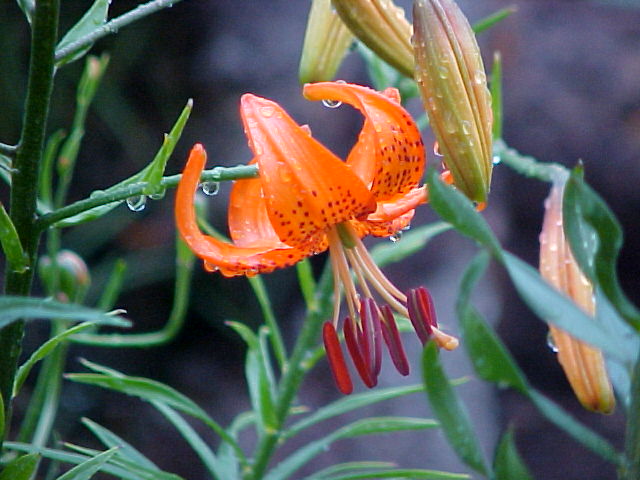 Lilium davidii
A tall Asian lily with edible bulbs and orange recurved flowers
🇨🇳 China and 1 more · Wildflower
Lilium davidii
A tall Asian lily with edible bulbs and orange recurved flowers
🇨🇳 China and 1 more · Wildflower
 Chinese LilyLilium brownii
A wild and cultivated lily from China with edible bulbs
🇨🇳 China and 3 more · Wildflower
Chinese LilyLilium brownii
A wild and cultivated lily from China with edible bulbs
🇨🇳 China and 3 more · Wildflower
More from Japan
All the flowers of Japan PeachPrunus persica
A flowering fruit tree from China, grown for its pink blossoms and sweet fruit
🇨🇳 China and 7 more · Flowering tree
PeachPrunus persica
A flowering fruit tree from China, grown for its pink blossoms and sweet fruit
🇨🇳 China and 7 more · Flowering tree
 BirchBetula
Slender trees with papery bark found across the northern world
🇨🇳 China and 7 more · Wildflower
BirchBetula
Slender trees with papery bark found across the northern world
🇨🇳 China and 7 more · Wildflower
 Chrysanthemum菊花
Autumn-blooming flower with thousands of varieties, cherished in East Asia and beyond
🇨🇳 China and 6 more · Wildflower
Chrysanthemum菊花
Autumn-blooming flower with thousands of varieties, cherished in East Asia and beyond
🇨🇳 China and 6 more · Wildflower
 Sacred lotusNelumbo nucifera
The pink aquatic flower sacred in Asia and grown for food, worship and beauty
🇮🇳 India and 7 more · Water flower
Sacred lotusNelumbo nucifera
The pink aquatic flower sacred in Asia and grown for food, worship and beauty
🇮🇳 India and 7 more · Water flower