
Formosa lily
Lilium formosanum, family Liliaceae
In its own language: 台灣百合
A tall, white, fragrant lily native to Taiwan with trumpet-shaped blooms
Formosa lily is a tall, trumpet-flowered plant from Taiwan, known for its fragrant white blooms with purple on the outside. It grows wild in Taiwan and is also found in parts of Africa, Australia, and the Americas, often used in ceremonies and as an ornamental flower.
- Native and endemic to Taiwan
- Tall stems with fragrant, trumpet-shaped white flowers
- Favoured in Rukai ceremonial headdresses
- Known as 'flower of broken bowl' in Hakka tradition
- Naturalized in Africa, Australia, and the Americas
What does Formosa lily look like?
The Formosa lily grows upright, reaching 120 to 150 cm tall. Its stem is smooth, sometimes with a purple tint, and the narrow, lance-shaped leaves are scattered along the stem. The plant produces one to five large, funnel-shaped flowers per stem, each about 11.5 to 14.5 cm long. The flowers are pure white inside with purple on the outside, and they have a strong fragrance. The plant forms small, rounded bulbs and produces slender seed capsules after flowering.
Where does Formosa lily come from?
Lilium formosanum is native and endemic to Taiwan, where it grows wild. It is closely related to the Easter lily of the Ryukyu Islands in Japan. Over time, the Formosa lily has been cultivated for its attractive flowers and has become naturalized in scattered regions of Africa, Australia, and the Americas. Its name and cultural ties are especially strong in Taiwan, where it is recognized by many local names.
When and how Formosa lily blooms
The Formosa lily blooms from June to December, producing its showy flowers in the warmer months. It grows from small, rounded bulbs with white to yellowish scales. Seeds ripen in long, slender capsules and germinate just above the soil surface. The plant is often grown as an ornamental in gardens for its striking appearance and scent.
How Formosa lily is used
In Taiwan, the Formosa lily is popular in gardens and is also worn in headdresses by the Rukai people during special occasions and ceremonies. Its flowers are valued for their beauty and fragrance. The plant is sometimes called 'flower of broken bowl' in Hakka tradition, with stories discouraging picking to protect water sources.
Kinds of Formosa lily
There are two recognized varieties: Lilium formosanum var. formosanum and Lilium formosanum var. microphyllum. The latter is distinguished by its smaller leaves. Both varieties share the same general appearance and flowering habits.
What Formosa lily means
The Formosa lily holds cultural significance in Taiwan, especially among indigenous groups like the Rukai, who use it in ceremonial dress. It is also linked to environmental respect in Hakka folklore. The flower has become a symbol in local movements and is known by several names reflecting its importance in daily and ceremonial life.
Questions people ask about Formosa lily
Where does the Formosa lily come from?
The Formosa lily is native and endemic to Taiwan, where it grows wild. It has also become naturalized in some parts of Africa, Australia, and the Americas.
What does the Formosa lily look like?
It is a tall plant, reaching up to 150 cm, with narrow leaves and large, trumpet-shaped flowers. The flowers are white inside with purple on the outside and have a strong fragrance.
How is the Formosa lily used in culture?
The Rukai people of Taiwan wear the flowers in headdresses during special occasions. In Hakka tradition, it is called 'flower of broken bowl' and is respected for its connection to clean water.
What are some other names for the Formosa lily?
It is also called Taiwanese lily, wild lily, trumpet flower, mountain garlic, master's flask, and flower of broken bowl.
When does the Formosa lily bloom?
The Formosa lily blooms from June to December, producing its fragrant flowers during summer, autumn, and winter.
Good reading and sources
- USDA Plants DatabaseUS Department of Agriculture, Article
- Plants of the World OnlineRoyal Botanic Gardens, Kew, Plant database
- Where it has been recordedGBIF, Plant database
- Sightings and photos by naturalistsiNaturalist, Plant database
- Lilium formosanum on WikipediaEncyclopedia
- More photos on Wikimedia CommonsPhotos
- Wikidata recordOpen data
The facts on this page come from the Wikipedia article "Lilium formosanum", written by its contributors and used under the CC BY-SA 4.0 licence, and from its Wikidata record (CC0). Phool rewrote the text in its own words, with AI assistance, and compares every page with the article to make sure no passage is copied. It may be reused under the same CC BY-SA 4.0 licence with a link back.
It may contain mistakes. It is not medical or foraging advice: many flowers are poisonous, and traditional uses are reported, not recommended. If something is wrong, tell us. Last refreshed 2026-10-03.
Others in the family Liliaceae
The whole family TulipTulipa
Spring-blooming bulbs with showy, cup-shaped flowers in many colours
🇳🇱 Netherlands and 7 more · Wildflower
TulipTulipa
Spring-blooming bulbs with showy, cup-shaped flowers in many colours
🇳🇱 Netherlands and 7 more · Wildflower
 LilyLilium
Tall bulb flowers with large, colourful blooms in many gardens and cultures
Lilium · Wildflower
LilyLilium
Tall bulb flowers with large, colourful blooms in many gardens and cultures
Lilium · Wildflower
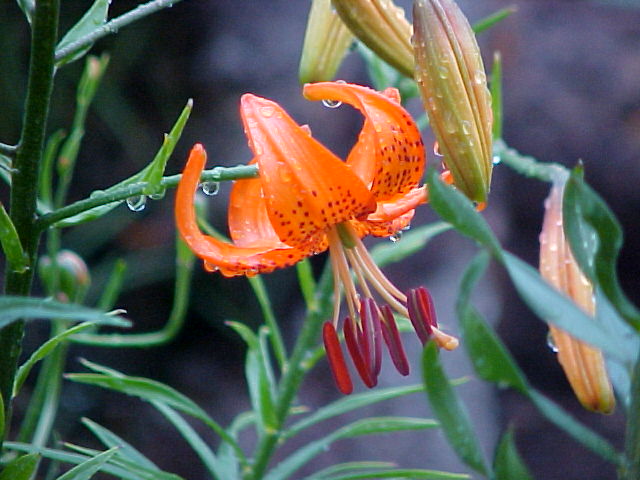 Lilium davidii
A tall Asian lily with edible bulbs and orange recurved flowers
🇨🇳 China and 1 more · Wildflower
Lilium davidii
A tall Asian lily with edible bulbs and orange recurved flowers
🇨🇳 China and 1 more · Wildflower
 Chinese LilyLilium brownii
A wild and cultivated lily from China with edible bulbs
🇨🇳 China and 3 more · Wildflower
Chinese LilyLilium brownii
A wild and cultivated lily from China with edible bulbs
🇨🇳 China and 3 more · Wildflower
More from Taiwan
All the flowers of Taiwan Brown mustardBrassica juncea
A leafy mustard plant grown for greens, seeds, and oil across Asia and beyond
🇨🇳 China and 7 more · Wildflower
Brown mustardBrassica juncea
A leafy mustard plant grown for greens, seeds, and oil across Asia and beyond
🇨🇳 China and 7 more · Wildflower
 Lilium pumilum
A small Asian lily with nodding red flowers and a light scent
🇨🇳 China and 3 more · Wildflower
Lilium pumilum
A small Asian lily with nodding red flowers and a light scent
🇨🇳 China and 3 more · Wildflower
 Pigeon orchidDendrobium crumenatum
A white, fragrant orchid that blooms all at once after rain
🇮🇳 India and 5 more · Wildflower
Pigeon orchidDendrobium crumenatum
A white, fragrant orchid that blooms all at once after rain
🇮🇳 India and 5 more · Wildflower
 Taiwan cherryPrunus campanulata
An early-blooming cherry tree with deep pink, bell-shaped flowers
🇨🇳 China and 4 more · Flowering tree
Taiwan cherryPrunus campanulata
An early-blooming cherry tree with deep pink, bell-shaped flowers
🇨🇳 China and 4 more · Flowering tree