Twinflower
Linnaea borealis, family Caprifoliaceae
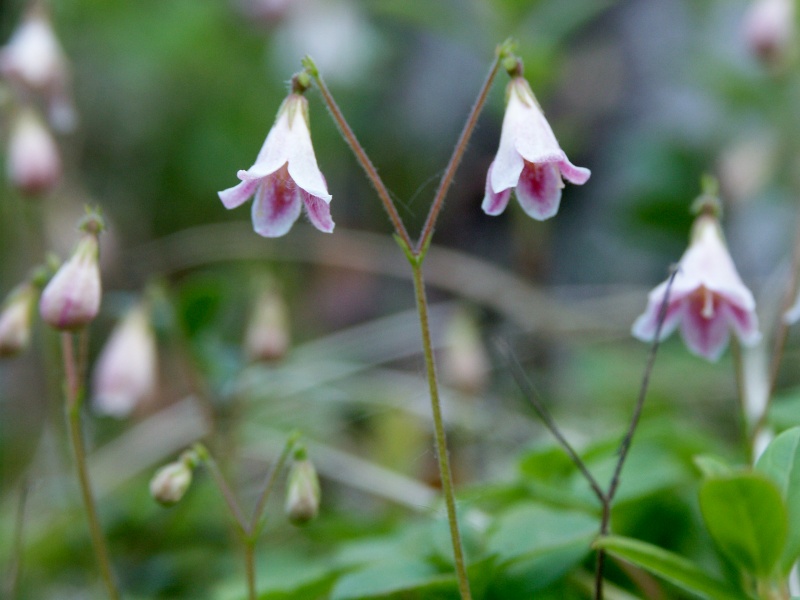
A small woodland plant with paired pale pink flowers, named for Carl Linnaeus
Twinflower (Linnaea borealis) is a low, trailing plant of cool forests across northern Europe, Asia, and North America. Its slender stems bear pairs of nodding, pale pink flowers. It spreads by runners and is known for its delicate appearance and as the personal symbol of Carl Linnaeus.
- Named after Carl Linnaeus, the founder of modern plant naming
- Has paired, nodding pale pink flowers on slender stems
- Grows in cool, moist forests across northern Europe, Asia, and North America
- Provincial flower of Småland, Sweden
- Indicator species for ancient woodland in Britain
What does Twinflower look like?
Twinflower is a slender, creeping subshrub with evergreen, rounded oval leaves just a few millimetres long. Its flowering stems rise only a few centimetres above the ground and are leafless except at the base. Each stem ends in a pair of small, nodding, bell-shaped flowers, pale pink and about 7–12 mm long. The plant forms mats or patches in cool, moist forests.
Where does Twinflower come from?
Linnaea borealis grows wild in boreal and subarctic forests across Europe, Asia, and North America, reaching southward in mountains and cool microclimates. It was first described by Carl Linnaeus in 1753 and named after him, as it was his favourite plant. The species survived past ice ages by persisting in cool habitats, often forming long-lived clonal patches.
When and how Twinflower blooms
Twinflower blooms in summer, producing its paired flowers on short, upright stems. It thrives in moist, cool woodlands, often in pine forests or on shaded slopes. The plant spreads mostly by stolons—horizontal stems that root and form new shoots—rather than by seed, as it requires cross-pollination and often forms isolated colonies.


How Twinflower is used
People value twinflower mainly for its delicate beauty in the wild and for its symbolic meaning. It is not widely cultivated or used in gardens, but it is the provincial flower of Småland in Sweden. In forestry, its presence can indicate ancient woodland. Linnaeus adopted it as his personal emblem.
Kinds of Twinflower
There are three main subspecies: subsp. borealis in Europe, subsp. americana in North America, and subsp. longiflora in Asia and western North America. These subspecies differ mainly in their geographic range. Some botanists have debated the boundaries of the genus, but Linnaea is now generally accepted as a single-species genus.
What Twinflower means
Twinflower is closely tied to Carl Linnaeus, who used it as his personal symbol and whose name it bears. It is the provincial flower of Småland, Sweden, Linnaeus's home region. In Britain and parts of the United States, it is considered scarce or of conservation concern, especially at the southern edges of its range. Its paired flowers are the source of its English name.
Questions people ask about Twinflower
Where does twinflower come from?
Twinflower is native to boreal and subarctic forests across Europe, Asia, and North America. It also grows further south in cool mountain regions and shaded slopes.
Why is it called twinflower?
The name 'twinflower' comes from its habit of producing flowers in pairs at the top of each slender stem. These paired, bell-shaped flowers are a key feature of the plant.
What does twinflower symbolise?
Twinflower is best known as the personal symbol of Carl Linnaeus, who named it after himself. It is also the provincial flower of Småland in Sweden, Linnaeus's home region.
Is twinflower common or rare?
Twinflower is widespread and secure in its main northern ranges, but it is scarce and of conservation concern at the southern edges of its range, such as in parts of Britain and the United States.
How does twinflower spread?
Twinflower mostly spreads by stolons—creeping stems that root and form new shoots—since it needs cross-pollination to produce seeds and often forms isolated colonies.
Good reading and sources
- Linnaea borealisUS Department of Agriculture, Article
- Linnaea borealisRoyal Horticultural Society, Article
- Plants of the World OnlineRoyal Botanic Gardens, Kew, Plant database
- Where it has been recordedGBIF, Plant database
- Sightings and photos by naturalistsiNaturalist, Plant database
The facts on this page come from the Wikipedia article "Linnaea", written by its contributors and used under the CC BY-SA 4.0 licence, and from its Wikidata record (CC0). Phool rewrote the text in its own words, with AI assistance, and compares every page with the article to make sure no passage is copied. It may be reused under the same CC BY-SA 4.0 licence with a link back.
It may contain mistakes. It is not medical or foraging advice: many flowers are poisonous, and traditional uses are reported, not recommended. If something is wrong, tell us. Last refreshed 2026-10-03.
Others in the family Caprifoliaceae
The whole family HoneysuckleLonicera
Twining vines and shrubs with sweet-scented tubular flowers and edible nectar
Lonicera · Wildflower
HoneysuckleLonicera
Twining vines and shrubs with sweet-scented tubular flowers and edible nectar
Lonicera · Wildflower
 Common ValerianValeriana officinalis
Tall, sweet-scented wildflower with pale pink blooms and a long history in herbal lore
🇮🇸 Iceland and 8 more · Wildflower
Common ValerianValeriana officinalis
Tall, sweet-scented wildflower with pale pink blooms and a long history in herbal lore
🇮🇸 Iceland and 8 more · Wildflower
 Patrinia scabiosifolia
A yellow-flowered perennial of East Asian meadows and gardens
🇨🇳 China and 4 more · Wildflower
Patrinia scabiosifolia
A yellow-flowered perennial of East Asian meadows and gardens
🇨🇳 China and 4 more · Wildflower
 Lomelosia comosa
A perennial wildflower and Mongolia's national flower
🇲🇳 Mongolia and 1 more · Wildflower
Lomelosia comosa
A perennial wildflower and Mongolia's national flower
🇲🇳 Mongolia and 1 more · Wildflower
More from the United States
All the flowers of the United States AlmondPrunus amygdalus
A Mediterranean tree grown for its fragrant spring flowers and edible seeds
🇮🇷 Iran and 6 more · Flowering tree
AlmondPrunus amygdalus
A Mediterranean tree grown for its fragrant spring flowers and edible seeds
🇮🇷 Iran and 6 more · Flowering tree
 CactusCactaceae
Succulent plants with spines, native to the Americas
🇲🇽 Mexico and 7 more · Wildflower
CactusCactaceae
Succulent plants with spines, native to the Americas
🇲🇽 Mexico and 7 more · Wildflower
 Chrysanthemum菊花
Autumn-blooming flower with thousands of varieties, cherished in East Asia and beyond
🇨🇳 China and 6 more · Wildflower
Chrysanthemum菊花
Autumn-blooming flower with thousands of varieties, cherished in East Asia and beyond
🇨🇳 China and 6 more · Wildflower
 LindenTilia
Tall, broad-leaved trees with fragrant yellow flowers and heart-shaped leaves
🇨🇳 China and 7 more · Flowering tree
LindenTilia
Tall, broad-leaved trees with fragrant yellow flowers and heart-shaped leaves
🇨🇳 China and 7 more · Flowering tree