
Tenweeks stock
Matthiola incana, family Brassicaceae
A fragrant garden flower in many colours, grown for beds and bouquets
Tenweeks stock is a garden plant with clusters of scented flowers in shades from white to purple. It grows wild along southern European coasts and has been cultivated for centuries for its colourful blooms, which are used in gardens and as cut flowers.
- Flowers are strongly scented and come in many colours
- Grows wild on Mediterranean coasts and cliffs
- Double-flowered forms are sterile and bred from singles
- Cultivated since at least the 16th century
What does Tenweeks stock look like?
Tenweeks stock is a bushy plant that often grows 20 to 28 centimeters tall, with woody lower stems and soft, ash-coloured leaves. Its flowers are grouped at the tips of the branches, with four petals each, and come in a range of colours including white, cream, yellow, pink, red, purple, and blue. The blooms have a strong, sweet scent, making them popular in gardens and bouquets. The plant is covered in fine, whitish hairs and produces flattened seed pods.
Where does Tenweeks stock come from?
This flower grows wild along the coasts of southern Europe, especially on cliffs and old walls near the sea. It is found from Spain through Italy and Greece, and also on Mediterranean islands like Malta and Sicily. People began growing it in gardens as early as the 16th century, and it has been widely cultivated ever since. The plant prefers calcareous, or chalky, soils and can sometimes be found inland up to 600 meters above sea level.
When and how Tenweeks stock blooms
Gardeners grow tenweeks stock from seed, choosing between annual and biennial varieties. Annual types are sown in spring for summer flowers, while biennial forms are planted in summer to bloom the next spring. Some varieties, like those from Malta, are treated as perennials. The plant does best in well-drained, sheltered spots, especially in regions with cold winters.


How Tenweeks stock is used
People grow tenweeks stock mainly for its colourful and fragrant flowers, which are used in summer bedding displays and as cut flowers for arrangements. The blooms can be single or double, with double-flowered forms especially valued for their showy appearance. The plant is also appreciated for its scent, making it a favourite in home gardens and floral gifts.
Kinds of Tenweeks stock
There are several subspecies and varieties, each linked to different regions. For example, the Maltese stock has fleshy, fuzzy leaves and pale violet or white flowers. Brompton stocks are biennial types grown for spring displays, while East Lothian stocks can be treated as either annuals or biennials. The 'Cinderella series' is a modern variety recognized for its garden performance.
What Tenweeks stock means
Tenweeks stock has a long history in gardens and floristry, valued for its fragrance and range of colours. Double-flowered forms are sterile and must be produced from single-flowered plants, a fact that has shaped how gardeners select and breed them. The plant is not tied to any particular festival or religious tradition, but its beauty and scent have made it a classic choice for ornamental use.
Questions people ask about Tenweeks stock
Where does tenweeks stock come from?
Tenweeks stock grows wild along the coasts of southern Europe, from Spain to Greece, and on Mediterranean islands like Malta and Sicily. It is often found on cliffs and old walls near the sea.
What does tenweeks stock look like?
It is a bushy plant with soft, ash-coloured leaves and clusters of fragrant flowers. The blooms can be white, cream, yellow, pink, red, purple, or blue, and are grouped at the ends of the branches.
How is tenweeks stock used?
People grow it mainly for its colourful, scented flowers, which are popular in gardens and as cut flowers for bouquets and arrangements. It is valued for both its appearance and its fragrance.
Are there different types of tenweeks stock?
Yes, there are several subspecies and varieties, including annual, biennial, and perennial forms. Some are linked to specific regions, like the Maltese stock, and modern varieties have been bred for garden performance.
Does tenweeks stock have any special meaning or symbolism?
While it is not tied to any particular festival or religious practice, tenweeks stock has long been valued for its beauty and scent in gardens and floral arrangements.
Good reading and sources
- Matthiola incana Cinderella Series, mixedRoyal Horticultural Society, Article
- Plants of the World OnlineRoyal Botanic Gardens, Kew, Plant database
- Where it has been recordedGBIF, Plant database
- Sightings and photos by naturalistsiNaturalist, Plant database
- Matthiola incana on WikipediaEncyclopedia
- More photos on Wikimedia CommonsPhotos
- Wikidata recordOpen data
The facts on this page come from the Wikipedia article "Matthiola incana", written by its contributors and used under the CC BY-SA 4.0 licence, and from its Wikidata record (CC0). Phool rewrote the text in its own words, with AI assistance, and compares every page with the article to make sure no passage is copied. It may be reused under the same CC BY-SA 4.0 licence with a link back.
It may contain mistakes. It is not medical or foraging advice: many flowers are poisonous, and traditional uses are reported, not recommended. If something is wrong, tell us. Last refreshed 2026-10-03.
Others in the family Brassicaceae
The whole family RapeseedBrassica napus
A yellow-flowered crop grown for its oil-rich seeds and protein meal
🇨🇳 China and 7 more · Wildflower
RapeseedBrassica napus
A yellow-flowered crop grown for its oil-rich seeds and protein meal
🇨🇳 China and 7 more · Wildflower
 Brown mustardBrassica juncea
A leafy mustard plant grown for greens, seeds, and oil across Asia and beyond
🇨🇳 China and 7 more · Wildflower
Brown mustardBrassica juncea
A leafy mustard plant grown for greens, seeds, and oil across Asia and beyond
🇨🇳 China and 7 more · Wildflower
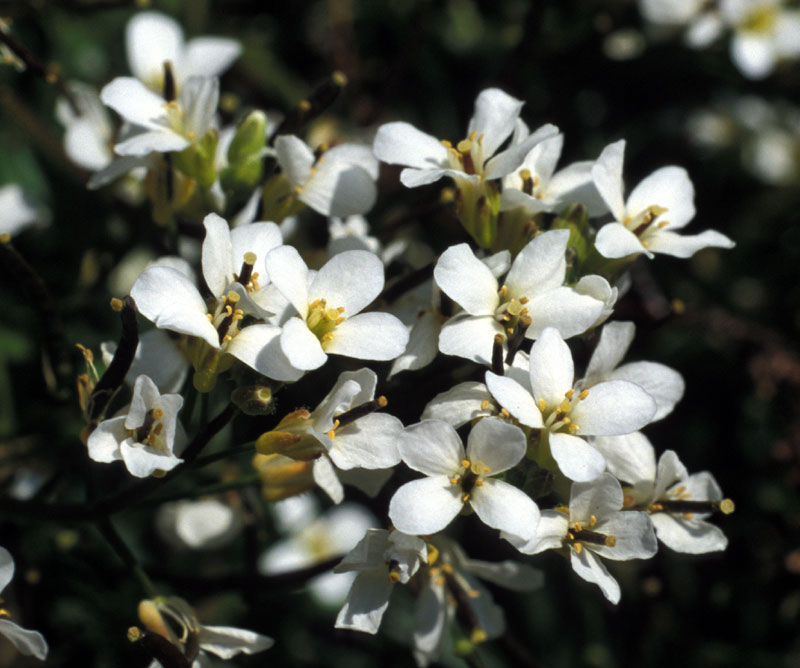 Whitlow grassDraba
A large group of small flowering plants, not true grasses
Draba · Wildflower
Whitlow grassDraba
A large group of small flowering plants, not true grasses
Draba · Wildflower
 Sea kaleCrambe maritima
Salt-loving coastal plant with edible white-flowered shoots
🇬🇧 United Kingdom and 7 more · Wildflower
Sea kaleCrambe maritima
Salt-loving coastal plant with edible white-flowered shoots
🇬🇧 United Kingdom and 7 more · Wildflower
More from Spain
All the flowers of Spain PeachPrunus persica
A flowering fruit tree from China, grown for its pink blossoms and sweet fruit
🇨🇳 China and 7 more · Flowering tree
PeachPrunus persica
A flowering fruit tree from China, grown for its pink blossoms and sweet fruit
🇨🇳 China and 7 more · Flowering tree
 AlmondPrunus amygdalus
A Mediterranean tree grown for its fragrant spring flowers and edible seeds
🇮🇷 Iran and 6 more · Flowering tree
AlmondPrunus amygdalus
A Mediterranean tree grown for its fragrant spring flowers and edible seeds
🇮🇷 Iran and 6 more · Flowering tree
 ApricotPrunus armeniaca
A small fruit tree with early white to pink blossoms and golden-orange fruit
🇨🇳 China and 6 more · Flowering tree
ApricotPrunus armeniaca
A small fruit tree with early white to pink blossoms and golden-orange fruit
🇨🇳 China and 6 more · Flowering tree
 RosemarySalvia rosmarinus
A fragrant evergreen shrub with needle-like leaves and purple, blue, or white flowers
🇪🇸 Spain and 5 more · Flowering shrub
RosemarySalvia rosmarinus
A fragrant evergreen shrub with needle-like leaves and purple, blue, or white flowers
🇪🇸 Spain and 5 more · Flowering shrub