
Broad-leaved paperbark
Melaleuca quinquenervia, family Myrtaceae
A swamp-dwelling Australian tree with peeling bark and creamy bottlebrush flowers
Broad-leaved paperbark is a small to medium tree with thick, layered bark that peels in strips. It bears grey-green leaves and cream or white bottlebrush-like flower spikes from spring to autumn. Native to parts of Australia, New Guinea and New Caledonia, it grows in wetlands and has become invasive in places like Florida.
- Peeling white bark gives it the name 'paperbark'
- Flowers feed fruit bats and lorikeets in Australia
- Classed as a noxious weed in six U.S. states
- Seeds can remain viable for almost ten years
- Grows in soil as acidic as pH 2.5
What does Broad-leaved paperbark look like?
This tree reaches 8–15 metres tall with a wide spread. Its trunk is wrapped in thick, soft bark that peels off in pale layers. The leaves are flat, leathery and grey-green, shaped like an egg or lance, with five clear veins. Creamy-white flowers grow in dense, cylindrical spikes at branch tips, each made of many tiny stamens bundled together.
Where does Broad-leaved paperbark come from?
It grows naturally along Australia’s east coast from New South Wales to Queensland, as well as in Papua New Guinea and New Caledonia. In New Caledonia’s grasslands, scattered trees may have spread with the help of human-set fires. The species name refers to the five veins on each leaf.
When and how Broad-leaved paperbark blooms
It thrives in wet, silty soils near rivers, swamps and estuaries, even in highly acidic ground. Flowering runs from late spring through early autumn in Australia. After blooming, it forms small woody capsules that hold hundreds of tiny seeds, which can stay viable for nearly a decade and even sprout underwater.


How Broad-leaved paperbark is used
In Australia, its bark has been used to make containers, shelters and food wraps. People also wash nectar from its flowers into water to drink. The tree yields strongly flavoured amber honey. It is planted in parks and as a street tree, valued for windbreaks and wildlife support, but is banned as a noxious weed in several U.S. states.
Kinds of Broad-leaved paperbark
Two main chemical types exist based on leaf oils. One is rich in E-nerolidol, the other in viridiflorol, along with compounds like linalool, 1,8-cineole and α-terpineol. An ellagitannin called grandinin also occurs in the leaves.
What Broad-leaved paperbark means
In Australia it supports birds and bats with nectar and is used in landscaping. Elsewhere, especially in Florida, it is a major ecological threat. It invades marshes, alters water flow, crowds out native plants and changes fire patterns. Biocontrol insects from Australia now help limit its spread in the U.S.
Where Broad-leaved paperbark is used and seen
 Australian National Botanic GardensAustralia’s largest living collection of native plants in Canberra
 Hòn non bộVietnamese miniature landscapes of mountains and islands in trays or basins
 Lisbon Tropical Botanical GardenA historic garden in Lisbon with tropical and subtropical plants from around the world
Questions people ask about Broad-leaved paperbark
Where does broad-leaved paperbark come from?
It is native to coastal eastern Australia, Papua New Guinea and New Caledonia, where it grows in swamps and floodplains.
Why is it a problem in Florida?
Introduced around 1900, it spreads aggressively in the Everglades, displacing native plants, altering water flow and changing fire patterns.
What are its traditional uses?
Aboriginal people used its bark for shelters, food wrapping and coolamons, and washed flower nectar into water for a drink.
When does it flower?
In Australia, it blooms from September to March, late spring through early autumn, with creamy-white bottlebrush flower spikes.
Is it grown in gardens?
Yes, it is planted as a street tree and in parks in Australia for its hardiness and wildlife value, but is restricted elsewhere due to invasiveness.
Good reading and sources
- Encyclopaedia BritannicaArticle
- Melaleuca quinquenerviaAustralian National Botanic Gardens, Article
- Plants of the World OnlineRoyal Botanic Gardens, Kew, Plant database
- Where it has been recordedGBIF, Plant database
- Sightings and photos by naturalistsiNaturalist, Plant database
- Melaleuca quinquenervia on WikipediaEncyclopedia
- More photos on Wikimedia CommonsPhotos
- Wikidata recordOpen data
The facts on this page come from the Wikipedia article "Melaleuca quinquenervia", written by its contributors and used under the CC BY-SA 4.0 licence, and from its Wikidata record (CC0). Phool rewrote the text in its own words, with AI assistance, and compares every page with the article to make sure no passage is copied. It may be reused under the same CC BY-SA 4.0 licence with a link back.
It may contain mistakes. It is not medical or foraging advice: many flowers are poisonous, and traditional uses are reported, not recommended. If something is wrong, tell us. Last refreshed 2026-10-03.
Others in the family Myrtaceae
The whole family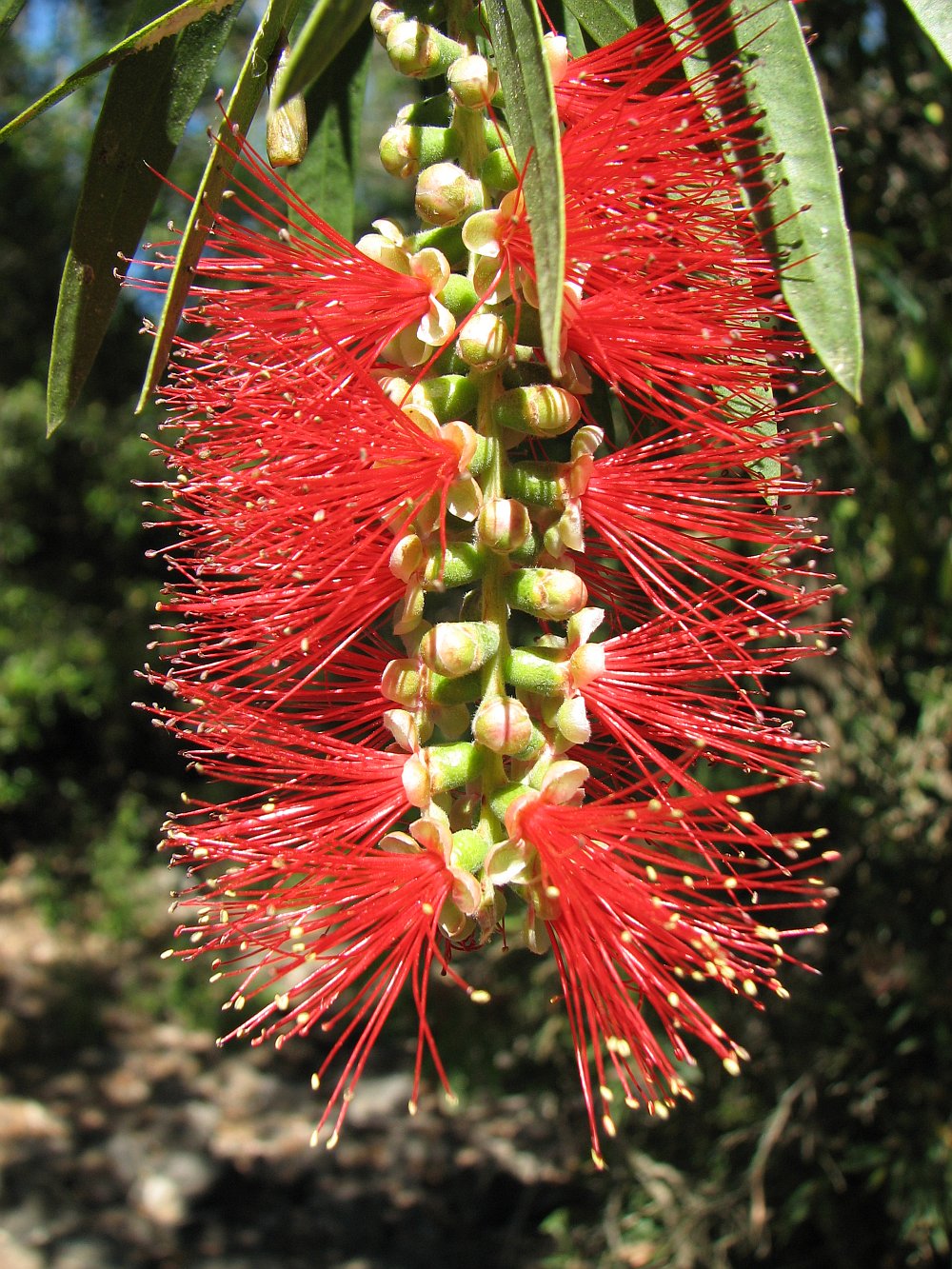 BottlebrushCallistemon
Shrubs with brush-shaped flowers native to Australia
🇦🇺 Australia · Flowering shrub
BottlebrushCallistemon
Shrubs with brush-shaped flowers native to Australia
🇦🇺 Australia · Flowering shrub
 Darwinia
Australian shrubs with bell-like flowers wrapped in colourful bracts
🇦🇺 Australia · Flowering shrub
Darwinia
Australian shrubs with bell-like flowers wrapped in colourful bracts
🇦🇺 Australia · Flowering shrub
 Common red bottlebrushMelaleuca citrina
A hardy Australian shrub with bright red brush-like flowers
🇦🇺 Australia · Flowering shrub
Common red bottlebrushMelaleuca citrina
A hardy Australian shrub with bright red brush-like flowers
🇦🇺 Australia · Flowering shrub
 Weeping bottlebrushMelaleuca viminalis
A red-flowered Australian tree with weeping branches and bottlebrush blooms
🇦🇺 Australia and 5 more · Flowering tree
Weeping bottlebrushMelaleuca viminalis
A red-flowered Australian tree with weeping branches and bottlebrush blooms
🇦🇺 Australia and 5 more · Flowering tree
More from Australia
All the flowers of Australia AlmondPrunus amygdalus
A Mediterranean tree grown for its fragrant spring flowers and edible seeds
🇮🇷 Iran and 6 more · Flowering tree
AlmondPrunus amygdalus
A Mediterranean tree grown for its fragrant spring flowers and edible seeds
🇮🇷 Iran and 6 more · Flowering tree
 FennelFoeniculum vulgare
A tall, aromatic herb with feathery leaves and yellow umbels, used for food and spice
🇨🇳 China and 7 more · Herb or useful flower
FennelFoeniculum vulgare
A tall, aromatic herb with feathery leaves and yellow umbels, used for food and spice
🇨🇳 China and 7 more · Herb or useful flower
 RosemarySalvia rosmarinus
A fragrant evergreen shrub with needle-like leaves and purple, blue, or white flowers
🇪🇸 Spain and 5 more · Flowering shrub
RosemarySalvia rosmarinus
A fragrant evergreen shrub with needle-like leaves and purple, blue, or white flowers
🇪🇸 Spain and 5 more · Flowering shrub
 Eucalyptus
The tall, aromatic trees and shrubs known as gum trees or eucalypts
🇦🇺 Australia and 7 more · Flowering tree
Eucalyptus
The tall, aromatic trees and shrubs known as gum trees or eucalypts
🇦🇺 Australia and 7 more · Flowering tree