
Paeonia anomala
A wild peony with finely divided leaves and magenta-red flowers from northern Eurasia
Paeonia anomala is a perennial peony found from northern Russia to Mongolia and northwest China. It grows up to 1 meter tall, with deeply cut leaves and usually one magenta-red flower per stem that smells like lily of the valley. The roots and fruits have been used in traditional food and medicine.
- Usually one magenta-red flower per stem, with a light lily-of-the-valley scent
- Native from northern Russia to Mongolia and northwest China
- Roots and fruits used in traditional Siberian and Mongolian remedies
- Leaves turn vivid red in autumn, rare among peonies
- Survives harsh winters, down to at least −25°C
What does Paeonia anomala look like?
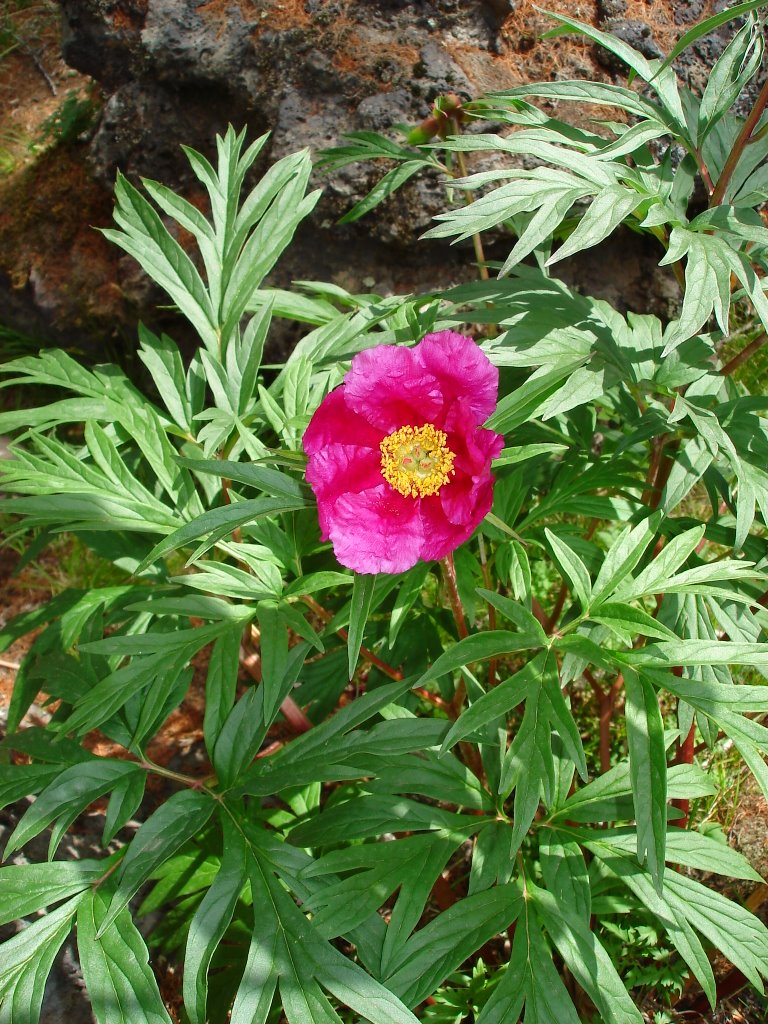
Paeonia anomala is a non-woody perennial peony that grows between half a meter and one meter tall. Its leaves are finely divided into many narrow segments, giving a feathery look, and may turn vivid red in autumn. Each stem usually carries a single nodding flower, magenta-red in color, but sometimes pink or white, with six to nine oblong petals. The flowers have a light scent similar to lily of the valley. After flowering, the plant produces seedpods with shiny black seeds.
Where does Paeonia anomala come from?
This species grows wild from northern European Russia across Siberia, Kazakhstan, Mongolia, and into northwest China (Xinjiang). It is found in moist forests, valleys, and meadows, from sea level in the north to high mountain areas in the south. Paeonia anomala was first described from Siberia in 1771. Over time, botanists have debated its classification, but recent genetic studies show it is a natural hybrid between Paeonia lactiflora and P. veitchii.
When and how Paeonia anomala blooms
Paeonia anomala blooms from spring to early summer, with flowering times varying by location and altitude. It prefers full sun or partial shade and well-drained, deep, rich soil, but tolerates lime and cold down to at least −25°C. Plants are long-lived and dislike disturbance of their roots. In gardens, double-flowered forms exist, but in the wild, each stem usually has one flower.


How Paeonia anomala is used
The roots of Paeonia anomala were eaten raw or added to soup by the Khakas people in Siberia. In Mongolia, both roots and fruits are used in traditional remedies for various ailments, including digestive and kidney issues. The plant is also valued as an ornamental in gardens for its unique foliage and flowers. Animals such as deer and rabbits do not eat it.
Kinds of Paeonia anomala
Double-flowered forms are sometimes grown in gardens. Paeonia anomala is closely related to P. veitchii, which usually has more flowers per stem. Other similar species include P. tenuifolia, with even more finely divided leaves, and P. emodi, with fewer leaf segments.
What Paeonia anomala means
The species name 'anomala' means 'deviant', possibly referring to its autumn leaf color, which is unusual among peonies. It has become naturalized in Finland and is valued for its hardiness and ornamental qualities. In local traditions, it has been used for food and medicine, but it is not tied to any specific religious or national symbolism.
Questions people ask about Paeonia anomala
Where does Paeonia anomala come from?
Paeonia anomala grows wild from northern European Russia through Siberia, Kazakhstan, Mongolia, and northwest China (Xinjiang), and has naturalized in Finland.
What does Paeonia anomala look like?
It is a perennial plant up to 1 meter tall, with finely divided, feathery leaves and usually one magenta-red, pink, or white flower per stem. The flowers are lightly scented and the leaves may turn red in autumn.
How is Paeonia anomala used?
Its roots were eaten raw or in soup by the Khakas people, and both roots and fruits are used in Mongolian traditional medicine for various ailments. It is also grown as an ornamental garden plant.
What does Paeonia anomala symbolize?
The sources do not mention any specific symbolism or national emblem status for Paeonia anomala.
How hardy is Paeonia anomala?
It is very cold-hardy, surviving temperatures down to at least −25°C, and can live in gardens for many decades.
Good reading and sources
- Plants of the World OnlineRoyal Botanic Gardens, Kew, Plant database
- Where it has been recordedGBIF, Plant database
- Sightings and photos by naturalistsiNaturalist, Plant database
- Paeonia anomala on WikipediaEncyclopedia
- More photos on Wikimedia CommonsPhotos
- Wikidata recordOpen data
The facts on this page come from the Wikipedia article "Paeonia anomala", written by its contributors and used under the CC BY-SA 4.0 licence, and from its Wikidata record (CC0). Phool rewrote the text in its own words, with AI assistance, and compares every page with the article to make sure no passage is copied. It may be reused under the same CC BY-SA 4.0 licence with a link back.
It may contain mistakes. It is not medical or foraging advice: many flowers are poisonous, and traditional uses are reported, not recommended. If something is wrong, tell us. Last refreshed 2026-10-03.
Others in the family Paeoniaceae
The whole family PeonyPaeonia
Large spring flowers in pink, red, white, yellow and purple, grown in gardens worldwide
🇨🇳 China and 7 more · Wildflower
PeonyPaeonia
Large spring flowers in pink, red, white, yellow and purple, grown in gardens worldwide
🇨🇳 China and 7 more · Wildflower
 Paeonia rockii紫斑牡丹
A large, fragrant tree peony from the mountains of China
🇨🇳 China · Garden flower
Paeonia rockii紫斑牡丹
A large, fragrant tree peony from the mountains of China
🇨🇳 China · Garden flower
 Woodland peonyPaeonia obovata
A woodland peony with white, pink or purple-red flowers from East Asia
🇨🇳 China and 2 more · Wildflower
Woodland peonyPaeonia obovata
A woodland peony with white, pink or purple-red flowers from East Asia
🇨🇳 China and 2 more · Wildflower
 Paeonia ostii
A Chinese tree peony with large white spring flowers
🇨🇳 China · Flowering shrub
Paeonia ostii
A Chinese tree peony with large white spring flowers
🇨🇳 China · Flowering shrub
More from Russia
All the flowers of Russia Common sunflowerHelianthus annuus
A tall annual plant grown for its large yellow flower heads and edible seeds
🇨🇦 Canada and 4 more · Wildflower
Common sunflowerHelianthus annuus
A tall annual plant grown for its large yellow flower heads and edible seeds
🇨🇦 Canada and 4 more · Wildflower
 BirchBetula
Slender trees with papery bark found across the northern world
🇨🇳 China and 7 more · Wildflower
BirchBetula
Slender trees with papery bark found across the northern world
🇨🇳 China and 7 more · Wildflower
 Common flaxLinum usitatissimum
The slender blue-flowered plant grown for linen and linseed
🇨🇳 China and 7 more · Wildflower
Common flaxLinum usitatissimum
The slender blue-flowered plant grown for linen and linseed
🇨🇳 China and 7 more · Wildflower
 Sacred lotusNelumbo nucifera
The pink aquatic flower sacred in Asia and grown for food, worship and beauty
🇮🇳 India and 7 more · Water flower
Sacred lotusNelumbo nucifera
The pink aquatic flower sacred in Asia and grown for food, worship and beauty
🇮🇳 India and 7 more · Water flower