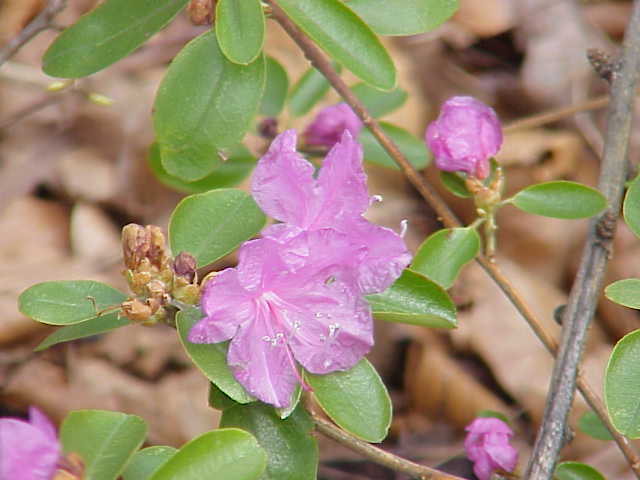
Rhododendron dauricum
A hardy shrub with purple flowers from northeast Asia
Rhododendron dauricum is a semi-evergreen shrub that grows up to 1.5 meters tall and wide. Native to parts of China, Mongolia, eastern Siberia, and northern Japan, it produces purple blooms in late winter or early spring, before its leaves develop. Gardeners value it for its cold tolerance and early flowering.
- Blooms in late winter or early spring before leaves appear
- Native to eastern Siberia, Mongolia, northern China, and Hokkaido, Japan
- Grows as a compact shrub up to 1.5 meters tall
- Parent of the cold-hardy PJM hybrid rhododendron
- The 'Mid-winter' cultivar has bright pink flowers
What does Rhododendron dauricum look like?
This plant is a compact shrub, reaching about 1.5 meters in both height and width. Its flowers are purple, sometimes bright pink in cultivated forms, and appear before the leaves. The foliage is dark green and semi-evergreen, meaning it may keep some leaves through winter. The shrub has a tidy, bushy shape and stands out for its early-season blossoms.
Where does Rhododendron dauricum come from?
Rhododendron dauricum is found growing wild in the forests and edges of forests across eastern Siberia, Mongolia, northern parts of China, and Hokkaido in Japan. The species name 'dauricum' refers to Dauria, a region in Siberia. Over time, it has been introduced to gardens in other cold regions for its resilience and early flowering.
When and how Rhododendron dauricum blooms
The shrub flowers in late winter or the start of spring, before its leaves are fully out. It prefers acidic soils rich in organic matter, such as leaf mould, and grows best in sheltered spots with dappled shade. Gardeners often choose it for its ability to withstand cold temperatures, down to -20°C.


How Rhododendron dauricum is used
Rhododendron dauricum is mainly grown as an ornamental shrub in gardens, valued for its early blooms and ability to thrive in cold climates. It is also used in breeding, as seen in the PJM hybrid, which combines its hardiness with other rhododendron traits.
Kinds of Rhododendron dauricum
One notable garden variety is 'Mid-winter', which has bright pink flowers and has received recognition for its performance in gardens. The species is also a parent of the PJM hybrid, created by crossing it with Rhododendron carolinianum.
What Rhododendron dauricum means
The plant's early flowering and cold hardiness make it popular in gardens where winters are long. The cultivar 'Mid-winter' has been awarded for its garden value. The Latin name links the species to Siberia, reflecting its origins.
Where Rhododendron dauricum is used and seen
 Parc Floral de la SourceA large public garden in Orléans built around the source of the Loiret river
 Rhododendron-Park BremenA vast park in Bremen with the world’s largest rhododendron and azalea collection
 Botanical Garden of the University of ViennaA historic 8-hectare plant collection next to Vienna’s Belvedere gardens
 Kórnik ArboretumPoland’s oldest and largest collection of trees and shrubs, near Kórnik Castle
 VanDusen Botanical GardenA public garden in Vancouver with global and native plant collections
 Abkhazi GardenA one-acre garden in Victoria, British Columbia, created by Prince and Princess Abkhazi
 Holden ArboretumA vast botanical garden and arboretum in Kirtland, Ohio
 Parc floral de ParisA botanical garden and flower park in the Bois de Vincennes, Paris
Questions people ask about Rhododendron dauricum
Where does Rhododendron dauricum come from?
It is native to forests and forest edges in eastern Siberia, Mongolia, northern China, and Hokkaido, Japan.
What does Rhododendron dauricum look like?
It is a compact shrub with purple or pink flowers that bloom before its dark green leaves appear. The plant can reach about 1.5 meters in height and width.
When does it flower?
The flowers open in late winter or early spring, making it one of the earliest rhododendrons to bloom.
How is Rhododendron dauricum used?
It is mainly grown as a garden shrub for its early flowers and cold tolerance, and is also used in hybrid breeding.
Is Rhododendron dauricum important in culture or gardening?
It is valued in gardens for its early blooms and hardiness, and the 'Mid-winter' cultivar is recognized for its ornamental qualities.
Good reading and sources
- Rhododendron dauricum 'Mid-winter' | rhododendron 'Mid-winter'Royal Horticultural Society, Article
- Plants of the World OnlineRoyal Botanic Gardens, Kew, Plant database
- Where it has been recordedGBIF, Plant database
- Sightings and photos by naturalistsiNaturalist, Plant database
- Rhododendron dauricum on WikipediaEncyclopedia
- More photos on Wikimedia CommonsPhotos
- Wikidata recordOpen data
The facts on this page come from the Wikipedia article "Rhododendron dauricum", written by its contributors and used under the CC BY-SA 4.0 licence, and from its Wikidata record (CC0). Phool rewrote the text in its own words, with AI assistance, and compares every page with the article to make sure no passage is copied. It may be reused under the same CC BY-SA 4.0 licence with a link back.
It may contain mistakes. It is not medical or foraging advice: many flowers are poisonous, and traditional uses are reported, not recommended. If something is wrong, tell us. Last refreshed 2026-10-03.
Others in the family Ericaceae
The whole family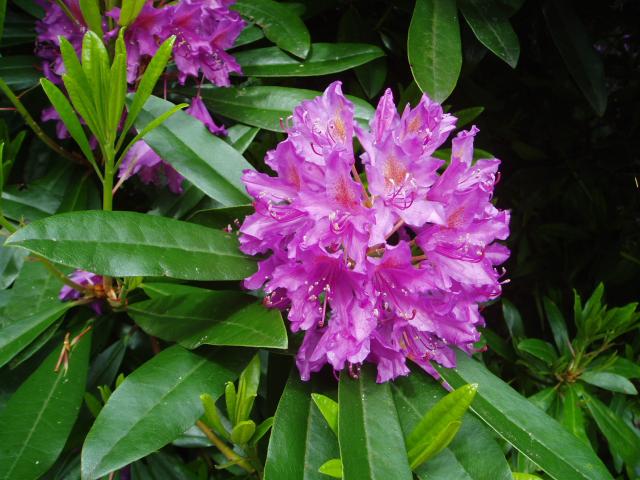 Rhododendron
A vast group of shrubs and trees with showy blooms in many colours
🇳🇵 Nepal and 4 more · Wildflower
Rhododendron
A vast group of shrubs and trees with showy blooms in many colours
🇳🇵 Nepal and 4 more · Wildflower
 Erica
Evergreen shrubs with tiny needle leaves and nodding flowers, known as heaths or heathers
🇿🇦 South Africa and 1 more · Wildflower
Erica
Evergreen shrubs with tiny needle leaves and nodding flowers, known as heaths or heathers
🇿🇦 South Africa and 1 more · Wildflower
 Catawba rosebayRhododendron catawbiense
A spring-flowering rhododendron native to the southern Appalachian Mountains
🇺🇸 United States · Wildflower
Catawba rosebayRhododendron catawbiense
A spring-flowering rhododendron native to the southern Appalachian Mountains
🇺🇸 United States · Wildflower
 Common rhododendronRhododendron ponticum
A dense evergreen shrub with violet-purple flowers from Europe and the Caucasus
🇵🇹 Portugal and 6 more · Flowering shrub
Common rhododendronRhododendron ponticum
A dense evergreen shrub with violet-purple flowers from Europe and the Caucasus
🇵🇹 Portugal and 6 more · Flowering shrub
More from China
All the flowers of China PeachPrunus persica
A flowering fruit tree from China, grown for its pink blossoms and sweet fruit
🇨🇳 China and 7 more · Flowering tree
PeachPrunus persica
A flowering fruit tree from China, grown for its pink blossoms and sweet fruit
🇨🇳 China and 7 more · Flowering tree
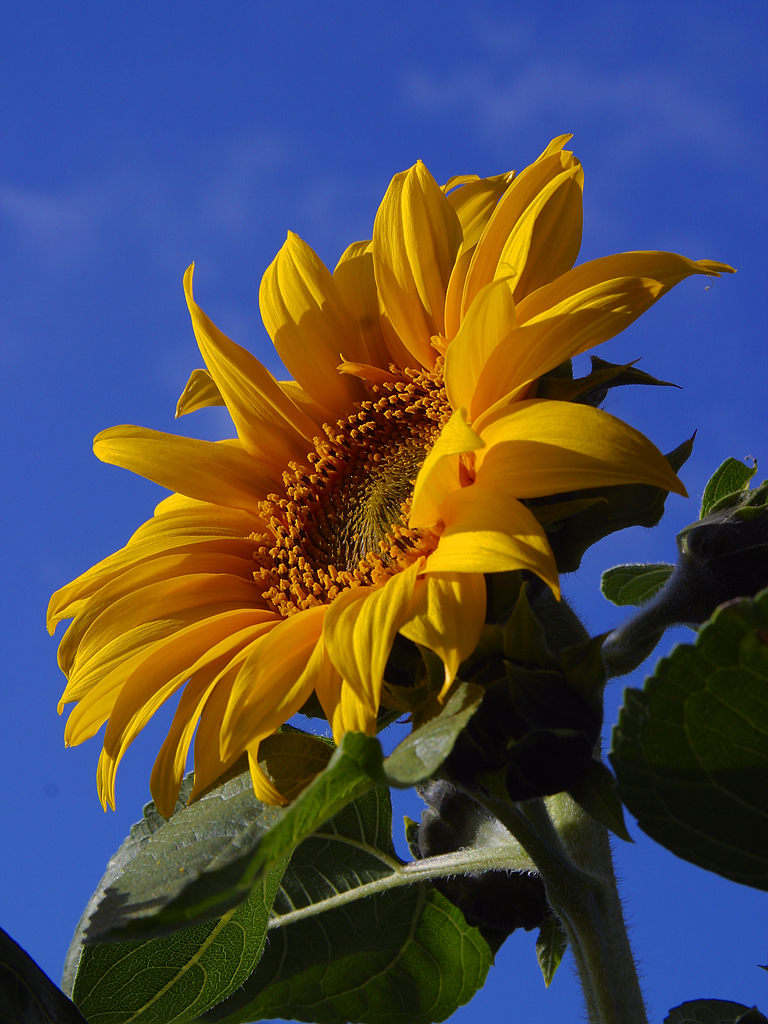 Common sunflowerHelianthus annuus
A tall annual plant grown for its large yellow flower heads and edible seeds
🇨🇦 Canada and 4 more · Wildflower
Common sunflowerHelianthus annuus
A tall annual plant grown for its large yellow flower heads and edible seeds
🇨🇦 Canada and 4 more · Wildflower
 PomegranatePunica granatum
A shrub with bright red flowers and a fruit full of edible seeds
🇮🇷 Iran and 9 more · Flowering shrub
PomegranatePunica granatum
A shrub with bright red flowers and a fruit full of edible seeds
🇮🇷 Iran and 9 more · Flowering shrub
 BirchBetula
Slender trees with papery bark found across the northern world
🇨🇳 China and 7 more · Wildflower
BirchBetula
Slender trees with papery bark found across the northern world
🇨🇳 China and 7 more · Wildflower