
Orange wild tulip
Tulipa orphanidea, family Liliaceae
A copper-red wild tulip from the Balkans and western Turkey
The orange wild tulip is a small bulb plant with star-like copper-red flowers, native to the Balkans, Greece, and western Turkey. It grows in forests and fields, blooms in spring, and is valued in gardens for its distinct colour forms.
- Native to Bulgaria, Greece, and western Turkey
- Blooms in spring with copper-red or yellow-red flowers
- Grows in pine forests, fields, and roadsides up to 1,700 m altitude
- Cultivated in gardens since the 1860s
- Several colour forms and groups are recognised
What does Orange wild tulip look like?
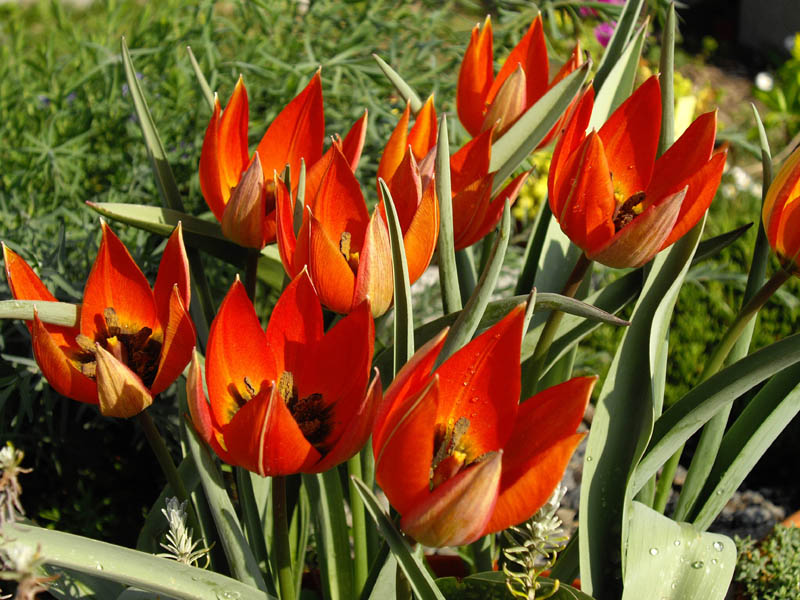
This tulip grows from a bulb and reaches about 10 to 20 cm tall. Its leaves are green, sometimes edged with red, and there can be two to seven per plant. Each stem carries up to four flowers, which are round to star-shaped. The petals are usually copper-red, but can also be yellow with red, and have a dark or yellow patch at the base. The stamens inside are a dark olive shade.
Where does Orange wild tulip come from?
Tulipa orphanidea grows wild in the southeastern Balkans, including Bulgaria and Greece, as well as the Aegean Islands, Crete, and western Turkey. It was first described in the 19th century by Boissier and Heldreich. The species is part of the Eriostemones subgenus and has a complex classification, with several forms and related species once grouped together.
When and how Orange wild tulip blooms
This tulip blooms in April and May. It is found in black pine woods, fields, and along roadsides, often at elevations up to 1,700 meters. In gardens, it is grown from bulbs, and several stable colour forms have been developed. Cultivar groups such as the Hageri Group and Whittallii Group are known among gardeners.

How Orange wild tulip is used
Gardeners have grown this tulip since the 1860s for its unique flower colours and forms. It is mainly used as an ornamental plant in gardens, where its spring blooms add colour. Different cultivated varieties are available for planting.
Kinds of Orange wild tulip
There are several named groups and cultivars, including the Hageri Group and Whittallii Group. These forms differ in flower colour and markings. Some related tulips were once considered separate species but are now often treated as forms of Tulipa orphanidea.
What Orange wild tulip means
The orange wild tulip is valued for its ornamental qualities and is grown in gardens for its spring flowers. Some cultivated forms have been recognised by horticultural societies. Its wild populations are part of the natural flora in the Balkans and western Turkey.
Questions people ask about Orange wild tulip
Where does the orange wild tulip come from?
It grows naturally in the southeastern Balkans, including Bulgaria and Greece, as well as in western Turkey, often in forests and fields.
What does Tulipa orphanidea look like?
It is a small bulb plant with green leaves, sometimes edged in red, and has 1 to 4 star-shaped flowers per stem. The flowers are mostly copper-red or yellow-red with a dark or yellow base patch.
When does this tulip bloom?
It flowers in spring, usually from April to May.
How is the orange wild tulip used?
It is mainly grown in gardens for its colourful spring blooms. Different cultivated forms are available for gardeners.
Are there different types of Tulipa orphanidea?
Yes, there are several groups and cultivars, such as the Hageri and Whittallii Groups, which show differences in flower colour and markings.
Good reading and sources
- Tulipa orphanidea Whittallii Group (15)Royal Horticultural Society, Article
- Plants of the World OnlineRoyal Botanic Gardens, Kew, Plant database
- Where it has been recordedGBIF, Plant database
- Sightings and photos by naturalistsiNaturalist, Plant database
- Tulipa orphanidea on WikipediaEncyclopedia
- More photos on Wikimedia CommonsPhotos
- Wikidata recordOpen data
The facts on this page come from the Wikipedia article "Tulipa orphanidea", written by its contributors and used under the CC BY-SA 4.0 licence, and from its Wikidata record (CC0). Phool rewrote the text in its own words, with AI assistance, and compares every page with the article to make sure no passage is copied. It may be reused under the same CC BY-SA 4.0 licence with a link back.
It may contain mistakes. It is not medical or foraging advice: many flowers are poisonous, and traditional uses are reported, not recommended. If something is wrong, tell us. Last refreshed 2026-10-03.
Others in the family Liliaceae
The whole family TulipTulipa
Spring-blooming bulbs with showy, cup-shaped flowers in many colours
🇳🇱 Netherlands and 7 more · Wildflower
TulipTulipa
Spring-blooming bulbs with showy, cup-shaped flowers in many colours
🇳🇱 Netherlands and 7 more · Wildflower
 LilyLilium
Tall bulb flowers with large, colourful blooms in many gardens and cultures
Lilium · Wildflower
LilyLilium
Tall bulb flowers with large, colourful blooms in many gardens and cultures
Lilium · Wildflower
 Lilium davidii
A tall Asian lily with edible bulbs and orange recurved flowers
🇨🇳 China and 1 more · Wildflower
Lilium davidii
A tall Asian lily with edible bulbs and orange recurved flowers
🇨🇳 China and 1 more · Wildflower
 Chinese LilyLilium brownii
A wild and cultivated lily from China with edible bulbs
🇨🇳 China and 3 more · Wildflower
Chinese LilyLilium brownii
A wild and cultivated lily from China with edible bulbs
🇨🇳 China and 3 more · Wildflower
More from Bulgaria
All the flowers of Bulgaria BlackthornPrunus spinosa
A spiny shrub with white spring flowers and tart blue-black fruit
🇬🇧 United Kingdom and 7 more · Wildflower
BlackthornPrunus spinosa
A spiny shrub with white spring flowers and tart blue-black fruit
🇬🇧 United Kingdom and 7 more · Wildflower
 Dog roseRosa canina
A wild climbing rose with pale pink flowers and bright red hips
🇮🇪 Ireland and 7 more · Wildflower
Dog roseRosa canina
A wild climbing rose with pale pink flowers and bright red hips
🇮🇪 Ireland and 7 more · Wildflower
 Horse-chestnutAesculus hippocastanum
A large flowering tree known for its white spring blooms and shiny brown conkers
🇦🇱 Albania and 7 more · Flowering tree
Horse-chestnutAesculus hippocastanum
A large flowering tree known for its white spring blooms and shiny brown conkers
🇦🇱 Albania and 7 more · Flowering tree
 EdelweissLeontopodium nivale
A woolly white star-shaped flower of the European mountains
🇦🇹 Austria and 5 more · Wildflower
EdelweissLeontopodium nivale
A woolly white star-shaped flower of the European mountains
🇦🇹 Austria and 5 more · Wildflower