
Purpletop vervain
Verbena bonariensis, family Verbenaceae
A tall South American perennial with clusters of purple flowers
Purpletop vervain is a tall, slender perennial from tropical South America, grown for its small purple flower clusters that attract butterflies and bees. It is often used in gardens for its airy appearance and long summer-to-fall bloom, but can spread easily and is considered invasive in some regions.
- Native to tropical South America, including Brazil and Argentina
- Produces clusters of purple flowers from summer to autumn
- Attracts butterflies and native bees to gardens
- Can become invasive in some regions due to self-seeding
- Grown as an annual or perennial depending on climate
What does Purpletop vervain look like?
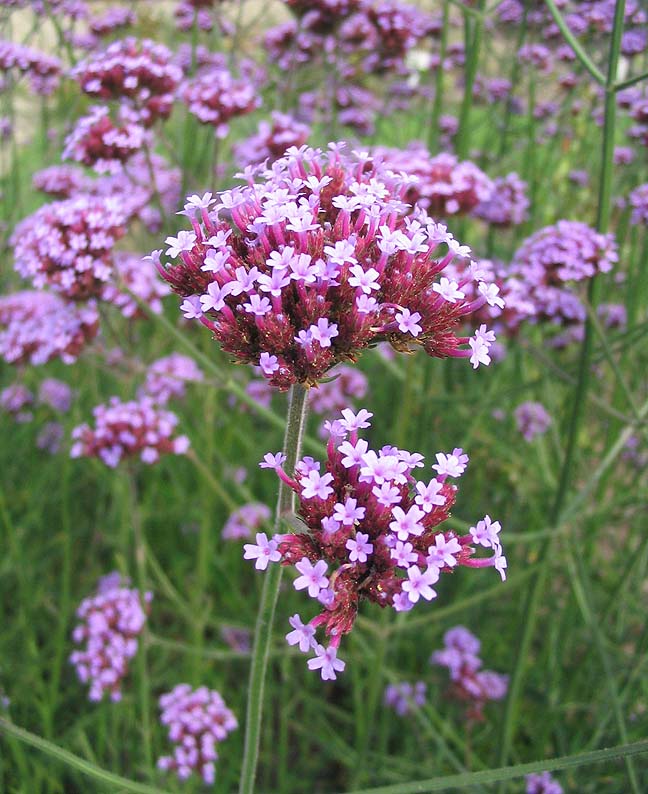
Purpletop vervain grows upright with thin, stiff stems that can reach up to 1.8 meters tall. Its leaves are narrow, with toothed edges, and can be up to 10 centimeters long. The plant forms small, fragrant clusters of lavender to rose-purple flowers at the tips and along the sides of its stems. These blooms appear from mid-summer until the first frost, giving the plant a light, open look in the garden.
Where does Purpletop vervain come from?
This species is native to the warm regions of South America, including Brazil, Argentina, Colombia, and Chile. It grows wild in open, sunny places. The name 'bonariensis' refers to Buenos Aires, meaning 'from Buenos Aires' in Latin. The genus name 'Verbena' comes from a Latin word for sacred branches, once used in rituals and medicine. Over time, purpletop vervain has spread widely through cultivation and naturalization.
When and how Purpletop vervain blooms
Purpletop vervain is usually grown from seed, which sprouts easily without special treatment. It thrives in well-drained soil and prefers full sun, but will tolerate some shade. The plant needs regular watering and is often grown as a perennial in mild climates, or as an annual where winters are cold. Its long stems allow it to mix well with other garden plants. It can also be propagated from stem cuttings.



How Purpletop vervain is used
Gardeners value purpletop vervain for its long-lasting flowers and ability to attract butterflies and bees. It is often planted in borders, pollinator gardens, and mixed beds. The plant's open structure lets it blend with other flowers without crowding them. Because it self-seeds, it can spread in suitable climates and is sometimes considered a weed or invasive, especially in parts of the United States, Australia, and the Pacific.
Kinds of Purpletop vervain
There are two recognized subspecies: Verbena bonariensis subsp. bonariensis and Verbena bonariensis subsp. conglomerata. The plant is sometimes confused with other vervains, especially Verbena brasiliensis, but they are distinct species. The flowers may vary slightly in color from lavender to rose-purple.
What Purpletop vervain means
Purpletop vervain is grown mainly for its ornamental value and its role in supporting pollinators. It is recognized as a reliable garden plant and has received formal recognition from horticultural societies. However, its ability to spread by seed has led to it being listed as a potential invasive species in several regions. The plant's name and history reflect its South American roots and its use in gardens worldwide.
Where Purpletop vervain is used and seen

Questions people ask about Purpletop vervain
Where does purpletop vervain come from?
Purpletop vervain is native to tropical regions of South America, especially Brazil, Argentina, Colombia, and Chile. It grows wild in sunny, open areas across these countries.
What does purpletop vervain look like?
It is a tall plant with thin, upright stems and narrow, toothed leaves. The flowers are small, lavender to rose-purple, and form tight clusters at the ends and sides of the stems.
How is purpletop vervain used?
Gardeners plant it for its long-lasting purple flowers and its ability to attract butterflies and bees. It is popular in borders and pollinator gardens, but can spread easily by seed.
Is purpletop vervain invasive?
Yes, in some areas it self-seeds readily and can become invasive, especially in parts of the United States, Australia, and Pacific islands. It is on watchlists for invasive species in several regions.
What does purpletop vervain symbolize?
The sources do not mention any specific symbolism for purpletop vervain.
Good reading and sources
- Verbena bonariensisRoyal Horticultural Society, Article
- Plants of the World OnlineRoyal Botanic Gardens, Kew, Plant database
- Where it has been recordedGBIF, Plant database
- Sightings and photos by naturalistsiNaturalist, Plant database
- Verbena bonariensis on WikipediaEncyclopedia
- More photos on Wikimedia CommonsPhotos
- Wikidata recordOpen data
The facts on this page come from the Wikipedia article "Verbena bonariensis", written by its contributors and used under the CC BY-SA 4.0 licence, and from its Wikidata record (CC0). Phool rewrote the text in its own words, with AI assistance, and compares every page with the article to make sure no passage is copied. It may be reused under the same CC BY-SA 4.0 licence with a link back.
It may contain mistakes. It is not medical or foraging advice: many flowers are poisonous, and traditional uses are reported, not recommended. If something is wrong, tell us. Last refreshed 2026-10-03.


More from China
All the flowers of China PeachPrunus persica
A flowering fruit tree from China, grown for its pink blossoms and sweet fruit
🇨🇳 China and 7 more · Flowering tree
PeachPrunus persica
A flowering fruit tree from China, grown for its pink blossoms and sweet fruit
🇨🇳 China and 7 more · Flowering tree
 Common sunflowerHelianthus annuus
A tall annual plant grown for its large yellow flower heads and edible seeds
🇨🇦 Canada and 4 more · Wildflower
Common sunflowerHelianthus annuus
A tall annual plant grown for its large yellow flower heads and edible seeds
🇨🇦 Canada and 4 more · Wildflower
 PomegranatePunica granatum
A shrub with bright red flowers and a fruit full of edible seeds
🇮🇷 Iran and 9 more · Flowering shrub
PomegranatePunica granatum
A shrub with bright red flowers and a fruit full of edible seeds
🇮🇷 Iran and 9 more · Flowering shrub
 BirchBetula
Slender trees with papery bark found across the northern world
🇨🇳 China and 7 more · Wildflower
BirchBetula
Slender trees with papery bark found across the northern world
🇨🇳 China and 7 more · Wildflower