
San Pedro Cactus
Echinopsis pachanoi, family Cactaceae
A tall, night-blooming cactus from the Andes with white, fragrant flowers
San Pedro Cactus is a fast-growing columnar cactus native to the Andes of Ecuador and Peru, now also found in Bolivia, Colombia, Chile, and beyond. It grows tall with green stems and produces large, fragrant white flowers at night. Traditionally, it is used in Andean medicine and spiritual rituals, and is widely grown as an ornamental plant.
- Native to the Andes of Ecuador and Peru, found up to 3,000 meters high
- Produces large, white, fragrant flowers that bloom at night
- Used for over 2,000 years in Andean healing and spiritual rituals
- Contains mescaline and other alkaloids with psychoactive effects
- Widely grown as an ornamental cactus and for living fences
What does San Pedro Cactus look like?
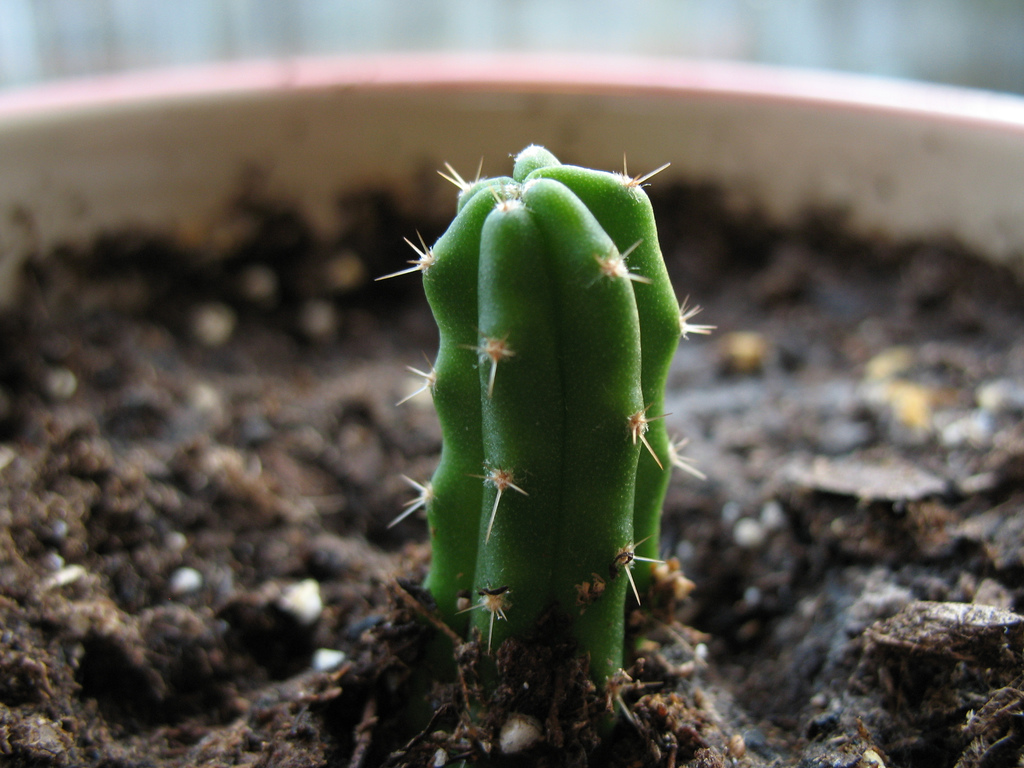
San Pedro Cactus is a tall, branching cactus with light to dark green stems that can reach 3–6 meters high, sometimes up to 12 meters. The stems are ribbed, usually with 6–8 ribs, and have whitish areoles that may carry up to seven short yellow to brown spines, though cultivated plants are often nearly spineless. Its large, white, highly fragrant flowers open at night and can be up to 24 cm long and 20 cm across. After flowering, it produces oblong dark green fruits filled with small seeds.
Where does San Pedro Cactus come from?
Echinopsis pachanoi grows wild in the Andes at elevations between 2,000 and 3,000 meters, especially in Ecuador and Peru. It has spread to Bolivia, Colombia, Chile, and parts of Spain and the Canary Islands, and is now cultivated in many countries. The species was first described scientifically in 1920 as Trichocereus pachanoi, and has since been reclassified under Echinopsis. Archaeological evidence shows its ritual use in the Andes goes back over 2,000 years, including by the Moche, Nazca, and Chavín cultures.
When and how San Pedro Cactus blooms
The cactus blooms at night, with flowers lasting about two days and opening over several weeks on mature plants. It thrives in fertile, well-drained soil and can grow up to 30 cm per year. It tolerates cold for short periods if kept dry, and is hardy in mild climates. Propagation is usually by cuttings, which root easily, or from seed sown in humid containers. In some places, it is planted close together as a living fence or for home protection.


How San Pedro Cactus is used
San Pedro Cactus has a long tradition in Andean healing and spiritual practices. In Peru and neighboring countries, shamans prepare a bitter drink from the cactus for ceremonies aimed at healing, diagnosis, and spiritual connection. It is also used in traditional veterinary medicine. The cactus is popular as an ornamental plant for its appearance and ease of cultivation. In Peru, planting it by the entrance of a house is thought to offer protection.
Kinds of San Pedro Cactus
Several named cultivars of San Pedro Cactus are prized by collectors, such as Ogunbodede, Vilcabamba A, and Yowie. Related species like Echinopsis lageniformis are also cultivated and sometimes grafted for faster growth. Cultivated forms often have fewer spines and may be nearly spineless compared to wild plants.
What San Pedro Cactus means
San Pedro Cactus is deeply woven into Andean culture, especially in Peru, where its ceremonial use was declared cultural heritage in 2022. The name 'San Pedro' reflects a blend of Indigenous and Christian traditions, symbolizing spiritual access. Its use in shamanic rituals is linked to visions, healing, and connection with nature and ancestors. The cactus is also recognized for its psychoactive properties due to mescaline.
Questions people ask about San Pedro Cactus
Where does the San Pedro Cactus come from?
San Pedro Cactus is native to the Andes Mountains of Ecuador and Peru, and is also found in Bolivia, Colombia, and Chile. It grows at high altitudes between 2,000 and 3,000 meters.
What does the San Pedro Cactus look like?
It is a tall, columnar cactus with green ribbed stems, usually with few or no spines. It produces large, white, fragrant flowers that open at night and can reach up to 24 cm in length.
How is the San Pedro Cactus used in traditional culture?
In the Andes, the cactus is used in healing and spiritual ceremonies. Shamans prepare a drink from it for rituals aimed at diagnosis, cleansing, and connecting with spirits or ancestors.
Why is it called San Pedro?
The name 'San Pedro' refers to Saint Peter, reflecting a blend of Indigenous and Christian beliefs. It is said to symbolize spiritual access, as Saint Peter holds the keys to heaven.
Is the San Pedro Cactus grown outside its native region?
Yes, it is widely grown as an ornamental plant in many countries, including Spain and the Canary Islands, and is cultivated in gardens and as living fences.
Good reading and sources
- IUCN Red List of Threatened SpeciesIUCN Red List, Article
- Plants of the World OnlineRoyal Botanic Gardens, Kew, Plant database
- Where it has been recordedGBIF, Plant database
- Sightings and photos by naturalistsiNaturalist, Plant database
- Echinopsis pachanoi on WikipediaEncyclopedia
- More photos on Wikimedia CommonsPhotos
- Wikidata recordOpen data
The facts on this page come from the Wikipedia article "Echinopsis pachanoi", written by its contributors and used under the CC BY-SA 4.0 licence, and from its Wikidata record (CC0). Phool rewrote the text in its own words, with AI assistance, and compares every page with the article to make sure no passage is copied. It may be reused under the same CC BY-SA 4.0 licence with a link back.
It may contain mistakes. It is not medical or foraging advice: many flowers are poisonous, and traditional uses are reported, not recommended. If something is wrong, tell us. Last refreshed 2026-10-03.
Others in the family Cactaceae
The whole family Prickly pearOpuntia
Cactus with flat pads and edible fruit, native to the Americas
🇲🇽 Mexico and 7 more · Wildflower
Indian fig opuntiaOpuntia ficus-indica
A large, spiny cactus grown for its sweet fruit and edible pads
🇲🇽 Mexico and 7 more · Wildflower
Prickly pearOpuntia
Cactus with flat pads and edible fruit, native to the Americas
🇲🇽 Mexico and 7 more · Wildflower
Indian fig opuntiaOpuntia ficus-indica
A large, spiny cactus grown for its sweet fruit and edible pads
🇲🇽 Mexico and 7 more · Wildflower
 Mammillaria
A diverse group of small, rounded cacti with funnel-shaped flowers
🇲🇽 Mexico and 5 more · Wildflower
Mammillaria
A diverse group of small, rounded cacti with funnel-shaped flowers
🇲🇽 Mexico and 5 more · Wildflower
 Disocactus ackermannii
A scarlet-flowered epiphytic cactus from southern Mexico's cloud forests
🇲🇽 Mexico and 1 more · Wildflower
Disocactus ackermannii
A scarlet-flowered epiphytic cactus from southern Mexico's cloud forests
🇲🇽 Mexico and 1 more · Wildflower
More from Peru
All the flowers of Peru CactusCactaceae
Succulent plants with spines, native to the Americas
🇲🇽 Mexico and 7 more · Wildflower
CactusCactaceae
Succulent plants with spines, native to the Americas
🇲🇽 Mexico and 7 more · Wildflower
 Thorn-appleDatura stramonium
A poisonous, night-blooming plant with trumpet-shaped white or violet flowers
🇨🇳 China and 7 more · Wildflower
Thorn-appleDatura stramonium
A poisonous, night-blooming plant with trumpet-shaped white or violet flowers
🇨🇳 China and 7 more · Wildflower
 PoinsettiaEuphorbia pulcherrima
The red-bracted shrub of Christmas displays, native to Mexico and Central America
🇲🇽 Mexico and 8 more · Wildflower
PoinsettiaEuphorbia pulcherrima
The red-bracted shrub of Christmas displays, native to Mexico and Central America
🇲🇽 Mexico and 8 more · Wildflower
 MarigoldTagetes
A group of bright annual and perennial flowers known worldwide as marigolds
🇲🇽 Mexico and 7 more · Wildflower
MarigoldTagetes
A group of bright annual and perennial flowers known worldwide as marigolds
🇲🇽 Mexico and 7 more · Wildflower