
Asian fawn lily
Erythronium japonicum, family Liliaceae
In its own language: 片栗
A pink spring lily of East Asian woodlands, known as katakuri in Japan
Asian fawn lily is a spring-flowering plant with solitary rose-pink blooms and broad leaves. Native to Japan, Korea, northeastern China, and the Russian Far East, it grows in woodlands and is slow to mature, often taking 7–8 years to flower. Its bulbs once provided a prized starch, now mostly replaced by potato starch.
- Blooms in woodlands from April to June
- Rose-pink flowers appear singly on slender stems
- Native to Japan, Korea, China, and the Russian Far East
- Bulb once used for prized starch, now mostly replaced by potato
- Some Japanese regions list it as near threatened or vulnerable
What does Asian fawn lily look like?
Asian fawn lily is a woodland plant with a single, rose-pink flower on a slender stem up to 20 cm tall. Its leaves are broad, elliptical to lance-shaped, and can reach 12 cm in length. The bulb is narrow and elongated, rarely more than 1 cm wide. Flowers appear singly and stand out for their delicate pink color. Some plants may show flecked markings on the leaves, but this is not always present.
Where does Asian fawn lily come from?
This species is native to woodlands in Japan, Korea, northeastern China, and the Russian Far East, including Sakhalin and the Kuril Islands. It thrives in moist, shaded forest floors. The plant has been known and named in local cultures for centuries, with traditional names such as katakuri in Japanese, zhūyáhuā in Chinese, and eolleji in Korean. Its spread is limited, as it is not farmed and grows slowly from seed or bulb.
When and how Asian fawn lily blooms
Asian fawn lily blooms in spring, from April to June, when it sends up a single flower after 7–8 years of growth. It prefers woodland soils and shaded conditions. The plant is not cultivated on a large scale and is mostly found in the wild. Reproduction is slow, and colonies can be wiped out by overharvesting or poaching.


How Asian fawn lily is used
Historically, the bulb was used to make katakuri powder, a starch once valued in Japanese cooking, but now rare due to low yield; potato starch is now used instead. The plant powder was also applied as an ointment for rashes. It is not widely farmed and is sometimes collected by wildflower enthusiasts. Its use in traditional sweets is mostly a misconception.
Kinds of Asian fawn lily
The sources do not describe notable varieties or cultivars of Erythronium japonicum, but note that leaf markings can vary, with some plants lacking the characteristic flecked pattern seen in related species.
What Asian fawn lily means
In Japan, the plant is called katakuri and is associated with spring woodland scenes. Its conservation status is debated: some regions list it as near threatened or vulnerable, while national assessments are lacking. Overharvesting and slow growth make wild colonies fragile, and some have disappeared after media attention. It is featured in certain parks and gardens, such as Shimizuyama-ikoi-no-mori in Tokyo.
Where Asian fawn lily is used and seen

Questions people ask about Asian fawn lily
Where does Asian fawn lily come from?
Asian fawn lily is native to woodlands in Japan, Korea, northeastern China, and the Russian Far East, including Sakhalin and the Kuril Islands.
What does the Asian fawn lily look like?
It has a single rose-pink flower on a slender stem up to 20 cm tall, with broad, elliptical leaves. The bulb is elongated and narrow. Some plants may have flecked markings on the leaves.
What is katakuri powder?
Katakuri powder originally referred to starch made from the bulb of Asian fawn lily. Due to the small amount produced, potato starch is now used instead, though it still carries the same name.
Is Asian fawn lily endangered?
Its conservation status varies by region. Some Japanese prefectures list it as near threatened or vulnerable, but there is no national assessment for the whole species.
What is the cultural significance of Asian fawn lily in Japan?
Known as katakuri, it is associated with spring and woodland scenery. Its starch was once valued, and it appears in some parks and gardens. Overharvesting has made some wild colonies rare or extinct.
Good reading and sources
- Plants of the World OnlineRoyal Botanic Gardens, Kew, Plant database
- Where it has been recordedGBIF, Plant database
- Sightings and photos by naturalistsiNaturalist, Plant database
- Erythronium japonicum on WikipediaEncyclopedia
- More photos on Wikimedia CommonsPhotos
- Wikidata recordOpen data
The facts on this page come from the Wikipedia article "Erythronium japonicum", written by its contributors and used under the CC BY-SA 4.0 licence, and from its Wikidata record (CC0). Phool rewrote the text in its own words, with AI assistance, and compares every page with the article to make sure no passage is copied. It may be reused under the same CC BY-SA 4.0 licence with a link back.
It may contain mistakes. It is not medical or foraging advice: many flowers are poisonous, and traditional uses are reported, not recommended. If something is wrong, tell us. Last refreshed 2026-10-03.
Others in the family Liliaceae
The whole family TulipTulipa
Spring-blooming bulbs with showy, cup-shaped flowers in many colours
🇳🇱 Netherlands and 7 more · Wildflower
TulipTulipa
Spring-blooming bulbs with showy, cup-shaped flowers in many colours
🇳🇱 Netherlands and 7 more · Wildflower
 LilyLilium
Tall bulb flowers with large, colourful blooms in many gardens and cultures
Lilium · Wildflower
LilyLilium
Tall bulb flowers with large, colourful blooms in many gardens and cultures
Lilium · Wildflower
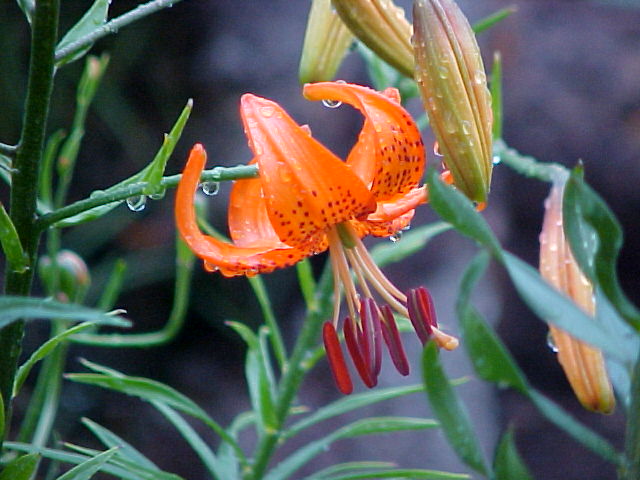 Lilium davidii
A tall Asian lily with edible bulbs and orange recurved flowers
🇨🇳 China and 1 more · Wildflower
Lilium davidii
A tall Asian lily with edible bulbs and orange recurved flowers
🇨🇳 China and 1 more · Wildflower
 Chinese LilyLilium brownii
A wild and cultivated lily from China with edible bulbs
🇨🇳 China and 3 more · Wildflower
Chinese LilyLilium brownii
A wild and cultivated lily from China with edible bulbs
🇨🇳 China and 3 more · Wildflower
More from Japan
All the flowers of Japan BirchBetula
Slender trees with papery bark found across the northern world
🇨🇳 China and 7 more · Wildflower
BirchBetula
Slender trees with papery bark found across the northern world
🇨🇳 China and 7 more · Wildflower
 Chrysanthemum菊花
Autumn-blooming flower with thousands of varieties, cherished in East Asia and beyond
🇨🇳 China and 6 more · Wildflower
Chrysanthemum菊花
Autumn-blooming flower with thousands of varieties, cherished in East Asia and beyond
🇨🇳 China and 6 more · Wildflower
 Wild cherryPrunus avium
A tall flowering tree native to Europe, grown for its sweet fruit and spring blossom
🇮🇹 Italy and 6 more · Flowering tree
Wild cherryPrunus avium
A tall flowering tree native to Europe, grown for its sweet fruit and spring blossom
🇮🇹 Italy and 6 more · Flowering tree
 LindenTilia
Tall, broad-leaved trees with fragrant yellow flowers and heart-shaped leaves
🇨🇳 China and 7 more · Flowering tree
LindenTilia
Tall, broad-leaved trees with fragrant yellow flowers and heart-shaped leaves
🇨🇳 China and 7 more · Flowering tree