
Yellow gum
Eucalyptus leucoxylon, family Myrtaceae
A eucalypt with smooth bark and white, pink or red flowers
Yellow gum is a small to medium-sized eucalypt tree native to south-eastern Australia. It bears clusters of white, pink or red flowers and has smooth yellowish or grey bark, often with rough bark at the base.
- Flowers can be white, pink or red
- Forms a lignotuber at the base
- Leaves used for eucalyptus oil production
- Six subspecies recognised across south-eastern Australia
- 'Euky Dwarf' is a compact garden form
What does Yellow gum look like?
Yellow gum grows 10 to 30 metres tall and forms a lignotuber at its base. Its bark is mostly smooth in white, yellow or bluish-grey tones, with rough fibrous patches near the trunk’s foot. Adult leaves are lance-shaped, glossy green on both sides, and taper to a short stalk. Flowers appear in threes, opening to white, pink or red blooms. The fruit is a woody capsule, cylindrical to nearly round.
Where does Yellow gum come from?
This species is found only in south-eastern mainland Australia. It was first described in 1855 by Ferdinand von Mueller. The name combines Greek words for 'white' and 'wood'. Six subspecies are recognised, each adapted to different local soils and climates across Victoria, South Australia and far western New South Wales.
When and how Yellow gum blooms
Yellow gum flowers in most months of the year. It grows in varied habitats, from coastal zones to inland ranges. Some forms thrive on skeletal soils, others in drier plains. In cultivation, selected types like 'Rosea' and 'Euky Dwarf' are planted in gardens and streets for their compact size and showy winter blooms.


How Yellow gum is used
The leaves yield cineole-rich eucalyptus oil when distilled. Certain subspecies are valued as ornamental trees in parks and home gardens, especially where space is limited. 'Euky Dwarf' reaches just 5–6 metres and is used in urban landscaping.
Kinds of Yellow gum
Subspecies include bellarinensis, known only from the Bellarine Peninsula, and connata, which grows in the Brisbane Ranges with fused juvenile leaves. Subspecies pruinosa has waxy foliage and white flowers, while megalocarpa, sold as 'Rosea', has broad leaves, red flowers and large fruit.
What Yellow gum means
Though not tied to specific festivals or faiths, yellow gum is appreciated in Australian horticulture. Its oil has traditional uses, and its hard wood gives it the name 'white ironbark'. Some subspecies are restricted to small geographic areas, making them of conservation interest.
Where Yellow gum is used and seen
 Essential oilFragrant plant oils used for scent, flavour, and traditional remedies
 Domaine du RayolA botanical garden by the sea in southern France with plants from five continents
 Sir Seewoosagur Ramgoolam Botanical GardenA historic garden in Mauritius known for giant water lilies and rare palms
 Flower gardenA garden space planted and arranged for flowering plants and seasonal blooms
 Batumi Botanical GardenA vast Black Sea garden with plants from around the world and sweeping sea views
Questions people ask about Yellow gum
Where does yellow gum come from?
It is native to south-eastern continental Australia, including parts of Victoria, South Australia and far western New South Wales.
What colour are its flowers?
The flowers are white, pink or red, appearing in groups of three throughout most months of the year.
Is it used for anything?
Its leaves are distilled to make eucalyptus oil, and some forms are planted as ornamental trees in gardens and streets.
How big does it grow?
In the wild it reaches 10–30 metres, but cultivated varieties like 'Euky Dwarf' stay under 6 metres tall.
Are there different kinds?
Yes, six subspecies are accepted, differing in leaf shape, flower bud form, fruit size and wax presence.
Good reading and sources
- IUCN Red List of Threatened SpeciesIUCN Red List, Article
- USDA Plants DatabaseUS Department of Agriculture, Article
- Plants of the World OnlineRoyal Botanic Gardens, Kew, Plant database
- Where it has been recordedGBIF, Plant database
- Sightings and photos by naturalistsiNaturalist, Plant database
- Eucalyptus leucoxylon on WikipediaEncyclopedia
- More photos on Wikimedia CommonsPhotos
- Wikidata recordOpen data
The facts on this page come from the Wikipedia article "Eucalyptus leucoxylon", written by its contributors and used under the CC BY-SA 4.0 licence, and from its Wikidata record (CC0). Phool rewrote the text in its own words, with AI assistance, and compares every page with the article to make sure no passage is copied. It may be reused under the same CC BY-SA 4.0 licence with a link back.
It may contain mistakes. It is not medical or foraging advice: many flowers are poisonous, and traditional uses are reported, not recommended. If something is wrong, tell us. Last refreshed 2026-10-03.
Others in the family Myrtaceae
The whole family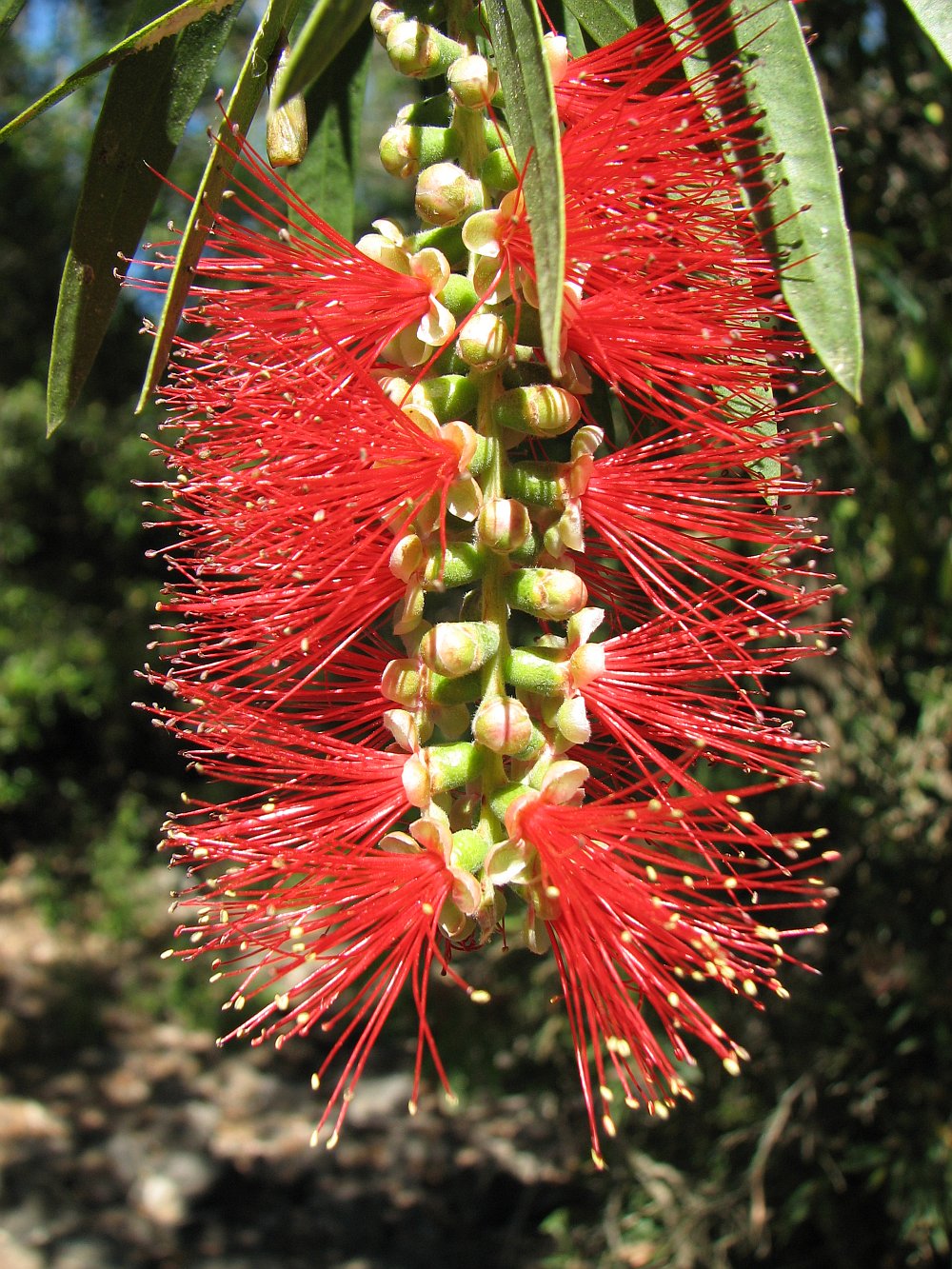 BottlebrushCallistemon
Shrubs with brush-shaped flowers native to Australia
🇦🇺 Australia · Flowering shrub
BottlebrushCallistemon
Shrubs with brush-shaped flowers native to Australia
🇦🇺 Australia · Flowering shrub
 Darwinia
Australian shrubs with bell-like flowers wrapped in colourful bracts
🇦🇺 Australia · Flowering shrub
Darwinia
Australian shrubs with bell-like flowers wrapped in colourful bracts
🇦🇺 Australia · Flowering shrub
 Common red bottlebrushMelaleuca citrina
A hardy Australian shrub with bright red brush-like flowers
🇦🇺 Australia · Flowering shrub
Common red bottlebrushMelaleuca citrina
A hardy Australian shrub with bright red brush-like flowers
🇦🇺 Australia · Flowering shrub
 Weeping bottlebrushMelaleuca viminalis
A red-flowered Australian tree with weeping branches and bottlebrush blooms
🇦🇺 Australia and 5 more · Flowering tree
Weeping bottlebrushMelaleuca viminalis
A red-flowered Australian tree with weeping branches and bottlebrush blooms
🇦🇺 Australia and 5 more · Flowering tree
More from Australia
All the flowers of Australia AlmondPrunus amygdalus
A Mediterranean tree grown for its fragrant spring flowers and edible seeds
🇮🇷 Iran and 6 more · Flowering tree
AlmondPrunus amygdalus
A Mediterranean tree grown for its fragrant spring flowers and edible seeds
🇮🇷 Iran and 6 more · Flowering tree
 FennelFoeniculum vulgare
A tall, aromatic herb with feathery leaves and yellow umbels, used for food and spice
🇨🇳 China and 7 more · Herb or useful flower
FennelFoeniculum vulgare
A tall, aromatic herb with feathery leaves and yellow umbels, used for food and spice
🇨🇳 China and 7 more · Herb or useful flower
 RosemarySalvia rosmarinus
A fragrant evergreen shrub with needle-like leaves and purple, blue, or white flowers
🇪🇸 Spain and 5 more · Flowering shrub
RosemarySalvia rosmarinus
A fragrant evergreen shrub with needle-like leaves and purple, blue, or white flowers
🇪🇸 Spain and 5 more · Flowering shrub
 Eucalyptus
The tall, aromatic trees and shrubs known as gum trees or eucalypts
🇦🇺 Australia and 7 more · Flowering tree
Eucalyptus
The tall, aromatic trees and shrubs known as gum trees or eucalypts
🇦🇺 Australia and 7 more · Flowering tree