
Dame's-violet
Hesperis matronalis, family Brassicaceae
A tall, fragrant flower with purple, pink, or white blooms in spring
Dame's-violet is a tall, leafy plant with clusters of scented flowers that bloom in spring. Native to parts of Eurasia, it is now grown in gardens and has spread to many temperate regions. Its flowers come in shades of purple, pink, or white, and are often used for their color and fragrance.
- Blooms have a strong scent, especially in the evening
- Flowers come in purple, pink, white, and mixed colors
- Leaves and shoots can be eaten raw or cooked
- Introduced to North America in the 17th century
- Considered invasive in several US states and in Alberta, Canada
What does Dame's-violet look like?
Dame's-violet grows upright, reaching about a meter or more in height, with several hairy stems. Its leaves are long, narrow, and toothed, covered in fine hairs that make them feel rough. The plant produces large, four-petaled flowers in loose clusters at the top of the stems. Most flowers are purple or lavender, but pink, white, and mixed colors are also seen, especially in cultivated varieties. The blooms have a strong scent, especially in the evening.
Where does Dame's-violet come from?
This plant comes from Eurasia, with its wild range stretching from Spain and Turkey to Xinjiang. It has been cultivated for many years and was named by Carl Linnaeus in 1753. Over time, it has been introduced to gardens in many temperate regions. In North America, it was brought over in the 1600s and has since spread widely, sometimes escaping gardens and growing in the wild.
When and how Dame's-violet blooms
Dame's-violet usually grows as a biennial, forming a mound of leaves in the first year and flowering in the second. It prefers moist, well-drained soil and can grow in sun or partial shade. The plant self-seeds easily, forming dense patches. Gardeners can also grow it from cuttings or by dividing clumps, especially for double-flowered forms.


How Dame's-violet is used
People grow dame's-violet for its colorful, fragrant flowers, which are enjoyed in gardens and sometimes picked for decoration. The young leaves and shoots can be eaten raw or cooked, and the flowers add a spicy taste and color to salads. In some places, it is considered a weed because it spreads quickly and can crowd out native plants.
Kinds of Dame's-violet
There are several named forms, including double-flowered types and varieties with different flower colors. Some cultivated plants have blooms that mix more than one color. The plant is sometimes confused with phlox, but can be told apart by its four petals and alternate leaves.
What Dame's-violet means
The name 'dame's-violet' and its many other names reflect its long history in gardens and language. The scent, strongest at dusk, inspired names like 'mother-of-the-evening.' In Europe, its leaves feed the caterpillars of some butterflies and moths. In parts of North America and Canada, it is listed as a noxious or invasive weed.
Questions people ask about Dame's-violet
Where does dame's-violet come from?
Dame's-violet is originally from Eurasia, with its wild range including parts of Spain, Turkey, and Xinjiang. It has since been introduced to many other temperate regions.
What does dame's-violet look like?
It is a tall plant with hairy stems and long, toothed leaves. The flowers are large, four-petaled, and appear in clusters, most often in shades of purple, but also pink, white, or mixed.
Why is it called dame's-violet?
The name comes from old English and French names that referred to its scent and sometimes to the city of Damascus. Many other names, like 'sweet rocket' and 'mother-of-the-evening,' reflect its fragrance and history.
Is dame's-violet edible?
Yes, the young leaves, shoots, flower buds, and flowers can be eaten. They are used in salads or cooked, and the leaves are high in vitamin C.
Is dame's-violet considered invasive?
In some regions, especially parts of North America and Canada, it is listed as a noxious or invasive weed because it spreads easily and can crowd out native plants.
Good reading and sources
- Encyclopaedia BritannicaArticle
- USDA Plants DatabaseUS Department of Agriculture, Article
- Hesperis matronalisRoyal Horticultural Society, Article
- Plants of the World OnlineRoyal Botanic Gardens, Kew, Plant database
- Where it has been recordedGBIF, Plant database
- Sightings and photos by naturalistsiNaturalist, Plant database
- Hesperis matronalis on WikipediaEncyclopedia
- More photos on Wikimedia CommonsPhotos
- Wikidata recordOpen data
The facts on this page come from the Wikipedia article "Hesperis matronalis", written by its contributors and used under the CC BY-SA 4.0 licence, and from its Wikidata record (CC0). Phool rewrote the text in its own words, with AI assistance, and compares every page with the article to make sure no passage is copied. It may be reused under the same CC BY-SA 4.0 licence with a link back.
It may contain mistakes. It is not medical or foraging advice: many flowers are poisonous, and traditional uses are reported, not recommended. If something is wrong, tell us. Last refreshed 2026-10-03.
Others in the family Brassicaceae
The whole family RapeseedBrassica napus
A yellow-flowered crop grown for its oil-rich seeds and protein meal
🇨🇳 China and 7 more · Wildflower
RapeseedBrassica napus
A yellow-flowered crop grown for its oil-rich seeds and protein meal
🇨🇳 China and 7 more · Wildflower
 Brown mustardBrassica juncea
A leafy mustard plant grown for greens, seeds, and oil across Asia and beyond
🇨🇳 China and 7 more · Wildflower
Brown mustardBrassica juncea
A leafy mustard plant grown for greens, seeds, and oil across Asia and beyond
🇨🇳 China and 7 more · Wildflower
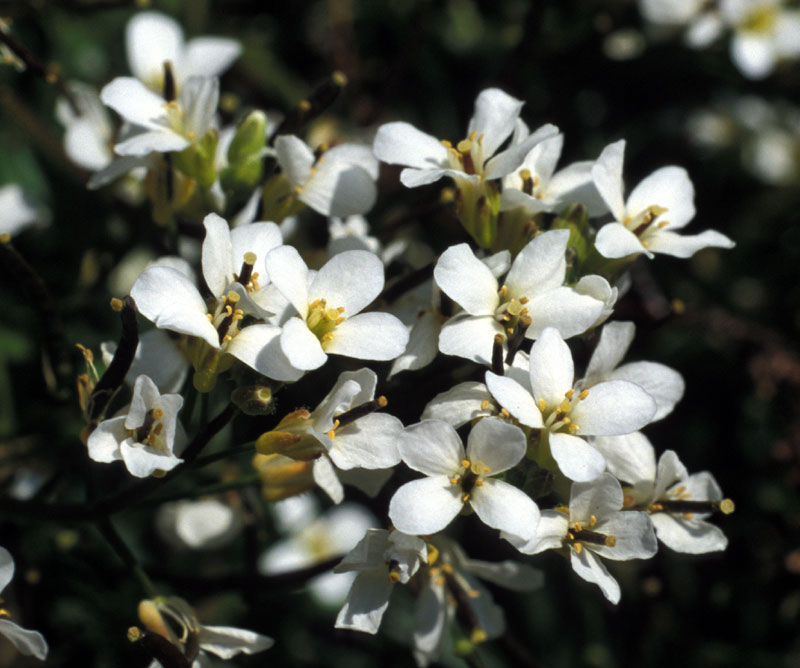 Whitlow grassDraba
A large group of small flowering plants, not true grasses
Draba · Wildflower
Whitlow grassDraba
A large group of small flowering plants, not true grasses
Draba · Wildflower
 Sea kaleCrambe maritima
Salt-loving coastal plant with edible white-flowered shoots
🇬🇧 United Kingdom and 7 more · Wildflower
Sea kaleCrambe maritima
Salt-loving coastal plant with edible white-flowered shoots
🇬🇧 United Kingdom and 7 more · Wildflower
More from Spain
All the flowers of Spain PeachPrunus persica
A flowering fruit tree from China, grown for its pink blossoms and sweet fruit
🇨🇳 China and 7 more · Flowering tree
PeachPrunus persica
A flowering fruit tree from China, grown for its pink blossoms and sweet fruit
🇨🇳 China and 7 more · Flowering tree
 AlmondPrunus amygdalus
A Mediterranean tree grown for its fragrant spring flowers and edible seeds
🇮🇷 Iran and 6 more · Flowering tree
AlmondPrunus amygdalus
A Mediterranean tree grown for its fragrant spring flowers and edible seeds
🇮🇷 Iran and 6 more · Flowering tree
 ApricotPrunus armeniaca
A small fruit tree with early white to pink blossoms and golden-orange fruit
🇨🇳 China and 6 more · Flowering tree
ApricotPrunus armeniaca
A small fruit tree with early white to pink blossoms and golden-orange fruit
🇨🇳 China and 6 more · Flowering tree
 RosemarySalvia rosmarinus
A fragrant evergreen shrub with needle-like leaves and purple, blue, or white flowers
🇪🇸 Spain and 5 more · Flowering shrub
RosemarySalvia rosmarinus
A fragrant evergreen shrub with needle-like leaves and purple, blue, or white flowers
🇪🇸 Spain and 5 more · Flowering shrub