
Impatiens
A large genus of flowering herbs known for their explosive seed pods and colorful blooms
Impatiens is a genus of over 1,000 flowering plant species found across the Northern Hemisphere and tropical regions. Most are herbaceous annuals or perennials with succulent stems, zygomorphic flowers, and seed capsules that burst open when touched, flinging seeds several meters away.
- Seed capsules explode when touched, scattering seeds meters away
- Over 1,000 species, mostly in tropical and subtropical mountains
- Used in traditional remedies for poison ivy and insect stings
- Contains lawsone, a dye also found in henna
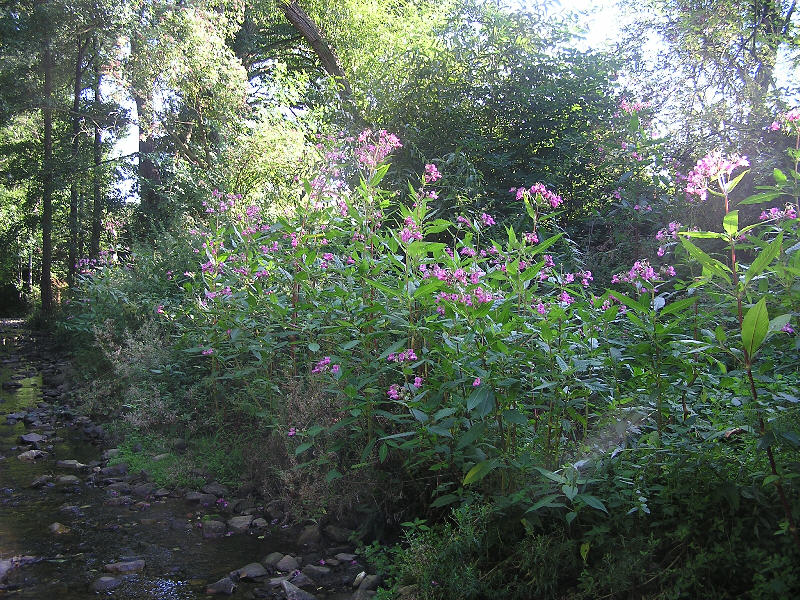
- Himalayan balsam is a problematic invasive weed in Europe
What does Impatiens look like?
Impatiens plants range from five centimeters to 2.5 meters tall. They have succulent stems that root where they touch soil and leaves that often shimmer silver underwater due to trapped air bubbles. Their flowers are irregularly shaped, with five petals, two pairs fused, and a nectar-producing spur on one sepal. Some Madagascan species lack this spur entirely.
Where does Impatiens come from?
The genus occurs naturally across Africa, Eurasia, and North America, with two species in Central America. Its greatest diversity lies in mountain forests of the tropics and subtropics, especially in Madagascar, the Himalayas, and India’s Western Ghats. Only one species, Impatiens noli-tangere, is native to Europe.
When and how Impatiens blooms
Most species grow as perennials in shaded, moist forest areas near streams or edges. Some temperate and Himalayan types are annuals. When light or nutrients are scarce, certain species produce closed, self-pollinating flowers instead of open ones. A few southeast Asian kinds grow as shrubs up to three meters high.



How Impatiens is used
People grow many impatiens as garden ornamentals, especially hybrids of I. walleriana and I. hawkeri. In traditional use, North American jewelweeds treat skin irritations from stings or poison ivy, though study results vary. The flowers yield lawsone, used historically in China as pink nail dye when mixed with alum and other petals.
Kinds of Impatiens
Flower forms fall into three main types: those with a sac-like spur and two-lipped bloom, those with a thread-like spur and flat face, and a group of 125 spur-less species from Madagascar. Pollination strategies differ widely, involving bees, butterflies, moths, flies, or sunbirds depending on the flower shape.
What Impatiens means
The name 'Impatiens' means 'impatient' in Latin, referencing how seed pods burst at a touch. Some species, like Himalayan balsam, are aggressive invaders in Europe, crowding out native plants and weakening riverbanks. Despite containing anti-inflammatory compounds, all parts taste bitter and can cause vomiting if eaten.
Where Impatiens is used and seen


Traditions that use it
Where to see Impatiens


Questions people ask about Impatiens
Where does impatiens come from?
Impatiens species are native to Africa, Eurasia, and North America, with the highest diversity in tropical and subtropical mountain forests of Madagascar, the Himalayas, and southwest India.
Why is it called 'touch-me-not'?
Its mature seed pods burst open explosively when touched, flinging seeds several meters away, hence the name 'touch-me-not' and the Latin genus name 'Impatiens', meaning impatient.
Are impatiens used in medicine?
North American jewelweeds have been used traditionally to treat bee stings, nettle rash, and poison ivy contact. Scientific studies show mixed results on effectiveness.
Is impatiens toxic?
All impatiens taste bitter and are slightly toxic if ingested, potentially causing vomiting and diarrhea. The exact toxic compounds are unknown but may be glycosides or alkaloids.
What colors do impatiens flowers come in?
Depending on the species, impatiens flowers appear in orange, yellow, pink, red, purple, and white. Some cultivated varieties display multiple hues.
Good reading and sources
- Encyclopaedia BritannicaArticle
- Invasive flower, policeman’s helmet, beautiful, but blacklistedScienceDaily, Article
- USDA Plants DatabaseUS Department of Agriculture, Article
- Plants of the World OnlineRoyal Botanic Gardens, Kew, Plant database
- Where it has been recordedGBIF, Plant database
- Sightings and photos by naturalistsiNaturalist, Plant database
The facts on this page come from the Wikipedia article "Impatiens", written by its contributors and used under the CC BY-SA 4.0 licence, and from its Wikidata record (CC0). Phool rewrote the text in its own words, with AI assistance, and compares every page with the article to make sure no passage is copied. It may be reused under the same CC BY-SA 4.0 licence with a link back.
It may contain mistakes. It is not medical or foraging advice: many flowers are poisonous, and traditional uses are reported, not recommended. If something is wrong, tell us. Last refreshed 2026-10-03.
Others in the family Balsaminaceae
The whole family Himalayan balsamImpatiens glandulifera
Tall Himalayan annual with pink helmet-shaped flowers and explosive seed pods
🇮🇳 India and 3 more · Wildflower
Himalayan balsamImpatiens glandulifera
Tall Himalayan annual with pink helmet-shaped flowers and explosive seed pods
🇮🇳 India and 3 more · Wildflower
 Busy LizzieImpatiens walleriana
A shade-loving garden flower with bright, soft-petalled blooms
🇰🇪 Kenya and 2 more · Garden flower
Busy LizzieImpatiens walleriana
A shade-loving garden flower with bright, soft-petalled blooms
🇰🇪 Kenya and 2 more · Garden flower
 BalsamImpatiens balsamina
The old-fashioned annual whose ripe seed pods burst at a touch
🇮🇳 India and 7 more · Garden flower
BalsamImpatiens balsamina
The old-fashioned annual whose ripe seed pods burst at a touch
🇮🇳 India and 7 more · Garden flower
More from Madagascar
All the flowers of Madagascar Pelargonium
A diverse group of flowering plants often grown as garden and house plants
🇿🇦 South Africa and 7 more · Garden flower
Pelargonium
A diverse group of flowering plants often grown as garden and house plants
🇿🇦 South Africa and 7 more · Garden flower
 Ylang-ylangCananga odorata
A tropical tree with highly fragrant yellow flowers used for perfume and decoration
🇻🇳 Vietnam and 8 more · Flowering tree
Ylang-ylangCananga odorata
A tropical tree with highly fragrant yellow flowers used for perfume and decoration
🇻🇳 Vietnam and 8 more · Flowering tree
 Erica
Evergreen shrubs with tiny needle leaves and nodding flowers, known as heaths or heathers
🇿🇦 South Africa and 1 more · Wildflower
Erica
Evergreen shrubs with tiny needle leaves and nodding flowers, known as heaths or heathers
🇿🇦 South Africa and 1 more · Wildflower
 Stephanotis
A tropical climber with waxy, fragrant white flowers
🇲🇬 Madagascar · Climber
Stephanotis
A tropical climber with waxy, fragrant white flowers
🇲🇬 Madagascar · Climber