
Bamboo lily
Lilium japonicum, family Liliaceae
A cold-hardy lily from central and southern Japan, used in Shinto rites
The bamboo lily (Lilium japonicum) is a bulbous flowering plant native to central and southern Japan. It grows 50 to 100 cm tall, with stems and leaves that resemble bamboo, and is sometimes used in Shinto ceremonies. Rare varieties are found in specific regions.
- Native to central and southern Japan
- Used in Shinto religious rites
- Grows 50–100 cm tall and resembles bamboo
- Some varieties are extremely rare and region-specific
What does Bamboo lily look like?
Bamboo lily is a perennial plant that grows from a bulb and reaches between 50 and 100 cm in height. Its stems and leaves look much like those of bamboo, which is reflected in its common name. The plant belongs to the lily family (Liliaceae) and produces flowers, though the sources do not describe their color or scent. It is often found growing alongside bamboo plants of the genus Sasa.
Where does Bamboo lily come from?
Lilium japonicum is native to central and southern Japan. It is adapted to the local climate and is cold-hardy. The plant is often found in association with bamboo, which it resembles. Some rare varieties are restricted to certain regions, such as Tokushima Prefecture on Shikoku and the Kii Peninsula of Honshu. Its name reflects its Japanese origin.
When and how Bamboo lily blooms
This lily grows from a bulb, known as a geophyte, and is suited to colder climates. It thrives in areas where bamboo also grows, often in similar soils. Some varieties are adapted to special conditions, like serpentine soils. The plant can be grown from bulbs, but details about cultivation are not given in the sources.

How Bamboo lily is used
Bamboo lily is used in Shinto rites in Japan. Its association with religious practice makes it significant in certain ceremonies. The sources do not mention other uses such as in gardens or as a cut flower.
Kinds of Bamboo lily
There are three accepted varieties of Lilium japonicum. Var. abeanum is extremely rare and found only in Tokushima Prefecture, adapted to serpentine soils. Var. angustifolium is found on the Kii Peninsula and may be a natural hybrid with Lilium auratum. Var. japonicum covers the species' full range.
What Bamboo lily means
The bamboo lily holds a place in Shinto religious practice in Japan, where it is used in rites. Its resemblance to bamboo and its rarity in some regions add to its cultural interest. The plant is not described as a national or prefectural emblem.
Questions people ask about Bamboo lily
Where does the bamboo lily come from?
The bamboo lily (Lilium japonicum) is native to central and southern Japan, where it grows wild and is sometimes found alongside bamboo.
What does the bamboo lily look like?
It is a bulbous plant that grows 50 to 100 cm tall, with stems and leaves that resemble bamboo. The sources do not describe the flower's color or scent.
How is the bamboo lily used?
The bamboo lily is used in Shinto religious rites in Japan. The sources do not mention other uses such as in gardens or as a cut flower.
Are there different types of bamboo lily?
Yes, there are three accepted varieties, including extremely rare forms found only in Tokushima Prefecture and the Kii Peninsula.
Is the bamboo lily an emblem or symbol?
The sources do not describe the bamboo lily as a national or prefectural emblem, but it is used in Shinto ceremonies.
Good reading and sources
- Lilium japonicum (IXb/a)Royal Horticultural Society, Article
- Plants of the World OnlineRoyal Botanic Gardens, Kew, Plant database
- Where it has been recordedGBIF, Plant database
- Sightings and photos by naturalistsiNaturalist, Plant database
- Lilium japonicum on WikipediaEncyclopedia
- More photos on Wikimedia CommonsPhotos
- Wikidata recordOpen data
The facts on this page come from the Wikipedia article "Lilium japonicum", written by its contributors and used under the CC BY-SA 4.0 licence, and from its Wikidata record (CC0). Phool rewrote the text in its own words, with AI assistance, and compares every page with the article to make sure no passage is copied. It may be reused under the same CC BY-SA 4.0 licence with a link back.
It may contain mistakes. It is not medical or foraging advice: many flowers are poisonous, and traditional uses are reported, not recommended. If something is wrong, tell us. Last refreshed 2026-10-03.
Others in the family Liliaceae
The whole family TulipTulipa
Spring-blooming bulbs with showy, cup-shaped flowers in many colours
🇳🇱 Netherlands and 7 more · Wildflower
TulipTulipa
Spring-blooming bulbs with showy, cup-shaped flowers in many colours
🇳🇱 Netherlands and 7 more · Wildflower
 LilyLilium
Tall bulb flowers with large, colourful blooms in many gardens and cultures
Lilium · Wildflower
LilyLilium
Tall bulb flowers with large, colourful blooms in many gardens and cultures
Lilium · Wildflower
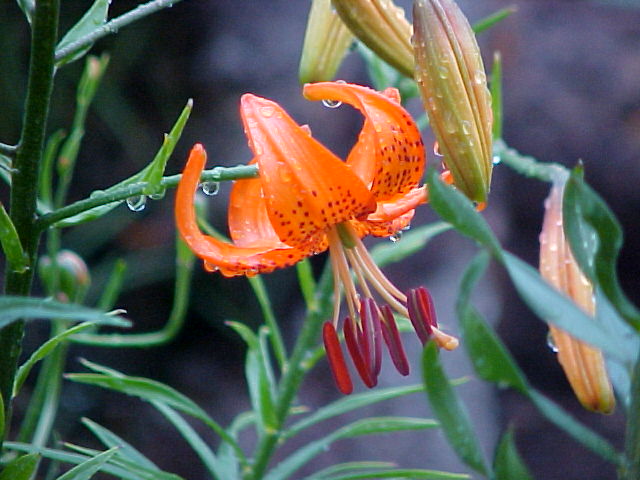 Lilium davidii
A tall Asian lily with edible bulbs and orange recurved flowers
🇨🇳 China and 1 more · Wildflower
Lilium davidii
A tall Asian lily with edible bulbs and orange recurved flowers
🇨🇳 China and 1 more · Wildflower
 Chinese LilyLilium brownii
A wild and cultivated lily from China with edible bulbs
🇨🇳 China and 3 more · Wildflower
Chinese LilyLilium brownii
A wild and cultivated lily from China with edible bulbs
🇨🇳 China and 3 more · Wildflower
More from Japan
All the flowers of Japan BirchBetula
Slender trees with papery bark found across the northern world
🇨🇳 China and 7 more · Wildflower
BirchBetula
Slender trees with papery bark found across the northern world
🇨🇳 China and 7 more · Wildflower
 Chrysanthemum菊花
Autumn-blooming flower with thousands of varieties, cherished in East Asia and beyond
🇨🇳 China and 6 more · Wildflower
Chrysanthemum菊花
Autumn-blooming flower with thousands of varieties, cherished in East Asia and beyond
🇨🇳 China and 6 more · Wildflower
 Wild cherryPrunus avium
A tall flowering tree native to Europe, grown for its sweet fruit and spring blossom
🇮🇹 Italy and 6 more · Flowering tree
Wild cherryPrunus avium
A tall flowering tree native to Europe, grown for its sweet fruit and spring blossom
🇮🇹 Italy and 6 more · Flowering tree
 LindenTilia
Tall, broad-leaved trees with fragrant yellow flowers and heart-shaped leaves
🇨🇳 China and 7 more · Flowering tree
LindenTilia
Tall, broad-leaved trees with fragrant yellow flowers and heart-shaped leaves
🇨🇳 China and 7 more · Flowering tree