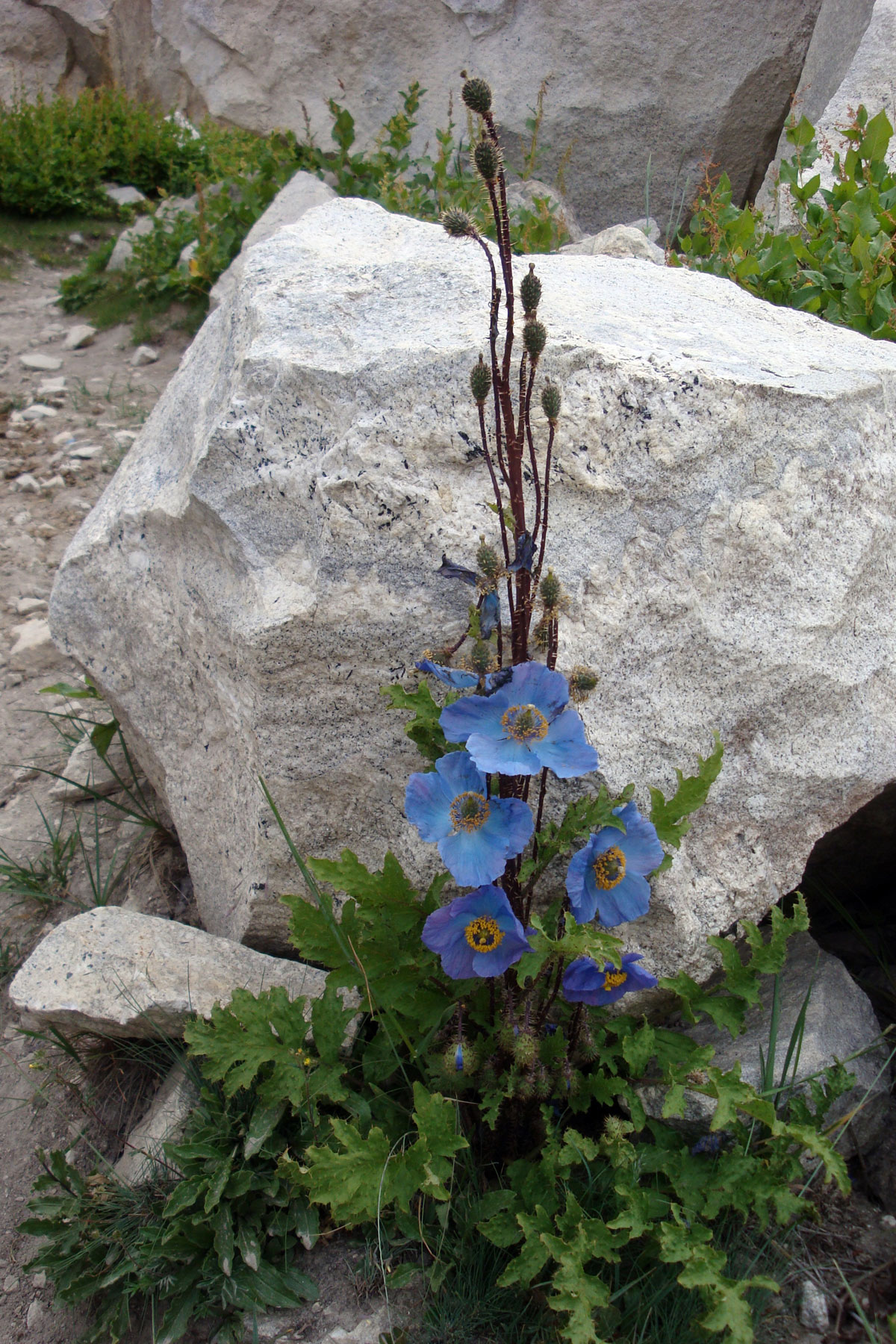
Thorny satin poppy
Meconopsis aculeata, family Papaveraceae
In its own language: Tsersnon
A rare blue poppy from the western Himalayas, valued in traditional medicine
Thorny satin poppy is a blue-flowered Himalayan plant found in limited areas of Pakistan and India. Known locally as Tsersnon in Ladakh, it is collected for use in Sowa-Rigpa traditional medicine, which has led to concerns about over-harvesting in the wild.
- Native to the west Himalayas of Pakistan and India
- Known locally as Tsersnon in Ladakh
- Blue flowers with thorny stems
- Used in Sowa-Rigpa (Amchi) traditional medicine
- Proposed as the state flower of Ladakh
What does Thorny satin poppy look like?
Thorny satin poppy is a Himalayan plant with striking blue flowers. The blooms are notable for their color and are borne on a plant with thorny features, as its name suggests. It grows in specific, often remote, areas of the western Himalayas. The plant is not widely distributed and is recognized by its blue petals and spiny stems.
Where does Thorny satin poppy come from?
This species is native to the western Himalayas, where it is found in certain regions of Pakistan and India, including Ladakh. It was first described from specimens collected in this area by Royle in 1833. The plant has a limited range and is not found outside these high-altitude regions. Its local name in Ladakh is Tsersnon.
When and how Thorny satin poppy blooms
Thorny satin poppy grows wild in the high-altitude climates of the west Himalayas. It is not widely cultivated and is mostly collected from the wild. The plant thrives in the specific conditions of its native range, which includes rocky slopes and alpine meadows.
How Thorny satin poppy is used
The plant is highly valued in the Sowa-Rigpa, or Amchi, system of traditional medicine, especially in Ladakh. It is collected for its medicinal properties, often alongside juniper. Its popularity in traditional healing has led to increased collection from the wild, raising concerns about its conservation.
Kinds of Thorny satin poppy
No notable varieties or cultivars are mentioned in the sources. The species is recognized mainly in its wild form.
What Thorny satin poppy means
Thorny satin poppy is important in Ladakh, where it has been proposed as the state flower. Its role in traditional medicine makes it culturally significant. Over-collection for medicinal use has put pressure on its wild populations, making conservation a concern.
Where Thorny satin poppy is used and seen


Traditions that use it
Questions people ask about Thorny satin poppy
Where does the thorny satin poppy come from?
It is native to the western Himalayas, specifically in certain areas of Pakistan and India, including Ladakh.
What does the flower look like?
It has blue flowers and thorny stems, growing in the high-altitude regions of the Himalayas.
How is this plant used?
It is collected for use in Sowa-Rigpa (Amchi) traditional medicine, especially in Ladakh.
Is the thorny satin poppy endangered?
The plant faces pressure from over-collection for medicinal use, which threatens its wild populations.
Does it have any cultural significance?
Yes, it has been proposed as the state flower of Ladakh and is important in local medicine.
Good reading and sources
- Plants of the World OnlineRoyal Botanic Gardens, Kew, Plant database
- Where it has been recordedGBIF, Plant database
- Sightings and photos by naturalistsiNaturalist, Plant database
- Meconopsis aculeata on WikipediaEncyclopedia
- More photos on Wikimedia CommonsPhotos
- Wikidata recordOpen data
The facts on this page come from the Wikipedia article "Meconopsis aculeata", written by its contributors and used under the CC BY-SA 4.0 licence, and from its Wikidata record (CC0). Phool rewrote the text in its own words, with AI assistance, and compares every page with the article to make sure no passage is copied. It may be reused under the same CC BY-SA 4.0 licence with a link back.
It may contain mistakes. It is not medical or foraging advice: many flowers are poisonous, and traditional uses are reported, not recommended. If something is wrong, tell us. Last refreshed 2026-10-03.
Others in the family Papaveraceae
The whole family Opium poppyPapaver somniferum
A tall annual poppy grown for seeds, opium, and striking garden flowers
🇨🇳 China and 2 more · Wildflower
Opium poppyPapaver somniferum
A tall annual poppy grown for seeds, opium, and striking garden flowers
🇨🇳 China and 2 more · Wildflower
 Common poppyPapaver rhoeas
The vivid red wildflower of fields and remembrance
🇨🇳 China and 7 more · Wildflower
Common poppyPapaver rhoeas
The vivid red wildflower of fields and remembrance
🇨🇳 China and 7 more · Wildflower
 PoppyPapaver
A group of colourful wild and garden flowers with capsule fruits and many seeds
Papaver · Wildflower
PoppyPapaver
A group of colourful wild and garden flowers with capsule fruits and many seeds
Papaver · Wildflower
 Meconopsis grandis
A blue-flowered poppy from the Himalayas grown for its striking blooms
🇧🇹 Bhutan and 3 more · Wildflower
Meconopsis grandis
A blue-flowered poppy from the Himalayas grown for its striking blooms
🇧🇹 Bhutan and 3 more · Wildflower
More from Pakistan
All the flowers of Pakistan JasmineJasminum
A group of fragrant shrubs and vines with white or yellow star-shaped flowers
🇵🇰 Pakistan and 7 more · Wildflower
JasmineJasminum
A group of fragrant shrubs and vines with white or yellow star-shaped flowers
🇵🇰 Pakistan and 7 more · Wildflower
 BaelAegle marmelos
A spiny tree with fragrant yellow-green flowers and hard-shelled aromatic fruit
🇮🇳 India and 6 more · Flowering tree
BaelAegle marmelos
A spiny tree with fragrant yellow-green flowers and hard-shelled aromatic fruit
🇮🇳 India and 6 more · Flowering tree
 Brown mustardBrassica juncea
A leafy mustard plant grown for greens, seeds, and oil across Asia and beyond
🇨🇳 China and 7 more · Wildflower
Brown mustardBrassica juncea
A leafy mustard plant grown for greens, seeds, and oil across Asia and beyond
🇨🇳 China and 7 more · Wildflower
 Marsh-marigoldCaltha palustris
A bright yellow wildflower of marshes and wet woodlands in cool climates
🇨🇳 China and 7 more · Wildflower
Marsh-marigoldCaltha palustris
A bright yellow wildflower of marshes and wet woodlands in cool climates
🇨🇳 China and 7 more · Wildflower