
Red water lily
Nymphaea rubra, family Nymphaeaceae
A red-flowered water lily found in rivers and ponds of South and Southeast Asia
Red water lily (Nymphaea rubra) is an aquatic plant with large, fragrant red flowers and broad leaves. Native to parts of South and Southeast Asia, it grows in slow-moving or still waters and is sometimes used in aquariums. Its flower stalks and seeds are eaten in some regions.
- Large, fragrant red flowers up to 25 cm wide
- Leaves are bronzy red to dark green on top, dark purple underneath
- Native to rivers and ponds in South and Southeast Asia
- Flower stalks and seeds are eaten in some regions
- Sometimes grown in aquariums for decoration
What does Red water lily look like?
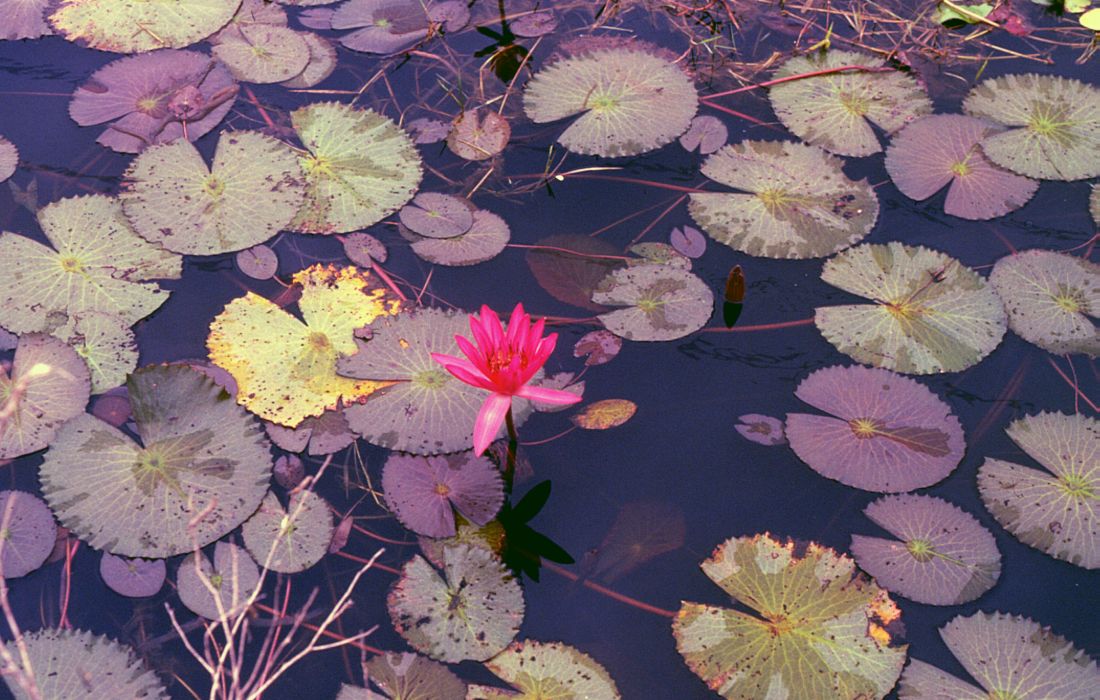
Red water lily is an aquatic plant with floating leaves that can reach up to 48 cm across. The upper side of the leaf ranges from bronzy red to dark green, while the underside is dark purple and has pronounced veins. Its flowers are large, measuring 15–25 cm wide, with many narrow, red petals and a pleasant scent. The flower stalks can be over a meter long, and the plant grows from thick rhizomes.
Where does Red water lily come from?
This water lily is native to rivers, lakes, and ponds in parts of South and Southeast Asia, including Myanmar, Sri Lanka, and northeastern India. It was first described by William Roxburgh and officially published in 1808 by Henry Cranke Andrews. The species name 'rubra' refers to its red color. Its exact origins are unclear, and it may be a hybrid.
When and how Red water lily blooms
Red water lily grows in still or slow-moving water, rooting in the mud at the bottom. It spreads mainly by stolons, but can sometimes reproduce through a rare process involving special flower structures. The plant can also reproduce without fertilization. It is sometimes kept in aquariums for its decorative leaves and flowers.


How Red water lily is used
People in some areas eat the flower stalks and seeds of Nymphaea rubra. The plant is also grown for its beauty in ponds and water gardens, and its large, fragrant flowers make it a popular choice for aquatic displays. It is suitable for cultivation in aquariums.
Kinds of Red water lily
Nymphaea rubra belongs to the subgenus Lotos within its genus. There are reports of unusual forms, such as a specimen that developed extra flower-like structures while growing in Germany in the 19th century. The plant may have hybrid origins, and its classification is still being studied.
What Red water lily means
The red water lily is valued for its striking appearance and pleasant scent. Its edible parts are used locally, but there are no widely recorded symbolic meanings or religious uses in the sources. It has been introduced to several countries outside its native range, including China, Cuba, and Hungary.
Where Red water lily is used and seen

Where to see Red water lily

Questions people ask about Red water lily
Where does the red water lily come from?
Red water lily is native to rivers, lakes, and ponds in South and Southeast Asia, including Myanmar, Sri Lanka, and northeastern India.
What does Nymphaea rubra look like?
It has large floating leaves with a bronzy red or dark green top and dark purple underside. The flowers are broad, red, and pleasantly fragrant, with many narrow petals.
How is the red water lily used?
People eat its flower stalks and seeds in some regions. It is also grown for its attractive flowers in water gardens and aquariums.
Does the red water lily have any special meaning or symbolism?
The sources do not mention any particular symbolic or religious meaning for Nymphaea rubra.
Can red water lily be grown in aquariums?
Yes, Nymphaea rubra is suitable for aquarium cultivation and is valued for its decorative leaves and flowers.
Good reading and sources
- IUCN Red List of Threatened SpeciesIUCN Red List, Article
- Plants of the World OnlineRoyal Botanic Gardens, Kew, Plant database
- Where it has been recordedGBIF, Plant database
- Sightings and photos by naturalistsiNaturalist, Plant database
- Nymphaea rubra on WikipediaEncyclopedia
- More photos on Wikimedia CommonsPhotos
- Wikidata recordOpen data
The facts on this page come from the Wikipedia article "Nymphaea rubra", written by its contributors and used under the CC BY-SA 4.0 licence, and from its Wikidata record (CC0). EveryPhool rewrote the text in its own words, with AI assistance, and compares every page with the article to make sure no passage is copied. It may be reused under the same CC BY-SA 4.0 licence with a link back.
It may contain mistakes. It is not medical or foraging advice: many flowers are poisonous, and traditional uses are reported, not recommended. If something is wrong, tell us. Last refreshed 2026-10-03.
Others in the family Nymphaeaceae
The whole family WaterlilyNymphaea
Floating aquatic flowers found in ponds and lakes worldwide
🇪🇬 Egypt and 7 more · Water flower
WaterlilyNymphaea
Floating aquatic flowers found in ponds and lakes worldwide
🇪🇬 Egypt and 7 more · Water flower
 Water-lily familyNymphaeaceae
Floating aquatic plants with showy flowers and round leaves
🇧🇩 Bangladesh and 2 more · Wildflower
Water-lily familyNymphaeaceae
Floating aquatic plants with showy flowers and round leaves
🇧🇩 Bangladesh and 2 more · Wildflower
 White Water-lilyNymphaea alba
A floating white flower of ponds and lakes across Europe and Asia
🇸🇪 Sweden and 5 more · Wildflower
White Water-lilyNymphaea alba
A floating white flower of ponds and lakes across Europe and Asia
🇸🇪 Sweden and 5 more · Wildflower
 Amazon waterlilyNymphaea amazonum
A night-blooming waterlily from Mexico to tropical South America
🇧🇷 Brazil and 4 more · Wildflower
Amazon waterlilyNymphaea amazonum
A night-blooming waterlily from Mexico to tropical South America
🇧🇷 Brazil and 4 more · Wildflower
More from Myanmar
All the flowers of Myanmar PomegranatePunica granatum
A shrub with bright red flowers and a fruit full of edible seeds
🇮🇷 Iran and 9 more · Flowering shrub
PomegranatePunica granatum
A shrub with bright red flowers and a fruit full of edible seeds
🇮🇷 Iran and 9 more · Flowering shrub
 FennelFoeniculum vulgare
A tall, aromatic herb with feathery leaves and yellow umbels, used for food and spice
🇨🇳 China and 7 more · Herb or useful flower
FennelFoeniculum vulgare
A tall, aromatic herb with feathery leaves and yellow umbels, used for food and spice
🇨🇳 China and 7 more · Herb or useful flower
 Common flaxLinum usitatissimum
The slender blue-flowered plant grown for linen and linseed
🇨🇳 China and 7 more · Wildflower
Common flaxLinum usitatissimum
The slender blue-flowered plant grown for linen and linseed
🇨🇳 China and 7 more · Wildflower
 OleanderNerium oleander
A showy, evergreen shrub with clusters of pink, white or red flowers
🇲🇦 Morocco and 8 more · Flowering shrub
OleanderNerium oleander
A showy, evergreen shrub with clusters of pink, white or red flowers
🇲🇦 Morocco and 8 more · Flowering shrub