
Plectranthus
A genus of mint-family plants from Africa and Madagascar
Plectranthus is a group of about 85 flowering plant species in the mint family. Most grow in southern and tropical Africa and on Madagascar, and several are used as ornamental garden plants.
- Belongs to the mint family Lamiaceae
- Name means 'spear-point flower' in Greek
- About 85 accepted species as of 2022
- Many former species moved to Coleus genus
- Grown as ornamental garden plants
What does Plectranthus look like?
Plectranthus plants are mostly herbaceous perennials, though some are soft-wooded shrubs or annuals. A few have succulent stems or tuberous bases. Their flowers give the group its common name 'spur-flower', hinting at their shape.
Where does Plectranthus come from?
The genus comes from southern and tropical parts of Africa and Madagascar. Its name blends Greek words for 'spear point' and 'flower', describing the flower structure. Recent studies reshaped its classification, moving many species to other genera like Coleus.
When and how Plectranthus blooms
These plants grow as perennials in suitable climates. Some forms are cultivated in gardens for their foliage or flowers. One well-known cultivar, Mona Lavender, has been recognised for garden performance by the Royal Horticultural Society.


How Plectranthus is used
Several Plectranthus species are grown as ornamental plants in gardens and containers. They are valued for their ease of growth and attractive leaves or blooms, making them popular choices for home landscapes.
Kinds of Plectranthus
Taxonomic work in recent years redefined the genus. Many plants once called Plectranthus, such as those now in Coleus, Equilabium, and other genera, were moved based on DNA evidence. As of 2022, about 84 species remain accepted under Plectranthus.
Questions people ask about Plectranthus
Where does Plectranthus come from?
It is native to southern and tropical Africa and Madagascar, according to botanical sources.
What is Plectranthus used for?
Several species are grown as ornamental plants in gardens and homes for their foliage and flowers.
Is Plectranthus related to Coleus?
Yes. Genetic studies showed many former Plectranthus species actually belong in Coleus and other genera.
What does the name Plectranthus mean?
It comes from Greek words for 'spear point' and 'flower', referring to the shape of the blossom.
Good reading and sources
- Plectranthus [Mona Lavender] ('Plepalila')Royal Horticultural Society, Article
- USDA Plants DatabaseUS Department of Agriculture, Article
- Plants of the World OnlineRoyal Botanic Gardens, Kew, Plant database
- Where it has been recordedGBIF, Plant database
- Sightings and photos by naturalistsiNaturalist, Plant database
The facts on this page come from the Wikipedia article "Plectranthus", written by its contributors and used under the CC BY-SA 4.0 licence, and from its Wikidata record (CC0). Phool rewrote the text in its own words, with AI assistance, and compares every page with the article to make sure no passage is copied. It may be reused under the same CC BY-SA 4.0 licence with a link back.
It may contain mistakes. It is not medical or foraging advice: many flowers are poisonous, and traditional uses are reported, not recommended. If something is wrong, tell us. Last refreshed 2026-10-03.
Others in the family Lamiaceae
The whole family RosemarySalvia rosmarinus
A fragrant evergreen shrub with needle-like leaves and purple, blue, or white flowers
🇪🇸 Spain and 5 more · Flowering shrub
RosemarySalvia rosmarinus
A fragrant evergreen shrub with needle-like leaves and purple, blue, or white flowers
🇪🇸 Spain and 5 more · Flowering shrub
 Salvia
A vast group of aromatic herbs and shrubs known for their flowers and uses
Salvia · Wildflower
Salvia
A vast group of aromatic herbs and shrubs known for their flowers and uses
Salvia · Wildflower
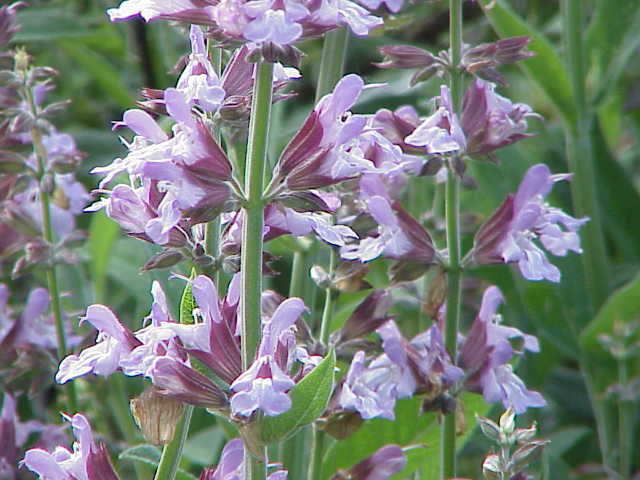 Common sageSalvia officinalis
A Mediterranean herb with grey-green leaves and blue to purple flowers
🇨🇳 China and 1 more · Herb or useful flower
Common sageSalvia officinalis
A Mediterranean herb with grey-green leaves and blue to purple flowers
🇨🇳 China and 1 more · Herb or useful flower
 Holy basilOcimum tenuiflorum
A fragrant herb central to Hindu worship and Southeast Asian cooking
🇲🇲 Myanmar and 6 more · Herb or useful flower
Holy basilOcimum tenuiflorum
A fragrant herb central to Hindu worship and Southeast Asian cooking
🇲🇲 Myanmar and 6 more · Herb or useful flower
More from Madagascar
All the flowers of Madagascar Pelargonium
A diverse group of flowering plants often grown as garden and house plants
🇿🇦 South Africa and 7 more · Garden flower
Pelargonium
A diverse group of flowering plants often grown as garden and house plants
🇿🇦 South Africa and 7 more · Garden flower
 Ylang-ylangCananga odorata
A tropical tree with highly fragrant yellow flowers used for perfume and decoration
🇻🇳 Vietnam and 8 more · Flowering tree
Ylang-ylangCananga odorata
A tropical tree with highly fragrant yellow flowers used for perfume and decoration
🇻🇳 Vietnam and 8 more · Flowering tree
 Erica
Evergreen shrubs with tiny needle leaves and nodding flowers, known as heaths or heathers
🇿🇦 South Africa and 1 more · Wildflower
Erica
Evergreen shrubs with tiny needle leaves and nodding flowers, known as heaths or heathers
🇿🇦 South Africa and 1 more · Wildflower
 Stephanotis
A tropical climber with waxy, fragrant white flowers
🇲🇬 Madagascar · Climber
Stephanotis
A tropical climber with waxy, fragrant white flowers
🇲🇬 Madagascar · Climber