
Great laurel
Rhododendron maximum, family Ericaceae
A large evergreen shrub with showy blooms in the Appalachian forests
Great laurel is a tall, evergreen shrub native to the Appalachian region of eastern North America. It produces clusters of white, pink, or pale purple flowers in early summer and forms dense thickets in forests, providing shelter for wildlife and stabilizing slopes.
- Native to the Appalachian Mountains from Alabama to Nova Scotia
- Evergreen shrub with deep green, leathery leaves
- Blooms in early summer with white, pink, or pale purple flowers
- Forms dense thickets called 'laurel slicks' in forests
- Leaves are toxic if ingested
What does Great laurel look like?
Great laurel is a robust evergreen shrub that can reach up to 4 meters, sometimes even 10 meters tall. Its leaves are deep green, leathery, and can remain on the plant for several years. The plant blooms in early to mid-summer, producing clusters of flowers about 2.5 to 3 centimeters wide. These blossoms can be white, pink, or pale purple and often have tiny greenish-yellow markings. The shrub forms dense thickets and its leaves are known to be toxic.
Where does Great laurel come from?
This species is native to the Appalachian Mountains, stretching from Alabama in the southern United States up to coastal Nova Scotia in Canada. It is most common and dominant in the southern Appalachians, where it thrives on moist, well-drained slopes and along streams. Over time, it has spread into disturbed areas and now forms extensive understory layers in many forests. Its presence is a key feature of Appalachian woodland ecosystems.
When and how Great laurel blooms
Great laurel blooms mainly in June and July, though flowers may appear from March to August. It prefers acidic, organic-rich soils and grows best in shaded or semi-shaded conditions. The plant can reproduce by seed, but more often spreads by layering, where branches that touch the ground develop roots. Its seeds are tiny and produced in dry capsules that split open in autumn.


How Great laurel is used
In its native forests, great laurel provides cover for animals and helps prevent soil erosion on steep slopes. It is valued for its ornamental qualities and is sometimes grown in gardens, especially in regions with suitable climate and soil. The wood is very hard and occasionally used for specialty items. However, its dense growth can limit regeneration of other plants.
Kinds of Great laurel
Several cultivated forms of great laurel have been selected for their flower color, ranging from white to purple. It also hybridizes with other rhododendron species, such as R. catawbiense, to create garden varieties. In the wild, it forms large, nearly pure stands known locally as 'laurel slicks' or 'laurel hells.'
What Great laurel means
Great laurel is a prominent feature of Appalachian landscapes and is sometimes used as a regional emblem. Its dense thickets are well known to hikers and naturalists in the area. While prized for its beauty, the plant's toxicity and tendency to dominate forest understories have made it a subject of ecological study and management.
Where Great laurel is used and seen
 Parc Floral de la SourceA large public garden in Orléans built around the source of the Loiret river
 Rhododendron-Park BremenA vast park in Bremen with the world’s largest rhododendron and azalea collection
 Botanical Garden of the University of ViennaA historic 8-hectare plant collection next to Vienna’s Belvedere gardens
 Kórnik ArboretumPoland’s oldest and largest collection of trees and shrubs, near Kórnik Castle
 VanDusen Botanical GardenA public garden in Vancouver with global and native plant collections
 Abkhazi GardenA one-acre garden in Victoria, British Columbia, created by Prince and Princess Abkhazi
 Holden ArboretumA vast botanical garden and arboretum in Kirtland, Ohio
 Parc floral de ParisA botanical garden and flower park in the Bois de Vincennes, Paris
Questions people ask about Great laurel
Where does great laurel come from?
Great laurel is native to the Appalachian Mountains of eastern North America, ranging from Alabama in the United States up to coastal Nova Scotia in Canada.
What does great laurel look like?
It is a large evergreen shrub with deep green, leathery leaves and clusters of flowers that can be white, pink, or pale purple, often blooming in early summer.
Is great laurel poisonous?
Yes, the leaves of great laurel are toxic if eaten, so care should be taken around pets and livestock.
How is great laurel used?
It is valued for its ornamental flowers and is sometimes grown in gardens. In the wild, it provides shelter for wildlife and helps stabilize soil on slopes.
Does great laurel have any special meaning or symbolism?
It is an important part of Appalachian forest ecosystems and is sometimes used as a regional symbol, but the sources do not mention specific symbolic meanings.
Good reading and sources
- Encyclopaedia BritannicaArticle
- IUCN Red List of Threatened SpeciesIUCN Red List, Article
- Rhododendron maximumUS Department of Agriculture, Article
- Plants of the World OnlineRoyal Botanic Gardens, Kew, Plant database
- Where it has been recordedGBIF, Plant database
- Sightings and photos by naturalistsiNaturalist, Plant database
- Rhododendron maximum on WikipediaEncyclopedia
- More photos on Wikimedia CommonsPhotos
- Wikidata recordOpen data
The facts on this page come from the Wikipedia article "Rhododendron maximum", written by its contributors and used under the CC BY-SA 4.0 licence, and from its Wikidata record (CC0). Phool rewrote the text in its own words, with AI assistance, and compares every page with the article to make sure no passage is copied. It may be reused under the same CC BY-SA 4.0 licence with a link back.
It may contain mistakes. It is not medical or foraging advice: many flowers are poisonous, and traditional uses are reported, not recommended. If something is wrong, tell us. Last refreshed 2026-10-03.
Others in the family Ericaceae
The whole family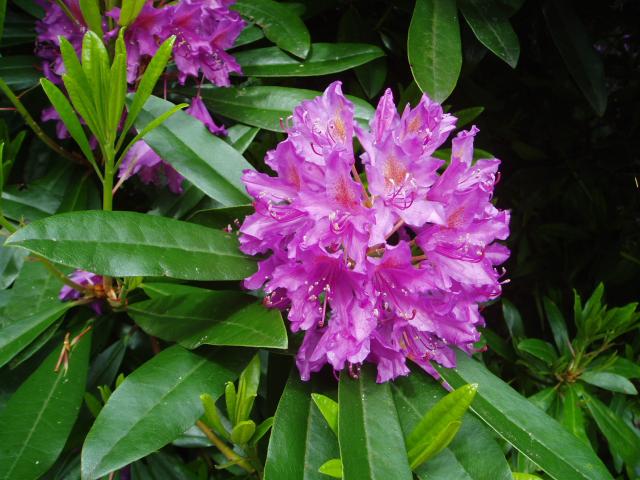 Rhododendron
A vast group of shrubs and trees with showy blooms in many colours
🇳🇵 Nepal and 4 more · Wildflower
Rhododendron
A vast group of shrubs and trees with showy blooms in many colours
🇳🇵 Nepal and 4 more · Wildflower
 Erica
Evergreen shrubs with tiny needle leaves and nodding flowers, known as heaths or heathers
🇿🇦 South Africa and 1 more · Wildflower
Erica
Evergreen shrubs with tiny needle leaves and nodding flowers, known as heaths or heathers
🇿🇦 South Africa and 1 more · Wildflower
 Catawba rosebayRhododendron catawbiense
A spring-flowering rhododendron native to the southern Appalachian Mountains
🇺🇸 United States · Wildflower
Catawba rosebayRhododendron catawbiense
A spring-flowering rhododendron native to the southern Appalachian Mountains
🇺🇸 United States · Wildflower
 Common rhododendronRhododendron ponticum
A dense evergreen shrub with violet-purple flowers from Europe and the Caucasus
🇵🇹 Portugal and 6 more · Flowering shrub
Common rhododendronRhododendron ponticum
A dense evergreen shrub with violet-purple flowers from Europe and the Caucasus
🇵🇹 Portugal and 6 more · Flowering shrub
More from the United States
All the flowers of the United States PeachPrunus persica
A flowering fruit tree from China, grown for its pink blossoms and sweet fruit
🇨🇳 China and 7 more · Flowering tree
PeachPrunus persica
A flowering fruit tree from China, grown for its pink blossoms and sweet fruit
🇨🇳 China and 7 more · Flowering tree
 AlmondPrunus amygdalus
A Mediterranean tree grown for its fragrant spring flowers and edible seeds
🇮🇷 Iran and 6 more · Flowering tree
AlmondPrunus amygdalus
A Mediterranean tree grown for its fragrant spring flowers and edible seeds
🇮🇷 Iran and 6 more · Flowering tree
 CactusCactaceae
Succulent plants with spines, native to the Americas
🇲🇽 Mexico and 7 more · Wildflower
CactusCactaceae
Succulent plants with spines, native to the Americas
🇲🇽 Mexico and 7 more · Wildflower
 Chrysanthemum菊花
Autumn-blooming flower with thousands of varieties, cherished in East Asia and beyond
🇨🇳 China and 6 more · Wildflower
Chrysanthemum菊花
Autumn-blooming flower with thousands of varieties, cherished in East Asia and beyond
🇨🇳 China and 6 more · Wildflower