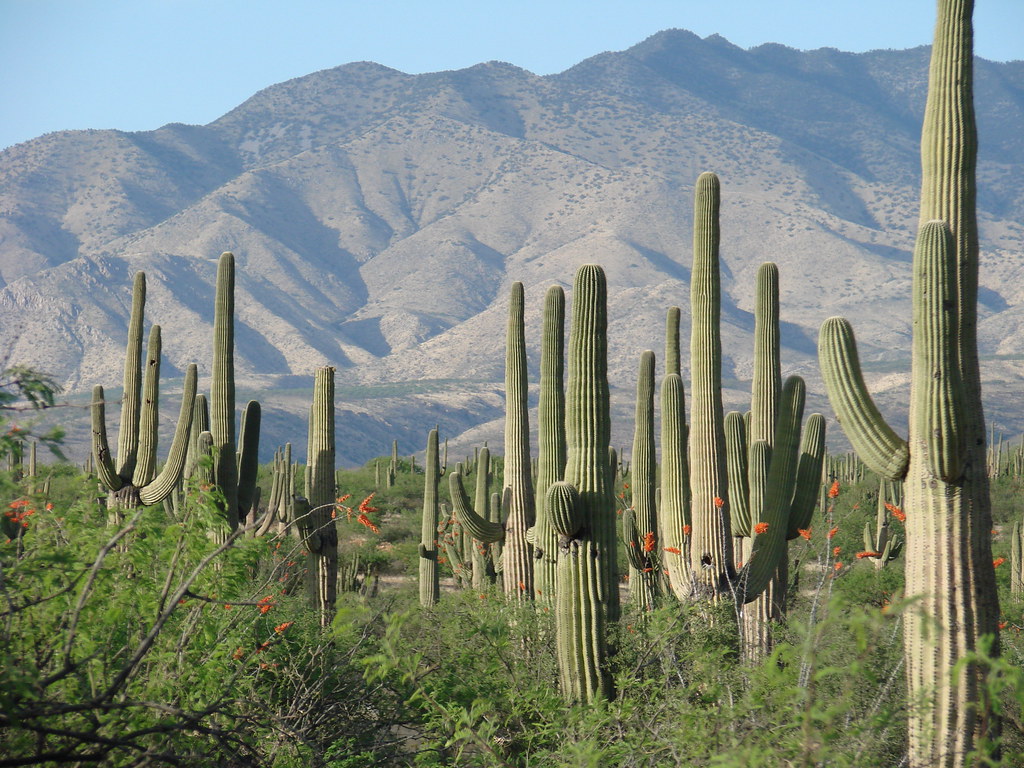
Saguaro
Carnegiea gigantea, family Cactaceae
The towering cactus of the Sonoran Desert with white flowers and red fruit
The saguaro is a giant, tree-like cactus native to the Sonoran Desert in Arizona, California, and Sonora, Mexico. It can grow over 12 meters tall, lives for more than 150 years, and produces white, waxy flowers in late spring, followed by edible red fruit. Its flowers are Arizona's state wildflower, and its ribs and fruit have long been used by native peoples.
- Can grow over 12 meters tall and live more than 150 years
- White flowers bloom at night from April to June
- Red fruit is harvested for syrup and bread by native peoples
- State wildflower of Arizona
- Rare crested forms occur in about 1 in 10,000 plants
What does Saguaro look like?
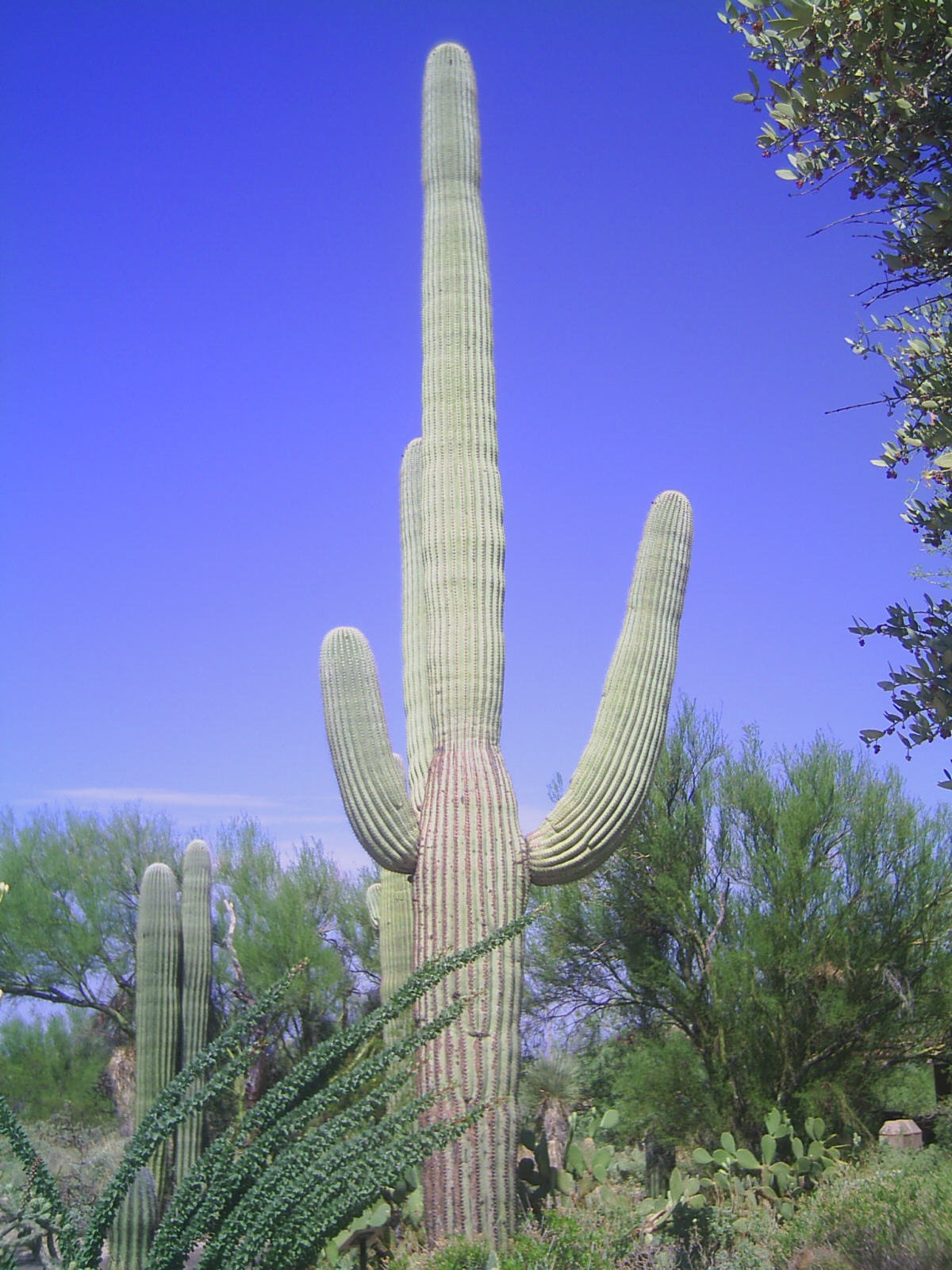
The saguaro is a column-shaped cactus that can reach 16 meters tall and up to 75 centimeters wide. It often grows arms, sometimes more than 50, which branch upward from the main stem. Its skin is green and ribbed, covered in sharp spines up to 7 centimeters long. In late spring, white, waxy flowers bloom at the tips of the stems and arms, followed by red, fleshy fruit in early summer. Inside, the plant has woody ribs that act as a skeleton.
Where does Saguaro come from?
The saguaro grows wild in the Sonoran Desert, covering parts of Arizona, California, and Sonora, Mexico. It thrives from sea level up to 1,500 meters, relying on summer rains and nurse plants for young seedlings. The species was first described in the mid-1800s during surveys along the US-Mexico border. Its name honors Andrew Carnegie, and 'gigantea' refers to its size. Saguaro National Park was set up in 1933 to protect these cacti near Tucson.
When and how Saguaro blooms
Saguaros bloom from April to June, with flowers opening at night and closing by afternoon. They grow slowly from seed, often taking decades to reach a meter tall. The cactus stores water in its tissues to survive drought. Its roots spread wide and deep to collect rain. The fruit ripens in June, and native peoples harvest it using long poles made from saguaro ribs.


How Saguaro is used
Native peoples, including the Tohono Oʼodham and Pima, have used saguaro fruit for food, making syrup and bread from the sweet red pulp and seeds. The woody ribs are used as building material in the desert. The saguaro is a symbol of the American Southwest and Arizona, appearing in art and film. Its flowers are the state wildflower of Arizona.
Kinds of Saguaro
Most saguaros have a single trunk with arms, but some grow without arms, called 'spears'. Rarely, a saguaro develops a crested or 'cristate' top, forming a fan-like shape due to abnormal growth. These crested forms are uncommon, found in about one in 10,000 plants.
What Saguaro means
The saguaro is a keystone species, providing food and shelter for many desert animals. Its image is widely used in Southwestern culture and is the state wildflower of Arizona. The cactus is protected in some areas, and Saguaro National Park was created to conserve its habitat. Its fruit harvest remains an important tradition for local indigenous peoples.
Questions people ask about Saguaro
Where does the saguaro come from?
The saguaro is native to the Sonoran Desert, which covers southern Arizona, parts of California, and the Mexican state of Sonora.
What does the saguaro flower look like?
The saguaro produces white, waxy flowers at the tips of its stems and arms. The flowers are large, open at night, and close by midafternoon.
How is the saguaro used by people?
Native peoples harvest the red fruit to make syrup and bread, and use the cactus's woody ribs for building. The saguaro is also a symbol of the American Southwest and Arizona.
What does the saguaro symbolise?
The saguaro is a symbol of the American Southwest and is the state wildflower of Arizona. It represents the desert landscape and is important in local indigenous culture.
How long does a saguaro live?
Saguaros often live for 150 to 200 years, with some reaching even greater ages.
Good reading and sources
- Encyclopaedia BritannicaArticle
- IUCN Red List of Threatened SpeciesIUCN Red List, Article
- Plants of the World OnlineRoyal Botanic Gardens, Kew, Plant database
- Where it has been recordedGBIF, Plant database
- Sightings and photos by naturalistsiNaturalist, Plant database
The facts on this page come from the Wikipedia article "Saguaro", written by its contributors and used under the CC BY-SA 4.0 licence, and from its Wikidata record (CC0). Phool rewrote the text in its own words, with AI assistance, and compares every page with the article to make sure no passage is copied. It may be reused under the same CC BY-SA 4.0 licence with a link back.
It may contain mistakes. It is not medical or foraging advice: many flowers are poisonous, and traditional uses are reported, not recommended. If something is wrong, tell us. Last refreshed 2026-10-03.
Others in the family Cactaceae
The whole family Prickly pearOpuntia
Cactus with flat pads and edible fruit, native to the Americas
🇲🇽 Mexico and 7 more · Wildflower
Indian fig opuntiaOpuntia ficus-indica
A large, spiny cactus grown for its sweet fruit and edible pads
🇲🇽 Mexico and 7 more · Wildflower
Prickly pearOpuntia
Cactus with flat pads and edible fruit, native to the Americas
🇲🇽 Mexico and 7 more · Wildflower
Indian fig opuntiaOpuntia ficus-indica
A large, spiny cactus grown for its sweet fruit and edible pads
🇲🇽 Mexico and 7 more · Wildflower
 Mammillaria
A diverse group of small, rounded cacti with funnel-shaped flowers
🇲🇽 Mexico and 5 more · Wildflower
Mammillaria
A diverse group of small, rounded cacti with funnel-shaped flowers
🇲🇽 Mexico and 5 more · Wildflower
 Disocactus ackermannii
A scarlet-flowered epiphytic cactus from southern Mexico's cloud forests
🇲🇽 Mexico and 1 more · Wildflower
Disocactus ackermannii
A scarlet-flowered epiphytic cactus from southern Mexico's cloud forests
🇲🇽 Mexico and 1 more · Wildflower
More from the United States
All the flowers of the United States AlmondPrunus amygdalus
A Mediterranean tree grown for its fragrant spring flowers and edible seeds
🇮🇷 Iran and 6 more · Flowering tree
AlmondPrunus amygdalus
A Mediterranean tree grown for its fragrant spring flowers and edible seeds
🇮🇷 Iran and 6 more · Flowering tree
 CactusCactaceae
Succulent plants with spines, native to the Americas
🇲🇽 Mexico and 7 more · Wildflower
CactusCactaceae
Succulent plants with spines, native to the Americas
🇲🇽 Mexico and 7 more · Wildflower
 Chrysanthemum菊花
Autumn-blooming flower with thousands of varieties, cherished in East Asia and beyond
🇨🇳 China and 6 more · Wildflower
Chrysanthemum菊花
Autumn-blooming flower with thousands of varieties, cherished in East Asia and beyond
🇨🇳 China and 6 more · Wildflower
 Asteraceae
The large plant family behind daisies, sunflowers and asters
🇺🇸 United States and 2 more · Wildflower
Asteraceae
The large plant family behind daisies, sunflowers and asters
🇺🇸 United States and 2 more · Wildflower