
Sisyrinchium bermudiana
A spring-flowering purple-blue wildflower from Bermuda and Ireland
Sisyrinchium bermudiana is a small perennial plant with purple-blue flowers and strap-shaped leaves. Native to Bermuda and found in Ireland, it blooms in spring and is grown in gardens for its colourful clusters. Bermudians consider it their national flower, and it appears in local art and jewellery.
- Chosen as the national flower of Bermuda
- First described by Carl Linnaeus in 1753
- Blooms in spring with purple-blue and yellow flowers
- Grows in both Bermuda and Ireland
- Appears in Bermudian art and jewellery
What does Sisyrinchium bermudiana look like?
Sisyrinchium bermudiana is a low-growing perennial with narrow, strap-like leaves that range from green to grey-green. In spring, it produces clusters of small flowers, each with six purple-blue segments that form a tube at the centre, highlighted by a yellow throat. The flower stems branch and carry several blooms at once. After flowering, it forms dark seed pods filled with many tiny black seeds.
Where does Sisyrinchium bermudiana come from?
This plant is native to Bermuda and also grows in Ireland, though it may have been introduced there in the 19th century. Carl Linnaeus first described the species in 1753, making it the type species for its genus. The name 'bermudiana' comes from an earlier genus name and refers to its strong link with Bermuda.
When and how Sisyrinchium bermudiana blooms
Sisyrinchium bermudiana blooms during the spring months. It thrives in moist spots such as meadows, near lakes, and along the edges of coastal woods, as well as in sandy soils. The plant spreads by dropping its seeds, which can lead to a carpet of flowers over time. It is also grown in gardens as an ornamental for its bright spring display.
How Sisyrinchium bermudiana is used
In Bermuda, this flower is a symbol of local identity and pride, chosen as the national flower. It is featured in Bermudian art, jewellery, and even on banknotes. Gardeners value it for its colourful spring flowers and its ability to naturalise in lawns and borders.
Kinds of Sisyrinchium bermudiana
Sisyrinchium bermudiana is the type species of its genus, which includes other blue-eyed grasses. While the species itself is distinct, related plants in the genus share similar features, such as narrow leaves and star-shaped flowers, but may differ in colour or habitat.
What Sisyrinchium bermudiana means
The Bermudiana holds special meaning in Bermuda, where it represents the island’s natural heritage. Its image is used in various forms of local art and design. In Ireland, it is less prominent in culture but is appreciated as a wildflower and garden plant.
Questions people ask about Sisyrinchium bermudiana
Where does Sisyrinchium bermudiana come from?
It is native to Bermuda and also found in Ireland, though it may have been introduced to Ireland in the 1800s.
What does the Bermudiana flower look like?
It has narrow, grass-like leaves and small flowers with six purple-blue segments and a yellow centre, blooming in clusters in spring.
What is Sisyrinchium bermudiana used for?
In Bermuda, it is the national flower and appears in art, jewellery, and on banknotes. Gardeners also grow it for its colourful spring flowers.
When does Sisyrinchium bermudiana bloom?
It flowers in the spring, producing clusters of purple-blue blooms.
What does the Bermudiana symbolise?
In Bermuda, it symbolises national identity and is a source of local pride, featured in various cultural items.
Good reading and sources
- Encyclopaedia BritannicaArticle
- Plants of the World OnlineRoyal Botanic Gardens, Kew, Plant database
- Where it has been recordedGBIF, Plant database
- Sightings and photos by naturalistsiNaturalist, Plant database
- Sisyrinchium bermudiana on WikipediaEncyclopedia
- More photos on Wikimedia CommonsPhotos
- Wikidata recordOpen data
The facts on this page come from the Wikipedia article "Sisyrinchium bermudiana", written by its contributors and used under the CC BY-SA 4.0 licence, and from its Wikidata record (CC0). Phool rewrote the text in its own words, with AI assistance, and compares every page with the article to make sure no passage is copied. It may be reused under the same CC BY-SA 4.0 licence with a link back.
It may contain mistakes. It is not medical or foraging advice: many flowers are poisonous, and traditional uses are reported, not recommended. If something is wrong, tell us. Last refreshed 2026-10-03.
Others in the family Iridaceae
The whole family Gladiolus
Tall, showy flower spikes grown from corms, known as sword lilies
Gladiolus · Garden flower
Gladiolus
Tall, showy flower spikes grown from corms, known as sword lilies
Gladiolus · Garden flower
 Iris
A large group of perennial flowers with striking, six-lobed blooms
Iris · Wildflower
Iris
A large group of perennial flowers with striking, six-lobed blooms
Iris · Wildflower
 Crocus
Small corm-grown flowers in white, yellow, orange or purple
🇹🇷 Turkey and 7 more · Wildflower
Crocus
Small corm-grown flowers in white, yellow, orange or purple
🇹🇷 Turkey and 7 more · Wildflower
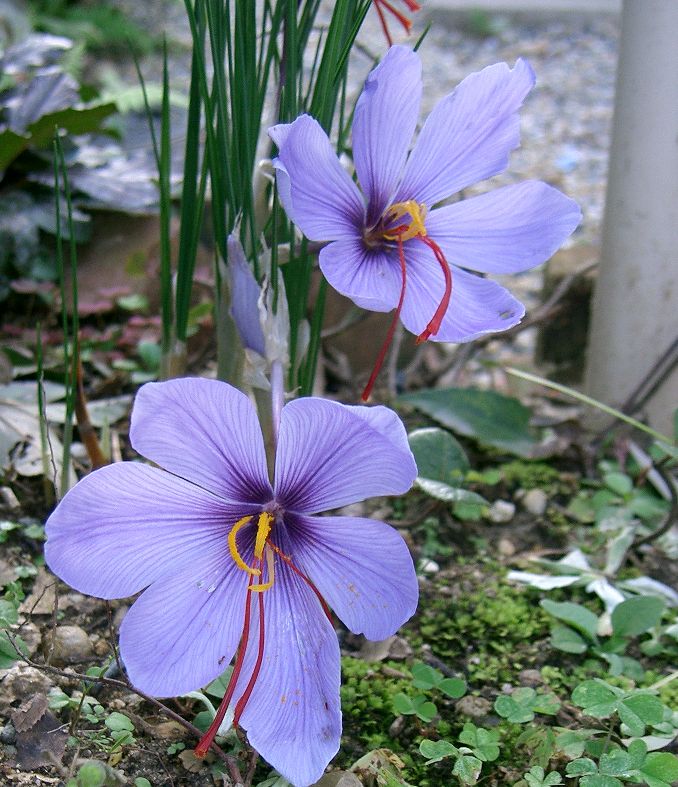 Saffron crocusCrocus sativus
The purple autumn flower whose red stigmas yield the spice saffron
🇨🇳 China and 1 more · Garden flower
Saffron crocusCrocus sativus
The purple autumn flower whose red stigmas yield the spice saffron
🇨🇳 China and 1 more · Garden flower
More from Ireland
All the flowers of Ireland Common flaxLinum usitatissimum
The slender blue-flowered plant grown for linen and linseed
🇨🇳 China and 7 more · Wildflower
Common flaxLinum usitatissimum
The slender blue-flowered plant grown for linen and linseed
🇨🇳 China and 7 more · Wildflower
 HawthornCrataegus
A thorny shrub or tree with white or pink spring flowers and small edible fruits
🇮🇪 Ireland and 7 more · Wildflower
HawthornCrataegus
A thorny shrub or tree with white or pink spring flowers and small edible fruits
🇮🇪 Ireland and 7 more · Wildflower
 Lily-of-the-valleyConvallaria majalis
A woodland plant with sweet-scented white bell flowers in late spring
🇫🇮 Finland and 4 more · Wildflower
Lily-of-the-valleyConvallaria majalis
A woodland plant with sweet-scented white bell flowers in late spring
🇫🇮 Finland and 4 more · Wildflower
 RapeseedBrassica napus
A yellow-flowered crop grown for its oil-rich seeds and protein meal
🇨🇳 China and 7 more · Wildflower
RapeseedBrassica napus
A yellow-flowered crop grown for its oil-rich seeds and protein meal
🇨🇳 China and 7 more · Wildflower