
Waling-waling
Vanda sanderiana, family Orchidaceae
A rare orchid known as the 'Queen of Philippine flowers'
Waling-waling (Vanda sanderiana) is a striking orchid native to Mindanao in the Philippines, where it grows on tree trunks in lowland forests. Its broad, flat flowers appear in clusters, and it is highly prized for its beauty and cultural importance, often called the 'Queen of Philippine flowers.'
- Endemic to Mindanao in the Philippines
- Known as the 'Queen of Philippine flowers'
- Grows on tree trunks in lowland forests
- Worshiped as a diwata by the Bagobo people
- Used in breeding new orchid hybrids
What does Waling-waling look like?
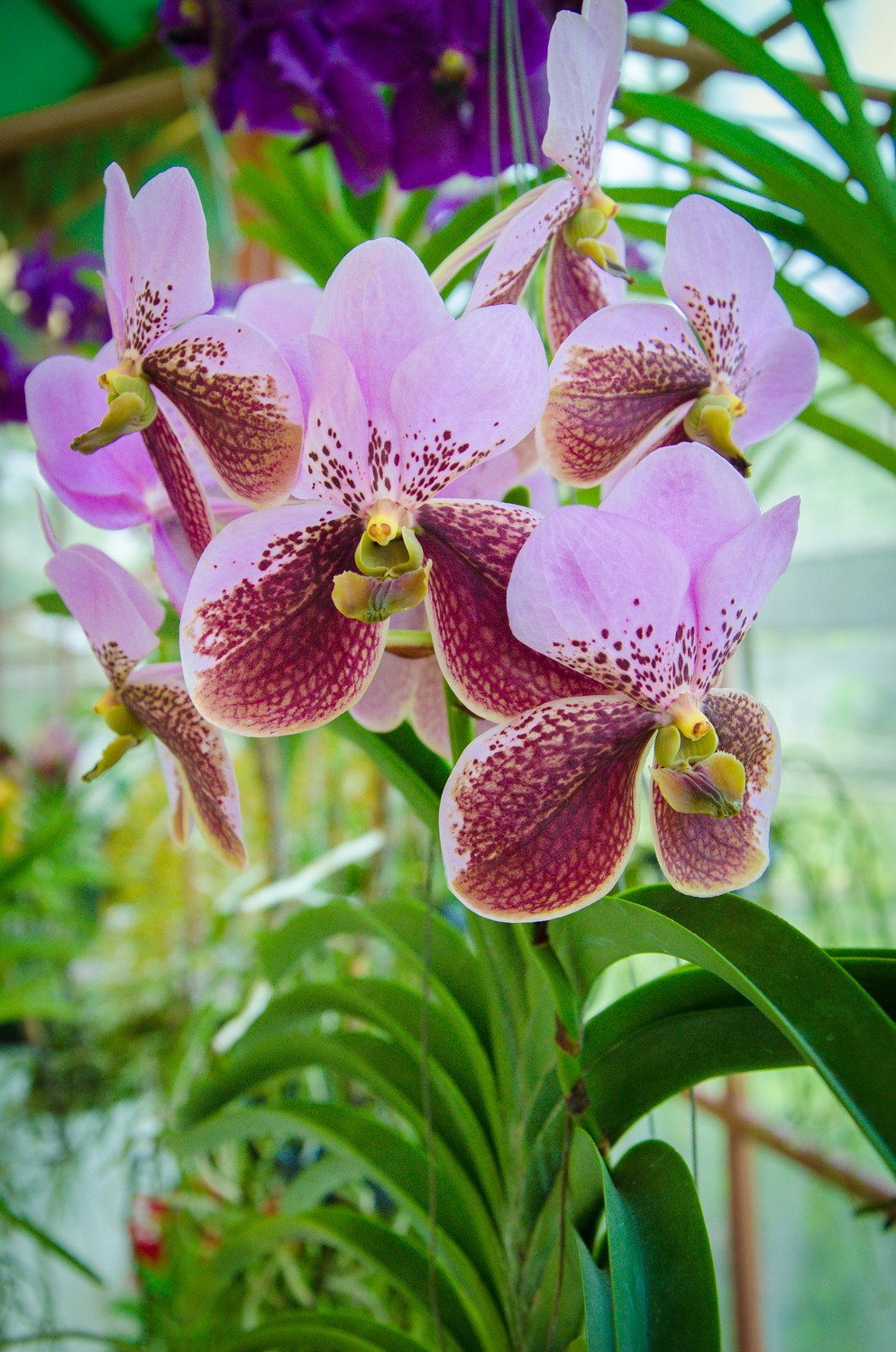
Waling-waling is an orchid with strap-shaped leaves and upright flower stalks that carry 8 to 12 broad, flat flowers. The flowers can show a mix of colors, including yellowish-green, white, rose, purple, and sometimes green or crimson on the lip. Some varieties have spotted or veined patterns. It grows as an epiphyte, meaning it lives on tree trunks rather than in soil.
Where does Waling-waling come from?
This orchid is found only in Mindanao, especially in Davao, Cotabato, and Zamboanga, where it grows on dipterocarp trees below 500 meters elevation. It was first described in 1882 by Heinrich Gustav Reichenbach, initially as Esmeralda sanderiana, and later placed in the genus Vanda. Over-collection has made it rare in the wild. The plant is named after Henry Frederick Conrad Sander, an orchidologist.
When and how Waling-waling blooms
Waling-waling blooms as an epiphyte on tree trunks in lowland forests. It thrives at elevations below 500 meters and is often grown by orchid enthusiasts for its showy flowers. The plant is also used in breeding new orchid hybrids. In cultivation, it is valued for its large, colorful blooms and is grown in gardens and collections.

How Waling-waling is used
Highly valued in the Philippines, waling-waling is a symbol of beauty and pride. It is featured in the logo of the Philippine Orchid Society and is celebrated at festivals. The indigenous Bagobo people worship it as a diwata, or spirit. Its rarity and striking flowers make it a prized plant for home gardens and orchid shows.
Kinds of Waling-waling
There are three main varieties: var. albata, with smaller flowers and yellowish-green sepals with white margins; var. froebeliana, which has very large, rose-colored flowers with yellow and purple veining; and var. labello-viridi, similar to the species but with a green lip marked with crimson stripes. Some varieties are now extremely rare in the wild.
What Waling-waling means
Waling-waling is often called the 'Queen of Philippine flowers' and is deeply respected in local culture. It was proposed as a national flower of the Philippines, and in 2013, a bill passed to declare it a national flower alongside the sampaguita, though this was later vetoed. The Bagobo people regard it as sacred. The flower is a symbol of natural heritage and conservation.
Questions people ask about Waling-waling
Where does the waling-waling orchid come from?
Waling-waling (Vanda sanderiana) is native to Mindanao in the Philippines, especially in the regions of Davao, Cotabato, and Zamboanga, where it grows on the trunks of dipterocarp trees in lowland forests.
What does the waling-waling flower look like?
The plant has strap-shaped leaves and upright stalks with 8 to 12 broad, flat flowers. Flower colors vary by variety and can include yellow, white, rose, purple, green, and crimson, often with spots or veining.
Why is the waling-waling important in the Philippines?
Waling-waling is considered the 'Queen of Philippine flowers' and is a symbol of beauty and pride. It is featured in cultural events and was proposed as a national flower. The Bagobo people also worship it as a diwata, or spirit.
Are there different varieties of waling-waling?
Yes, there are three main varieties: albata, with smaller, yellowish-green and white flowers; froebeliana, with large, rose and yellow flowers with purple veins; and labello-viridi, which has a green and crimson-striped lip.
Is waling-waling easy to find in the wild?
No, waling-waling is now rare in its natural habitat due to over-collection. Some varieties are extremely rare in the wild, but the plant is often grown in gardens and used in orchid breeding.
Good reading and sources
- Encyclopaedia BritannicaArticle
- Vanda sanderianaRoyal Horticultural Society, Article
- Plants of the World OnlineRoyal Botanic Gardens, Kew, Plant database
- Where it has been recordedGBIF, Plant database
- Sightings and photos by naturalistsiNaturalist, Plant database
- Waling-waling on WikipediaEncyclopedia
- More photos on Wikimedia CommonsPhotos
- Wikidata recordOpen data
The facts on this page come from the Wikipedia article "Waling-waling", written by its contributors and used under the CC BY-SA 4.0 licence, and from its Wikidata record (CC0). Phool rewrote the text in its own words, with AI assistance, and compares every page with the article to make sure no passage is copied. It may be reused under the same CC BY-SA 4.0 licence with a link back.
It may contain mistakes. It is not medical or foraging advice: many flowers are poisonous, and traditional uses are reported, not recommended. If something is wrong, tell us. Last refreshed 2026-10-03.
Others in the family Orchidaceae
The whole family OrchidOrchidaceae
A vast family of colourful, often fragrant flowers found almost everywhere on earth
Orchidaceae · Wildflower
OrchidOrchidaceae
A vast family of colourful, often fragrant flowers found almost everywhere on earth
Orchidaceae · Wildflower
 Vanilla
Climbing orchids with pods used for the world’s most popular flavor
🇲🇽 Mexico and 7 more · Wildflower
Vanilla
Climbing orchids with pods used for the world’s most popular flavor
🇲🇽 Mexico and 7 more · Wildflower
 Orchis
A group of wild orchids with tuberous roots from Europe, North Africa and Asia
🇹🇷 Turkey and 7 more · Wildflower
Orchis
A group of wild orchids with tuberous roots from Europe, North Africa and Asia
🇹🇷 Turkey and 7 more · Wildflower
 Paphiopedilum glaucophyllum
A Southeast Asian slipper orchid with blue-green leaves and striped flowers
🇮🇩 Indonesia · Wildflower
Paphiopedilum glaucophyllum
A Southeast Asian slipper orchid with blue-green leaves and striped flowers
🇮🇩 Indonesia · Wildflower
More from the Philippines
All the flowers of the Philippines JasmineJasminum
A group of fragrant shrubs and vines with white or yellow star-shaped flowers
🇵🇰 Pakistan and 7 more · Wildflower
JasmineJasminum
A group of fragrant shrubs and vines with white or yellow star-shaped flowers
🇵🇰 Pakistan and 7 more · Wildflower
 WaterlilyNymphaea
Floating aquatic flowers found in ponds and lakes worldwide
🇪🇬 Egypt and 7 more · Water flower
WaterlilyNymphaea
Floating aquatic flowers found in ponds and lakes worldwide
🇪🇬 Egypt and 7 more · Water flower
 Plumeria
Fragrant tropical tree with waxy, five-petaled flowers in many colours
🇲🇽 Mexico and 6 more · Flowering tree
Plumeria
Fragrant tropical tree with waxy, five-petaled flowers in many colours
🇲🇽 Mexico and 6 more · Flowering tree
 AchioteBixa orellana
Shrub with spiky red pods, source of the natural dye annatto
🇧🇷 Brazil and 9 more · Flowering shrub
AchioteBixa orellana
Shrub with spiky red pods, source of the natural dye annatto
🇧🇷 Brazil and 9 more · Flowering shrub