
American wisteria
Wisteria frutescens, family Fabaceae
A climbing vine with blue-purple flower clusters from the southeastern United States
American wisteria is a woody vine from the southeastern United States, known for its twining stems and compact blue-purple flower clusters that bloom in late spring or early summer. It grows in moist woods and along streams, and its flowers are smaller than those of Asian wisterias, making it popular for bonsai and woodland gardens.
- Produces the smallest flower clusters of any wisteria
- Native to moist woods and stream banks in the southeastern United States
- All parts of the plant, especially seeds and pods, are toxic if eaten
- Popular for bonsai due to its compact blooms
- Larval host for several butterfly and moth species
What does American wisteria look like?
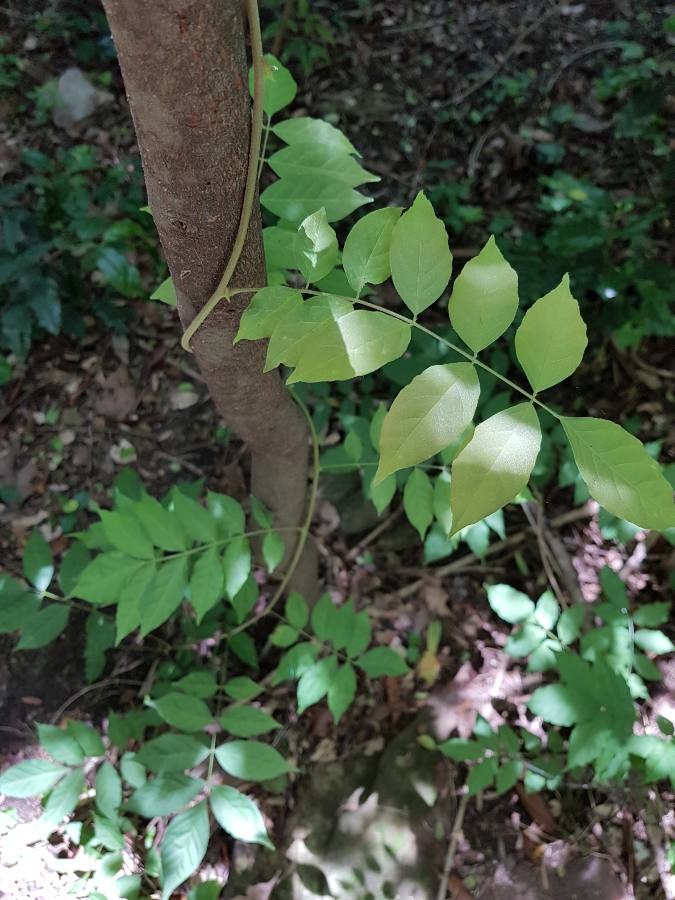
American wisteria is a perennial vine that can reach up to 15 meters in length, climbing by twisting its stems around supports. Its leaves are dark green, shiny, and divided into 9 to 15 oblong leaflets. The plant produces dense, short clusters of blue-purple flowers, each about 2 centimeters wide, in late spring or early summer. These clusters are the smallest among wisterias. After flowering, it forms bean-like seed pods that are greenish-tan and fuzzy when young, turning smooth and brown as they mature. The flowers have a light scent, and the plant is often grown for its manageable size and attractive blooms.
Where does American wisteria come from?
This species grows wild in the southeastern United States, from Virginia through Texas and Florida, and northward to Iowa, Michigan, and New York. It is found in moist woods, thickets, and along stream banks. Carl Linnaeus first described the species. Over time, it has become valued in gardens, especially in North America, for its smaller flower clusters and less aggressive growth compared to Asian wisterias. The Kentucky wisteria, a variety found in the southeastern states, is sometimes treated as a separate species.
When and how American wisteria blooms
American wisteria blooms from late spring into early summer, producing its flowers when exposed to partial or full sunlight. It prefers moist, well-drained soils and is tolerant of some shade, though it flowers best with more sun. The vine grows in USDA zones 5 to 9 and can be started from seed or cuttings. In gardens, it is often trained to climb trellises, fences, or arbors, and is also used in bonsai for its small flower clusters.

How American wisteria is used
People grow American wisteria mainly for its ornamental value in gardens and woodland settings. Its compact flower clusters make it suitable for smaller spaces and for bonsai enthusiasts. The plant is also a larval host for several butterfly and moth species. While it is not widely used in ceremonies or as a cut flower, its presence in gardens supports local wildlife and adds color in late spring and early summer.
Kinds of American wisteria
Kentucky wisteria (Wisteria frutescens var. macrostachya) is a notable variety, with longer racemes and slightly scented bluish-purple to white flowers. This variety is found in the southeastern United States, especially Kentucky, and is sometimes classified as a separate species. American wisteria is distinct from Asian species by its shorter flower clusters and less vigorous growth.
What American wisteria means
American wisteria is valued as a native plant in the United States and is sometimes used as a regional emblem. Its manageable size and native status make it a favorite for naturalistic gardens. The plant contains toxic compounds in its seeds and pods, so care is needed around children and pets. It supports several native butterfly and moth species as a larval host.
Where American wisteria is used and seen
 Hunter Valley GardensA vast themed garden and event venue in Pokolbin, New South Wales
 KanzashiTraditional Japanese hair ornaments, often crafted as folded silk flowers
 HanafudaJapanese playing cards with flower designs used for traditional games
 Jindai Botanical GardenTokyo’s first botanical garden, with themed plant zones and a large greenhouse
Questions people ask about American wisteria
Where does American wisteria grow naturally?
American wisteria is found in the wild across the southeastern United States, from Virginia to Texas and Florida, and also north to Iowa, Michigan, and New York. It prefers moist woods, thickets, and areas along streams.
What does American wisteria look like?
It is a climbing vine with shiny, dark green leaves divided into many leaflets. The plant produces short, dense clusters of blue-purple flowers in late spring or early summer, followed by bean-like seed pods.
Is American wisteria poisonous?
Yes, all parts of American wisteria, especially the seeds and pods, contain toxic compounds. Eating them can cause nausea, vomiting, and other symptoms, so it should be kept away from children and pets.
How is American wisteria different from Asian wisterias?
American wisteria has shorter flower clusters, grows less aggressively, and its mature seed pods are smooth rather than velvety. Its flowers are also lightly scented and it is more manageable in gardens.
What is American wisteria used for?
It is mainly grown as an ornamental vine in gardens and woodland settings. It is also used in bonsai and supports native butterflies and moths as a larval host.
Good reading and sources
- Lady Bird Johnson Wildflower CenterLady Bird Johnson Wildflower Center, Article
- USDA Plants DatabaseUS Department of Agriculture, Article
- Plants of the World OnlineRoyal Botanic Gardens, Kew, Plant database
- Where it has been recordedGBIF, Plant database
- Sightings and photos by naturalistsiNaturalist, Plant database
- Wisteria frutescens on WikipediaEncyclopedia
- More photos on Wikimedia CommonsPhotos
- Wikidata recordOpen data
The facts on this page come from the Wikipedia article "Wisteria frutescens", written by its contributors and used under the CC BY-SA 4.0 licence, and from its Wikidata record (CC0). Phool rewrote the text in its own words, with AI assistance, and compares every page with the article to make sure no passage is copied. It may be reused under the same CC BY-SA 4.0 licence with a link back.
It may contain mistakes. It is not medical or foraging advice: many flowers are poisonous, and traditional uses are reported, not recommended. If something is wrong, tell us. Last refreshed 2026-10-03.
Others in the family Fabaceae
The whole family Acacia
Shrubs and trees with golden or cream puffball flowers, native mostly to Australia
🇦🇺 Australia and 6 more · Wildflower
Acacia
Shrubs and trees with golden or cream puffball flowers, native mostly to Australia
🇦🇺 Australia and 6 more · Wildflower
 Sensitive PlantMimosa pudica
A touch-sensitive plant whose leaves fold up when disturbed
🇧🇷 Brazil and 8 more · Wildflower
Sensitive PlantMimosa pudica
A touch-sensitive plant whose leaves fold up when disturbed
🇧🇷 Brazil and 8 more · Wildflower
 Black locustRobinia pseudoacacia
A tall, fragrant-flowered tree native to eastern North America
🇺🇸 United States and 7 more · Flowering tree
Black locustRobinia pseudoacacia
A tall, fragrant-flowered tree native to eastern North America
🇺🇸 United States and 7 more · Flowering tree
 LupinLupinus
Tall, spiky-flowered legumes grown for gardens, food, and soil health
🇺🇸 United States and 7 more · Wildflower
LupinLupinus
Tall, spiky-flowered legumes grown for gardens, food, and soil health
🇺🇸 United States and 7 more · Wildflower
More from the United States
All the flowers of the United States PeachPrunus persica
A flowering fruit tree from China, grown for its pink blossoms and sweet fruit
🇨🇳 China and 7 more · Flowering tree
PeachPrunus persica
A flowering fruit tree from China, grown for its pink blossoms and sweet fruit
🇨🇳 China and 7 more · Flowering tree
 AlmondPrunus amygdalus
A Mediterranean tree grown for its fragrant spring flowers and edible seeds
🇮🇷 Iran and 6 more · Flowering tree
AlmondPrunus amygdalus
A Mediterranean tree grown for its fragrant spring flowers and edible seeds
🇮🇷 Iran and 6 more · Flowering tree
 CactusCactaceae
Succulent plants with spines, native to the Americas
🇲🇽 Mexico and 7 more · Wildflower
CactusCactaceae
Succulent plants with spines, native to the Americas
🇲🇽 Mexico and 7 more · Wildflower
 Chrysanthemum菊花
Autumn-blooming flower with thousands of varieties, cherished in East Asia and beyond
🇨🇳 China and 6 more · Wildflower
Chrysanthemum菊花
Autumn-blooming flower with thousands of varieties, cherished in East Asia and beyond
🇨🇳 China and 6 more · Wildflower