
Soaptree yucca
Yucca elata, family Asparagaceae
A tall desert plant with white, bell-shaped flowers and fibrous leaves
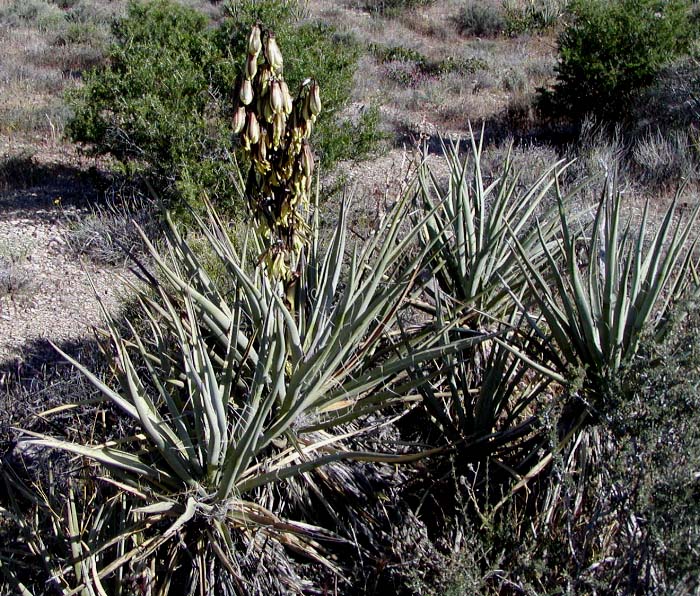
Soaptree yucca is a perennial plant found in the deserts of the southwestern United States and northern Mexico. It grows tall with a narrow trunk, dense whorls of slender leaves, and clusters of creamy white, bell-shaped flowers. Its leaves and roots have long been used by Native Americans for weaving and soap.
- Native to the deserts of the southwestern US and northern Mexico
- Used by Native Americans for weaving and soap
- White, bell-shaped flowers bloom in dense clusters
- State flower of New Mexico
- Trunk and roots contain a natural soap
What does Soaptree yucca look like?
Soaptree yucca grows as a tall, narrow-trunked plant, reaching heights from about 1.2 to 4.5 meters. Its trunk is brown and slim, often showing holes from yucca moth larvae. At the top, slender leaves form a dense spiral whorl, each leaf stretching up to nearly a meter long but only a centimeter wide. The flowers are creamy white, bell-shaped, and cluster densely on a stalk above the leaves. The fruit is a brown capsule that splits into three to release black seeds.
Where does Soaptree yucca come from?
This plant is native to the Sonoran and Chihuahuan Deserts, covering parts of the southwestern United States—especially western Texas, New Mexico, Arizona, southern Nevada, and southwestern Utah—and northern Mexico, including Chihuahua, Coahuila, Sonora, and Nuevo León. It thrives in dry, sunny, semi-desert climates and is widely distributed across these regions, though its numbers are thought to be decreasing.
When and how Soaptree yucca blooms
Soaptree yucca does not flower every year. When it does, the flowers appear in summer, forming dense clusters at the top of the plant. It grows best in dry, sunny areas and is adapted to withstand cold as well as drought. The plant can be grown from seed, and its fibrous leaves and soapy roots are harvested for traditional uses.


How Soaptree yucca is used
Native Americans have long used the strong fibers from the leaves to make sandals, belts, baskets, mats, and cords. The flowers are edible. The trunk and roots contain a soapy substance high in saponins, once used as soap and shampoo. Some tribes, such as the Zuni and Apache, used yucca for washing and for making rope and dental floss. In droughts, ranchers have fed chopped trunks and leaves to cattle.
Kinds of Soaptree yucca
There are three recognized subspecies: Yucca elata ssp. elata, with large capsules and long leaves found throughout the range; ssp. verdiensis, with smaller capsules and shorter leaves, found only in Arizona; and ssp. utahensis. Sources differ on whether these are varieties or subspecies.
What Soaptree yucca means
The flowers of Yucca are the state flower of New Mexico, and soaptree yucca is one of the most widespread species in that state. Its use for soap, weaving, and food is part of Native American tradition. The plant is valued for its resilience in harsh desert environments and for its many practical uses.
Where Soaptree yucca is used and seen


Questions people ask about Soaptree yucca
Where does soaptree yucca come from?
Soaptree yucca is native to the Sonoran and Chihuahuan Deserts, found in the southwestern United States and northern Mexico, including regions like New Mexico, Arizona, and Chihuahua.
What does soaptree yucca look like?
It is a tall plant with a slim, brown trunk and a dense crown of long, narrow leaves. Its flowers are creamy white, bell-shaped, and grow in clusters at the top of the plant.
How have people used soaptree yucca?
Native Americans used its leaf fibers for weaving items like sandals and baskets, and its roots and trunk for soap. The flowers are also edible, and ranchers sometimes feed the plant to cattle during drought.
Is soaptree yucca a symbol for any place?
Yes, the flowers of Yucca, including soaptree yucca, are the state flower of New Mexico.
Are there different types of soaptree yucca?
There are three subspecies: ssp. elata, ssp. verdiensis, and ssp. utahensis, which differ in leaf length and fruit size, and are found in different parts of its range.
Good reading and sources
- IUCN Red List of Threatened SpeciesIUCN Red List, Article
- Species: Yucca elataUS Department of Agriculture, Article
- Plants of the World OnlineRoyal Botanic Gardens, Kew, Plant database
- Where it has been recordedGBIF, Plant database
- Sightings and photos by naturalistsiNaturalist, Plant database
The facts on this page come from the Wikipedia article "Yucca elata", written by its contributors and used under the CC BY-SA 4.0 licence, and from its Wikidata record (CC0). Phool rewrote the text in its own words, with AI assistance, and compares every page with the article to make sure no passage is copied. It may be reused under the same CC BY-SA 4.0 licence with a link back.
It may contain mistakes. It is not medical or foraging advice: many flowers are poisonous, and traditional uses are reported, not recommended. If something is wrong, tell us. Last refreshed 2026-10-03.
Others in the family Asparagaceae
The whole family Lily-of-the-valleyConvallaria majalis
A woodland plant with sweet-scented white bell flowers in late spring
🇫🇮 Finland and 4 more · Wildflower
Lily-of-the-valleyConvallaria majalis
A woodland plant with sweet-scented white bell flowers in late spring
🇫🇮 Finland and 4 more · Wildflower
 HyacinthHyacinthus
A spring-blooming bulb with fragrant, colourful flower spikes
🇹🇷 Turkey and 7 more · Bulb flower
HyacinthHyacinthus
A spring-blooming bulb with fragrant, colourful flower spikes
🇹🇷 Turkey and 7 more · Bulb flower
 Yucca
Dry-climate plants with pointed leaves and clusters of creamy white flowers
🇲🇽 Mexico and 4 more · Wildflower
Yucca
Dry-climate plants with pointed leaves and clusters of creamy white flowers
🇲🇽 Mexico and 4 more · Wildflower
 Ornithogalum thyrsoides
A white, long-lasting bulb flower from South Africa’s Cape Province
🇿🇦 South Africa · Bulb flower
Ornithogalum thyrsoides
A white, long-lasting bulb flower from South Africa’s Cape Province
🇿🇦 South Africa · Bulb flower
More from the United States
All the flowers of the United States AlmondPrunus amygdalus
A Mediterranean tree grown for its fragrant spring flowers and edible seeds
🇮🇷 Iran and 6 more · Flowering tree
AlmondPrunus amygdalus
A Mediterranean tree grown for its fragrant spring flowers and edible seeds
🇮🇷 Iran and 6 more · Flowering tree
 CactusCactaceae
Succulent plants with spines, native to the Americas
🇲🇽 Mexico and 7 more · Wildflower
CactusCactaceae
Succulent plants with spines, native to the Americas
🇲🇽 Mexico and 7 more · Wildflower
 Chrysanthemum菊花
Autumn-blooming flower with thousands of varieties, cherished in East Asia and beyond
🇨🇳 China and 6 more · Wildflower
Chrysanthemum菊花
Autumn-blooming flower with thousands of varieties, cherished in East Asia and beyond
🇨🇳 China and 6 more · Wildflower
 LindenTilia
Tall, broad-leaved trees with fragrant yellow flowers and heart-shaped leaves
🇨🇳 China and 7 more · Flowering tree
LindenTilia
Tall, broad-leaved trees with fragrant yellow flowers and heart-shaped leaves
🇨🇳 China and 7 more · Flowering tree