
Kaffir lime
Citrus hystrix, family Rutaceae
In its own language: มะกรูด
A citrus shrub with double leaves and bumpy green fruit, used across Southeast Asia
Kaffir lime is a thorny citrus shrub or small tree grown for its aromatic double leaves and bumpy green fruit. Native to tropical Southeast Asia, it is widely used in cooking, traditional medicine, and religious rites across the region.
- Leaves are uniquely 'double', with a winged petiole fused to the blade
- Fruit is bumpy, green turning yellow, about 4 cm wide
- Used in Cambodian religious ceremonies with lustral water
- Contains furanocoumarins that can cause skin inflammation
- City of Cabuyao in the Philippines named after this fruit
What does Kaffir lime look like?
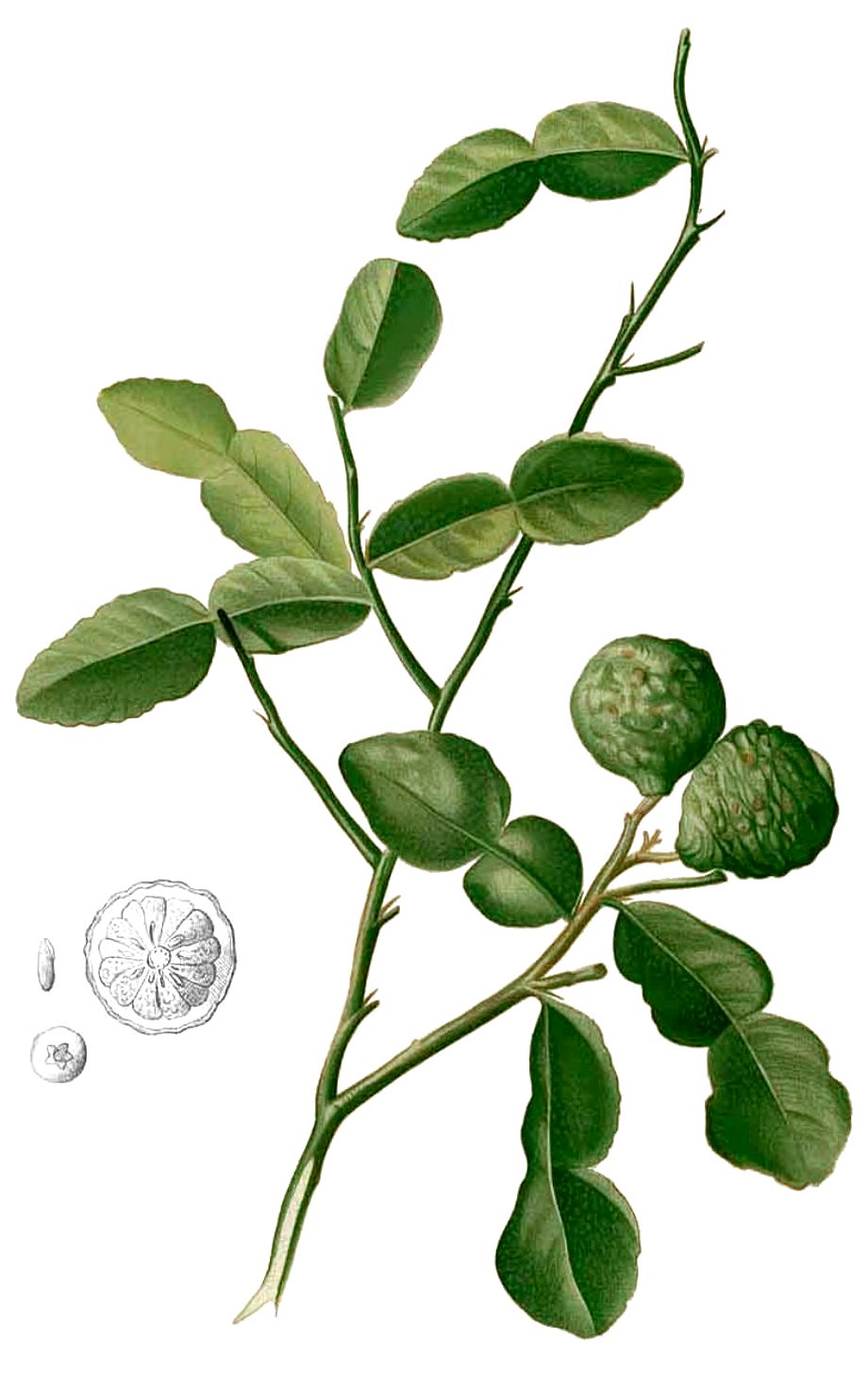
Kaffir lime is a thorny shrub or small tree reaching up to 11 metres tall. It has unusual 'double' leaves, each leaf blade joined to a flattened, leaf-like stalk. The small fruit is rough, green when unripe and yellow when ripe, about 4 cm wide, with a bumpy surface. Its white flowers are fragrant.
Where does Kaffir lime come from?
The plant is native to the Tibet Autonomous Region and tropical Southeast Asia. Early European records from Ceylon (now Sri Lanka) in the late 19th century refer to it as 'Caffre Lime' or 'Leech Lime', noting its use against leeches. The name 'makrut' comes from Thai, where it is a common culinary ingredient.
When and how Kaffir lime blooms
It grows as a shrub or small tree in warm climates and is often cultivated in containers on patios or in conservatories. It produces fragrant white flowers with four or five petals. The leaves, fruit rind, and essential oil are harvested for various uses throughout the year.



How Kaffir lime is used
Its leaves are essential in Thai, Cambodian, Indonesian, and other Southeast Asian cuisines. The rind flavors curry pastes, while the juice is used in shampoo and as a cleanser. In Cambodia, sliced fruit is added to lustral water for religious ceremonies. The oil is used in perfumery and cosmetics.
What Kaffir lime means
In Cambodia, the fruit appears in religious rituals. The city of Cabuyao in the Philippines takes its name from the local term for the fruit, 'kabuyaw'. Due to the offensive connotations of 'kaffir' in South Africa, alternative names like 'makrut lime' or 'Thai lime' are increasingly preferred.
Where Kaffir lime is used and seen
 Essential oilFragrant plant oils used for scent, flavour, and traditional remedies
 Hanbury botanical gardensA historic Mediterranean botanical garden on the Italian Riviera
 Jardin botanique exotique de MentonA Mediterranean garden in Menton with rare and exotic plants from around the world
 Mehtab BaghA Mughal riverside garden facing the Taj Mahal in Agra
 Lincoln Park ConservatoryA Victorian glasshouse and gardens in Chicago's Lincoln Park
 Gardens of the WorldA 4.5-acre botanical garden with themed gardens in Thousand Oaks, California
 Jardin des plantes de NantesA historic botanical garden in the heart of Nantes, France
 Villa BorgheseA grand eighty-hectare landscape park and historic estate in the heart of Rome
Questions people ask about Kaffir lime
Where does kaffir lime come from?
It is native to the Tibet Autonomous Region and tropical Southeast Asia, and is widely cultivated across countries like Thailand, Cambodia, Indonesia, and the Philippines.
What is kaffir lime used for?
Its leaves and rind are used in Southeast Asian cooking, its juice in traditional shampoo and cleansers, and its oil in perfumery. In Cambodia, it is used in religious ceremonies.
Is kaffir lime toxic?
Yes, it contains furanocoumarins in both peel and pulp that can cause phytophotodermatitis, a severe skin inflammation, especially after sun exposure.
Why is it called makrut lime?
‘Makrut’ comes from the Thai name มะกรูด (makrud), commonly used in Thai cuisine. This name is now preferred over ‘kaffir lime’ due to the latter’s offensive connotations in some regions.
What do kaffir lime flowers look like?
They have four to five white petals and are fragrant, appearing on a thorny shrub or small tree that also bears bumpy green fruit.
Good reading and sources
- Plants of the World OnlineRoyal Botanic Gardens, Kew, Plant database
- Where it has been recordedGBIF, Plant database
- Sightings and photos by naturalistsiNaturalist, Plant database
The facts on this page come from the Wikipedia article "Kaffir lime", written by its contributors and used under the CC BY-SA 4.0 licence, and from its Wikidata record (CC0). EveryPhool rewrote the text in its own words, with AI assistance, and compares every page with the article to make sure no passage is copied. It may be reused under the same CC BY-SA 4.0 licence with a link back.
It may contain mistakes. It is not medical or foraging advice: many flowers are poisonous, and traditional uses are reported, not recommended. If something is wrong, tell us. Last refreshed 2026-10-04.
Others in the family Rutaceae
The whole family Bitter orangeCitrus × aurantium
The citrus tree behind Seville orange marmalade and Neroli oil
🇨🇳 China and 6 more · Flowering tree
Bitter orangeCitrus × aurantium
The citrus tree behind Seville orange marmalade and Neroli oil
🇨🇳 China and 6 more · Flowering tree
 Philotheca
A group of Australian shrubs with delicate five-petalled flowers
🇦🇺 Australia · Flowering shrub
Philotheca
A group of Australian shrubs with delicate five-petalled flowers
🇦🇺 Australia · Flowering shrub
 Tachibana orangeCitrus × tachibana
A wild mandarin orange found in the forests of Japan
🇯🇵 Japan and 1 more · Wildflower
Tachibana orangeCitrus × tachibana
A wild mandarin orange found in the forests of Japan
🇯🇵 Japan and 1 more · Wildflower
 Satsuma mandarinCitrus unshiu
A sweet, easy-peeling citrus fruit grown in Japan, China, and beyond
🇯🇵 Japan and 5 more · Flowering tree
Satsuma mandarinCitrus unshiu
A sweet, easy-peeling citrus fruit grown in Japan, China, and beyond
🇯🇵 Japan and 5 more · Flowering tree
More from Thailand
All the flowers of Thailand BaelAegle marmelos
A spiny tree with fragrant yellow-green flowers and hard-shelled aromatic fruit
🇮🇳 India and 6 more · Flowering tree
BaelAegle marmelos
A spiny tree with fragrant yellow-green flowers and hard-shelled aromatic fruit
🇮🇳 India and 6 more · Flowering tree
 Ylang-ylangCananga odorata
A tropical tree with highly fragrant yellow flowers used for perfume and decoration
🇻🇳 Vietnam and 8 more · Flowering tree
Ylang-ylangCananga odorata
A tropical tree with highly fragrant yellow flowers used for perfume and decoration
🇻🇳 Vietnam and 8 more · Flowering tree
 Holy basilOcimum tenuiflorum
A fragrant herb central to Hindu worship and Southeast Asian cooking
🇲🇲 Myanmar and 6 more · Herb or useful flower
Holy basilOcimum tenuiflorum
A fragrant herb central to Hindu worship and Southeast Asian cooking
🇲🇲 Myanmar and 6 more · Herb or useful flower
 Arabian jasmineJasminum sambac
A small white jasmine with a strong, sweet scent, treasured in Asia for garlands and ceremonies
🇨🇳 China and 7 more · Flowering shrub
Arabian jasmineJasminum sambac
A small white jasmine with a strong, sweet scent, treasured in Asia for garlands and ceremonies
🇨🇳 China and 7 more · Flowering shrub