
Rhipsalis
A genus of hanging cacti with thin, tangled stems and small white flowers
Rhipsalis is a genus of epiphytic cacti that grow on trees in tropical rainforests without harming them. Native to Central and South America, one species also occurs naturally in Africa, Madagascar and Sri Lanka, the only cactus found wild outside the Americas.
- Only cactus genus naturally found outside the Americas
- Grows on trees without harming them (epiphytic)
- Named from Greek for 'wickerwork' due to tangled stems
- Most species have spineless adult stems
- Produces small white flowers and colorful berries
What does Rhipsalis look like?
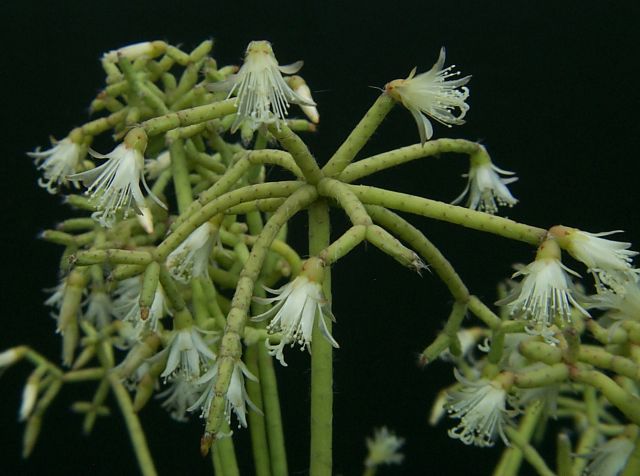
Rhipsalis plants have thin, succulent stems that hang down or sprawl. Their stems may be round, angled or flat, and are often tangled like wickerwork, hence the name. Most lack spines as adults. Small flowers, usually white but sometimes yellow or red, appear along the stems. These turn into berries that can be white, pink, red or yellow.
Where does Rhipsalis come from?
Rhipsalis grows wild across tropical rainforests of the Americas, with its greatest diversity in Brazil’s Mata Atlantica. Uniquely among cacti, one species, Rhipsalis baccifera, is also native to parts of Africa, Madagascar and Sri Lanka. It was first described in 1788, though mistakenly thought to be a parasitic laurel, not a cactus.
When and how Rhipsalis blooms
These cacti grow as epiphytes on trees in humid forests, absorbing moisture from the air. Some species grow on rocks or rarely in soil. They thrive in warm, shaded, moist environments typical of tropical rainforests. Their stems grow long and pendulous over time, branching repeatedly.



Kinds of Rhipsalis
The genus includes many species with different stem forms, from thick and fleshy to thread-thin. Rhipsalis pilocarpa is covered in bristles, while R. hoelleri is the only one with red flowers. Molecular studies have reshaped its classification into three subgenera based on evolutionary relationships.
Questions people ask about Rhipsalis
Where does Rhipsalis come from?
Rhipsalis is native to tropical rainforests of Central America, the Caribbean, and northern and central South America, especially Brazil’s Mata Atlantica. One species also grows wild in Africa, Madagascar and Sri Lanka.
Is Rhipsalis a true cactus?
Yes, Rhipsalis belongs to the cactus family (Cactaceae). It was first misidentified in 1788 as a parasitic laurel, but is now confirmed as an epiphytic cactus.
What do Rhipsalis flowers look like?
The flowers are small, about 1 cm wide, usually white or whitish. A few species have yellow or red flowers. They grow along the stems or at the tips.
Why is it called mistletoe cactus?
It is called mistletoe cactus because it grows on trees like mistletoe, though unlike mistletoe it does not parasitize them, it is an epiphyte that uses trees only for support.
Does Rhipsalis have spines?
Most Rhipsalis species lack spines as adults; some only have them in their juvenile stage. The stems are typically smooth, though Rhipsalis pilocarpa is covered in bristles.
Good reading and sources
- Encyclopaedia BritannicaArticle
- USDA Plants DatabaseUS Department of Agriculture, Article
- Plants of the World OnlineRoyal Botanic Gardens, Kew, Plant database
- Where it has been recordedGBIF, Plant database
- Sightings and photos by naturalistsiNaturalist, Plant database
The facts on this page come from the Wikipedia article "Rhipsalis", written by its contributors and used under the CC BY-SA 4.0 licence, and from its Wikidata record (CC0). EveryPhool rewrote the text in its own words, with AI assistance, and compares every page with the article to make sure no passage is copied. It may be reused under the same CC BY-SA 4.0 licence with a link back.
It may contain mistakes. It is not medical or foraging advice: many flowers are poisonous, and traditional uses are reported, not recommended. If something is wrong, tell us. Last refreshed 2026-10-04.
Others in the family Cactaceae
The whole family Prickly pearOpuntia
Cactus with flat pads and edible fruit, native to the Americas
🇲🇽 Mexico and 7 more · Wildflower
Indian fig opuntiaOpuntia ficus-indica
A large, spiny cactus grown for its sweet fruit and edible pads
🇲🇽 Mexico and 7 more · Wildflower
Prickly pearOpuntia
Cactus with flat pads and edible fruit, native to the Americas
🇲🇽 Mexico and 7 more · Wildflower
Indian fig opuntiaOpuntia ficus-indica
A large, spiny cactus grown for its sweet fruit and edible pads
🇲🇽 Mexico and 7 more · Wildflower
 Mammillaria
A diverse group of small, rounded cacti with funnel-shaped flowers
🇲🇽 Mexico and 5 more · Wildflower
Mammillaria
A diverse group of small, rounded cacti with funnel-shaped flowers
🇲🇽 Mexico and 5 more · Wildflower
 Disocactus ackermannii
A scarlet-flowered epiphytic cactus from southern Mexico's cloud forests
🇲🇽 Mexico and 1 more · Wildflower
Disocactus ackermannii
A scarlet-flowered epiphytic cactus from southern Mexico's cloud forests
🇲🇽 Mexico and 1 more · Wildflower
More from Brazil
All the flowers of Brazil CactusCactaceae
Succulent plants with spines, native to the Americas
🇲🇽 Mexico and 7 more · Wildflower
CactusCactaceae
Succulent plants with spines, native to the Americas
🇲🇽 Mexico and 7 more · Wildflower
 Gymnocalycium
Low-growing South American cacti with bright, funnel-shaped flowers
🇦🇷 Argentina and 4 more · Wildflower
Gymnocalycium
Low-growing South American cacti with bright, funnel-shaped flowers
🇦🇷 Argentina and 4 more · Wildflower
 Echinopsis
South American cacti with large, showy flowers and spiny stems
🇦🇷 Argentina and 6 more · Wildflower
Echinopsis
South American cacti with large, showy flowers and spiny stems
🇦🇷 Argentina and 6 more · Wildflower
 Rose mossPortulaca grandiflora
A low, colourful succulent with bright flowers for sunny gardens and containers
🇧🇷 Brazil and 3 more · Garden flower
Rose mossPortulaca grandiflora
A low, colourful succulent with bright flowers for sunny gardens and containers
🇧🇷 Brazil and 3 more · Garden flower