
Wisteria
Woody climbing vines with long, fragrant flower clusters
Wisteria is a group of twining, woody vines in the legume family, known for their long, hanging clusters of fragrant flowers in shades of white, lilac, purple, and pink. Native to East Asia and North America, wisteria is widely grown as an ornamental plant, but all parts are toxic if eaten.
- Wisteria flowers hang in long, fragrant clusters up to 2 meters long
- All parts of the plant are toxic if eaten, especially the seeds
- Native to East Asia and North America, now grown worldwide
- Wisteria is a symbol in Japanese family crests and art
- The world's largest wisteria vine is in Sierra Madre, California
What does Wisteria look like?
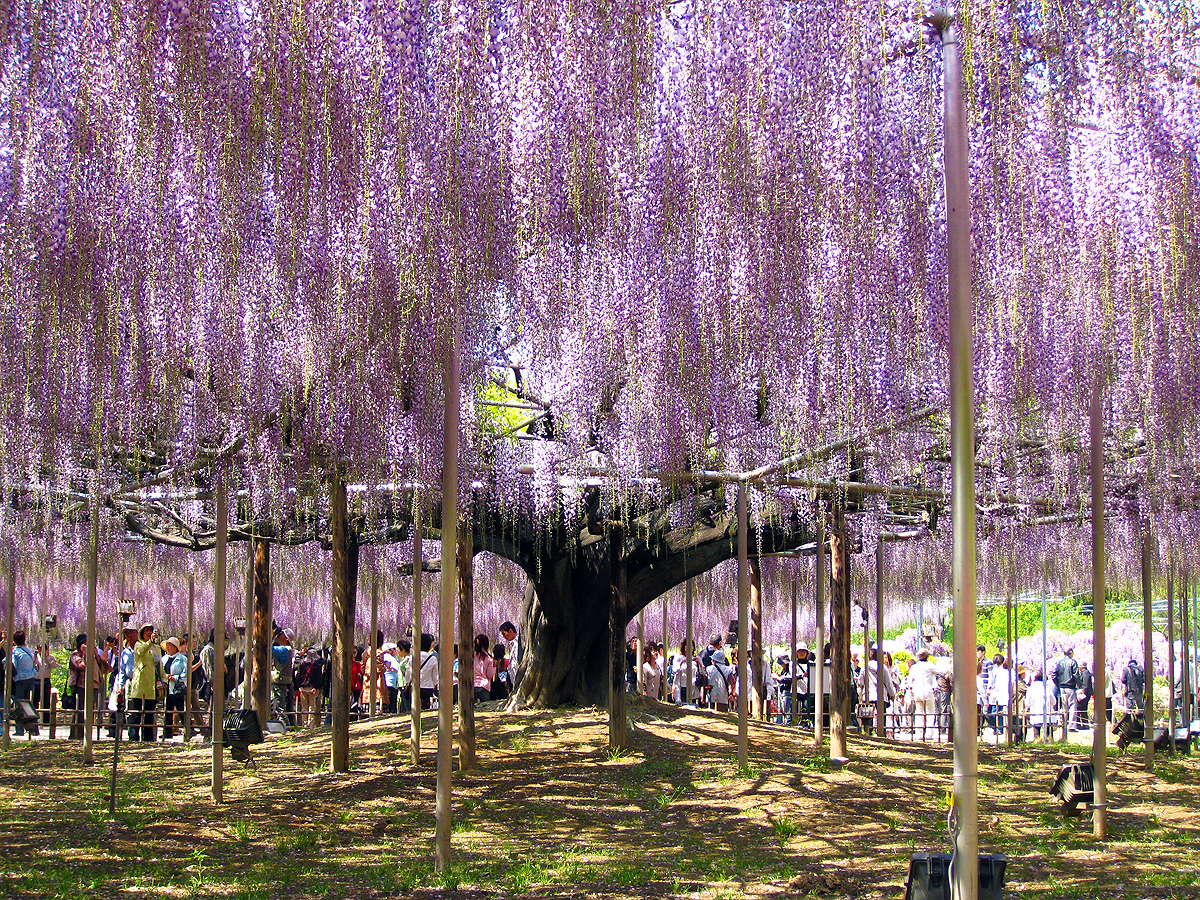
Wisteria vines climb by wrapping their woody stems around supports, reaching up to 20 meters high and spreading 10 meters wide. The leaves are long and divided into many leaflets. Its flowers hang in drooping clusters, called racemes, which can be very long—up to 2 meters in some Japanese varieties. The flowers are usually white, lilac, purple, or pink, and many have a sweet, musky scent. After flowering, wisteria produces seed pods similar to those of other legumes.
Where does Wisteria come from?
Wisteria is native to East Asia—China, Japan, Korea, and Vietnam—as well as parts of North America, including the eastern United States and southern Canada, and north of Iran. The genus was named in Philadelphia in 1818 by Thomas Nuttall, in memory of Caspar Wistar. Wisteria was introduced to Europe in the 19th century and quickly became a popular ornamental plant. Its name is sometimes spelled 'wistaria', and in several European languages, it is known by variants of its former genus name, Glycine.
When and how Wisteria blooms
Wisteria blooms in spring in Asian species and in summer in American species. It prefers fertile, moist, well-drained soil and full sun, but can grow in poorer soils. It is usually grown from cuttings or grafts, as plants grown from seed may take many years to flower. Wisteria needs strong support, such as a pergola or wall, as mature plants become very heavy. Pruning helps control its size and encourages flowering.



How Wisteria is used
Wisteria is mainly grown as an ornamental vine in gardens, admired for its abundant, fragrant flowers. Some varieties of wisteria are edible if prepared correctly, but all parts contain a toxic compound called wisterin, and seeds are especially dangerous if eaten. In Japan, wisteria has been a popular symbol in family crests and art. In the United States, some species are considered invasive.
Kinds of Wisteria
There are four accepted species of wisteria. W. floribunda (Japanese wisteria) is known for its very long flower clusters, while W. sinensis (Chinese wisteria) is valued for its hardiness and shorter racemes. W. frutescens (American wisteria) has the shortest flower clusters. Many cultivars exist, especially of Japanese wisteria, with a range of flower colors and raceme lengths.
What Wisteria means
Wisteria is a traditional motif in Japanese family crests, especially those of the Fujiwara clan, and appears in art, dance, and design. The plant symbolizes longevity and fertility in Japan. In the West, wisteria has been used in decorative arts, such as tiles and stained glass. Wisteria is also grown in national collections in the United Kingdom.
Where Wisteria is used and seen
 Hunter Valley GardensA vast themed garden and event venue in Pokolbin, New South Wales
 KanzashiTraditional Japanese hair ornaments, often crafted as folded silk flowers
 HanafudaJapanese playing cards with flower designs used for traditional games
 Jindai Botanical GardenTokyo’s first botanical garden, with themed plant zones and a large greenhouse
 GivernyThe Normandy village home to Claude Monet's water lilies and walled garden
 Isola MadreThe largest Borromean island on Lake Maggiore, home to an English-style botanical garden
Where to see Wisteria
 🇫🇷 Giverny · Apr to OctMonet's garden and water lily pond at GivernyThe flower garden and lily pond that Claude Monet made in Normandy and painted for the last decades of his life.
 🇪🇸 Granada · Apr to OctThe Generalife gardens above the AlhambraThe summer estate of Granada's Nasrid rulers, where water channels run between roses, myrtle, jasmine and orange trees.
 🇺🇸 San Marino · Jan to DecThe Huntington's rose, camellia and desert gardensA library and art estate near Pasadena with more than a dozen themed gardens, strongest in winter and spring.
Questions people ask about Wisteria
Where does wisteria come from?
Wisteria is native to China, Japan, Korea, Vietnam, the eastern United States, southern Canada, and north of Iran. It has been introduced to Europe and other parts of the world as an ornamental plant.
What does wisteria look like?
Wisteria is a woody vine that climbs by twining around supports. It has long, divided leaves and produces drooping clusters of flowers in white, lilac, purple, or pink, often with a strong, sweet scent.
Is wisteria poisonous?
Yes, all parts of the wisteria plant contain a toxic compound called wisterin. The seeds are especially poisonous and can cause serious illness if eaten.
How is wisteria used in culture?
In Japan, wisteria is a common symbol in family crests and appears in art and dance. In the West, it is used in decorative arts and as a popular garden plant.
Can wisteria be eaten?
Some Japanese sources say certain parts of Wisteria floribunda can be eaten if prepared properly, but the plant is generally considered toxic, especially the seeds, and has caused poisoning.
Good reading and sources
- Encyclopaedia BritannicaArticle
- Wisteria floribunda, W. sinensisUS Department of Agriculture, Article
- Plants of the World OnlineRoyal Botanic Gardens, Kew, Plant database
- Where it has been recordedGBIF, Plant database
- Sightings and photos by naturalistsiNaturalist, Plant database
The facts on this page come from the Wikipedia article "Wisteria", written by its contributors and used under the CC BY-SA 4.0 licence, and from its Wikidata record (CC0). Phool rewrote the text in its own words, with AI assistance, and compares every page with the article to make sure no passage is copied. It may be reused under the same CC BY-SA 4.0 licence with a link back.
It may contain mistakes. It is not medical or foraging advice: many flowers are poisonous, and traditional uses are reported, not recommended. If something is wrong, tell us. Last refreshed 2026-10-03.
Others in the family Fabaceae
The whole family Acacia
Shrubs and trees with golden or cream puffball flowers, native mostly to Australia
🇦🇺 Australia and 6 more · Wildflower
Acacia
Shrubs and trees with golden or cream puffball flowers, native mostly to Australia
🇦🇺 Australia and 6 more · Wildflower
 Sensitive PlantMimosa pudica
A touch-sensitive plant whose leaves fold up when disturbed
🇧🇷 Brazil and 8 more · Wildflower
Sensitive PlantMimosa pudica
A touch-sensitive plant whose leaves fold up when disturbed
🇧🇷 Brazil and 8 more · Wildflower
 Black locustRobinia pseudoacacia
A tall, fragrant-flowered tree native to eastern North America
🇺🇸 United States and 7 more · Flowering tree
Black locustRobinia pseudoacacia
A tall, fragrant-flowered tree native to eastern North America
🇺🇸 United States and 7 more · Flowering tree
 LupinLupinus
Tall, spiky-flowered legumes grown for gardens, food, and soil health
🇺🇸 United States and 7 more · Wildflower
LupinLupinus
Tall, spiky-flowered legumes grown for gardens, food, and soil health
🇺🇸 United States and 7 more · Wildflower
More from China
All the flowers of China RoseRosa
Prickly flowering shrubs grown across the world for fragrant blossoms and rose hips
🇨🇳 China and 7 more · Flowering shrub
RoseRosa
Prickly flowering shrubs grown across the world for fragrant blossoms and rose hips
🇨🇳 China and 7 more · Flowering shrub
 PeachPrunus persica
A flowering fruit tree from China, grown for its pink blossoms and sweet fruit
🇨🇳 China and 7 more · Flowering tree
PeachPrunus persica
A flowering fruit tree from China, grown for its pink blossoms and sweet fruit
🇨🇳 China and 7 more · Flowering tree
 Common sunflowerHelianthus annuus
A tall annual plant grown for its large yellow flower heads and edible seeds
🇨🇦 Canada and 4 more · Wildflower
Common sunflowerHelianthus annuus
A tall annual plant grown for its large yellow flower heads and edible seeds
🇨🇦 Canada and 4 more · Wildflower
 PomegranatePunica granatum
A shrub with bright red flowers and a fruit full of edible seeds
🇮🇷 Iran and 9 more · Flowering shrub
PomegranatePunica granatum
A shrub with bright red flowers and a fruit full of edible seeds
🇮🇷 Iran and 9 more · Flowering shrub