
Soapweed yucca
Yucca glauca, family Asparagaceae
A hardy, spiky-leaved yucca of the central North American plains
Soapweed yucca is a tough, evergreen plant with long, narrow leaves and tall spikes of pale, drooping flowers. Native to the central plains of North America, it thrives in dry, open areas. People have used its leaves, roots, and flowers for food, tools, and washing, and it is valued in gardens for its drought resistance.
- Grows in clumps of sharp, narrow leaves up to 60 cm long
- Native to the plains from Canada to the southern United States
- Flowers are white to pale green and hang in clusters on tall stalks
- Roots and leaves were used by Native Americans for washing and making tools
- Pollinated by yucca moths in a unique partnership
What does Soapweed yucca look like?
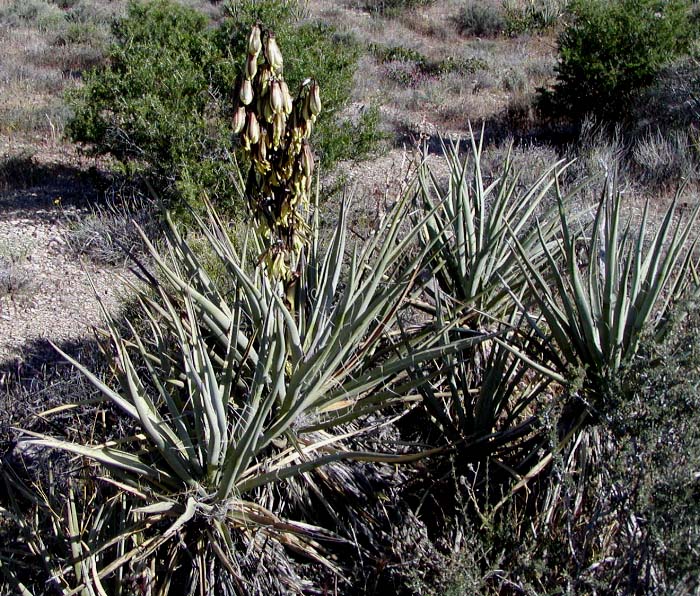
Soapweed yucca grows in clumps, each made up of a rosette of stiff, narrow leaves that can reach up to 60 cm long but are rarely more than 12 mm wide. The leaves end in sharp points. In summer, it sends up a flower stalk that can be as tall as a meter, sometimes branching. Its flowers hang downward and are white to pale green, shaped like small bells. The plant produces dry seed capsules containing shiny black seeds.
Where does Soapweed yucca come from?
This yucca is native to the central plains of North America, found from Alberta and Saskatchewan in Canada down through the United States into Texas and New Mexico. It is well adapted to dry, open habitats and has long been part of the landscape there. The plant was first described scientifically under the name Yucca angustifolia. Its relationship with yucca moths, which pollinate its flowers, was first studied in the 19th century.
When and how Soapweed yucca blooms
Soapweed yucca blooms in summer, producing tall spikes of flowers. It grows best in dry, well-drained soils and open, sunny places. The plant can be started from seed, which benefits from cold treatment, or by dividing roots or taking stem cuttings. Its sharp-tipped leaves make it wise to plant away from paths. The plant is valued for its ability to survive drought and cold.

How Soapweed yucca is used
Native American groups such as the Blackfoot, Cheyenne, Lakota, and Zuni used different parts of this yucca. The roots were pounded to make a soapy lather for washing. Leaves were crafted into brushes, mats, ropes, and pads. Young flower stalks and unripe fruits were cooked and eaten, and the seed pods were boiled for food. Today, it is also planted in gardens for its resilience.
Kinds of Soapweed yucca
Yucca glauca is sometimes called by other names, such as small soapweed or Spanish bayonet. It is closely related to other yuccas, like Yucca filamentosa, which shares similar pollinators. The plant may vary in size and the branching of its flower stalks, but its narrow, pointed leaves and pale, drooping flowers are its main features.
What Soapweed yucca means
Soapweed yucca has a close relationship with yucca moths, which are its main pollinators. This partnership has been studied since the 1800s and is important for both the plant and the moth. The plant has been used traditionally for practical purposes, but it does not have a strong role in symbolism or religious practice. Its tough nature and striking form make it a favorite for dry gardens.
Where Soapweed yucca is used and seen


Questions people ask about Soapweed yucca
Where does soapweed yucca come from?
Soapweed yucca is native to the central plains of North America, stretching from Alberta and Saskatchewan in Canada through the central United States to Texas and New Mexico.
What does soapweed yucca look like?
It forms dense clusters of long, narrow, pointed leaves and sends up tall stalks with drooping, bell-shaped flowers that are white to pale green.
How have people used soapweed yucca?
Native American groups used its roots for soap, its leaves for making ropes, mats, and brushes, and its young flower stalks and fruits as food.
What pollinates soapweed yucca?
Yucca moths, especially Tegeticula yuccasella, pollinate its flowers in a close mutual relationship.
Is soapweed yucca good for gardens?
Yes, it is valued for drought tolerance, cold hardiness, and its striking appearance, especially in xeriscapes and high-altitude gardens.
Good reading and sources
- Lady Bird Johnson Wildflower CenterLady Bird Johnson Wildflower Center, Article
- IUCN Red List of Threatened SpeciesIUCN Red List, Article
- Yucca glaucaUS Department of Agriculture, Article
- Plants of the World OnlineRoyal Botanic Gardens, Kew, Plant database
- Where it has been recordedGBIF, Plant database
- Sightings and photos by naturalistsiNaturalist, Plant database
The facts on this page come from the Wikipedia article "Yucca glauca", written by its contributors and used under the CC BY-SA 4.0 licence, and from its Wikidata record (CC0). Phool rewrote the text in its own words, with AI assistance, and compares every page with the article to make sure no passage is copied. It may be reused under the same CC BY-SA 4.0 licence with a link back.
It may contain mistakes. It is not medical or foraging advice: many flowers are poisonous, and traditional uses are reported, not recommended. If something is wrong, tell us. Last refreshed 2026-10-03.
Others in the family Asparagaceae
The whole family Lily-of-the-valleyConvallaria majalis
A woodland plant with sweet-scented white bell flowers in late spring
🇫🇮 Finland and 4 more · Wildflower
Lily-of-the-valleyConvallaria majalis
A woodland plant with sweet-scented white bell flowers in late spring
🇫🇮 Finland and 4 more · Wildflower
 HyacinthHyacinthus
A spring-blooming bulb with fragrant, colourful flower spikes
🇹🇷 Turkey and 7 more · Bulb flower
HyacinthHyacinthus
A spring-blooming bulb with fragrant, colourful flower spikes
🇹🇷 Turkey and 7 more · Bulb flower
 Yucca
Dry-climate plants with pointed leaves and clusters of creamy white flowers
🇲🇽 Mexico and 4 more · Wildflower
Yucca
Dry-climate plants with pointed leaves and clusters of creamy white flowers
🇲🇽 Mexico and 4 more · Wildflower
 Ornithogalum thyrsoides
A white, long-lasting bulb flower from South Africa’s Cape Province
🇿🇦 South Africa · Bulb flower
Ornithogalum thyrsoides
A white, long-lasting bulb flower from South Africa’s Cape Province
🇿🇦 South Africa · Bulb flower
More from Canada
All the flowers of Canada Common sunflowerHelianthus annuus
A tall annual plant grown for its large yellow flower heads and edible seeds
🇨🇦 Canada and 4 more · Wildflower
Common sunflowerHelianthus annuus
A tall annual plant grown for its large yellow flower heads and edible seeds
🇨🇦 Canada and 4 more · Wildflower
 BirchBetula
Slender trees with papery bark found across the northern world
🇨🇳 China and 7 more · Wildflower
BirchBetula
Slender trees with papery bark found across the northern world
🇨🇳 China and 7 more · Wildflower
 CactusCactaceae
Succulent plants with spines, native to the Americas
🇲🇽 Mexico and 7 more · Wildflower
CactusCactaceae
Succulent plants with spines, native to the Americas
🇲🇽 Mexico and 7 more · Wildflower
 TulipTulipa
Spring-blooming bulbs with showy, cup-shaped flowers in many colours
🇳🇱 Netherlands and 7 more · Wildflower
TulipTulipa
Spring-blooming bulbs with showy, cup-shaped flowers in many colours
🇳🇱 Netherlands and 7 more · Wildflower