
Sieber's crocus
Crocus sieberi, family Iridaceae
A small wild crocus from the Balkans with vivid orange stamens
Sieber's crocus is a low-growing spring flower found in the Balkans, especially Greece and Crete. Its blooms show off white, lilac, or violet petals with striking orange or yellow centers. People grow it in gardens for its early color, and in some places, its corms and leaves are eaten.
- Native to Greece, Crete, Albania, Bulgaria, and North Macedonia
- Blooms early in spring, often as snow melts
- Flowers can be white, lilac, violet, or pink with orange or yellow centers
- Corms eaten raw in Greece, leaves eaten in Turkey
- Several garden varieties are widely grown
What does Sieber's crocus look like?
Sieber's crocus is a compact plant, usually reaching 3 to 4 inches tall. Its flowers can be white, lilac, violet, or pale pink, often with a yellow or orange throat and sometimes marked with purple on the outside. The most eye-catching feature is the bright orange or yellow style and stamens in the center. The leaves are slender and grass-like.
Where does Sieber's crocus come from?
This crocus grows wild in the Balkans, especially in Greece, Crete, Albania, Bulgaria, and North Macedonia. It is found in rocky places, mountain woods, and open scrub, often above 1000 meters. Several subspecies are tied to particular regions, such as Crete and the Attica area near Athens. Over time, it has been brought into gardens for its early spring flowers.
When and how Sieber's crocus blooms
Sieber's crocus blooms early in the spring, sometimes as snow is melting. It grows from a corm, a bulb-like storage organ, and prefers stony or well-drained soils. Gardeners plant the corms in autumn for spring flowers. The plant can spread naturally in suitable conditions, forming small colonies.


How Sieber's crocus is used
Gardeners value Sieber's crocus for its bright, early flowers. In Greece, people sometimes eat the corms raw, describing the taste as similar to hazelnuts. In Turkey, the leaves are gathered and eaten as greens. Its main use, though, is as an ornamental plant in gardens and borders.
Kinds of Sieber's crocus
There are four main subspecies, each with its own flower color and region: the Crete form has white flowers with yellow throats and purple markings; the Attica type is lilac-blue or violet; the Peloponnese subspecies is pale lilac with yellow; and nivalis is lilac-blue with yellow. Gardeners also grow named varieties like 'Bowles's White', 'Firefly', 'Tricolor', and 'Violet Queen', each with unique color patterns.
What Sieber's crocus means
Sieber's crocus is mostly grown for its beauty in gardens. Some of its cultivars have been recognized for their quality by horticultural societies. In its native regions, it is also part of local food traditions, though it is not widely used in ceremonies or as a symbol.
Where Sieber's crocus is used and seen
 TulipiereA pottery vessel with spouts for growing tulip bulbs indoors
 Dutch gardenA formal, geometric flower garden style from the Netherlands
 Duin- en BollenstreekThe Dutch coastal region famous for spring bulb fields and flower parades
 Hortus BulborumA Dutch garden preserving centuries-old spring bulbs
Questions people ask about Sieber's crocus
Where does Sieber's crocus come from?
Sieber's crocus grows wild in the Balkans, especially in Greece, Crete, Albania, Bulgaria, and North Macedonia. It is often found in rocky or mountainous places.
What does Sieber's crocus look like?
It is a small plant with flowers that can be white, lilac, violet, or pink, usually with a yellow or orange center. The flowers have slender petals and bright orange or yellow stamens and styles.
How is Sieber's crocus used?
It is mainly grown in gardens for its early spring flowers. In Greece, people sometimes eat the corms raw, and in Turkey, the leaves are used as greens.
Are there different types of Sieber's crocus?
Yes, there are four main subspecies, each found in a different region and with its own flower color. Gardeners also grow several named varieties.
Does Sieber's crocus have any special meaning or use in culture?
It is mostly valued for its ornamental flowers and is not widely used as a symbol or in ceremonies. Some local food uses are recorded in Greece and Turkey.
Good reading and sources
- Crocus sieberi 'Bowles's White'Royal Horticultural Society, Article
- USDA Plants DatabaseUS Department of Agriculture, Article
- Plants of the World OnlineRoyal Botanic Gardens, Kew, Plant database
- Where it has been recordedGBIF, Plant database
- Sightings and photos by naturalistsiNaturalist, Plant database
- Crocus sieberi on WikipediaEncyclopedia
- More photos on Wikimedia CommonsPhotos
- Wikidata recordOpen data
The facts on this page come from the Wikipedia article "Crocus sieberi", written by its contributors and used under the CC BY-SA 4.0 licence, and from its Wikidata record (CC0). Phool rewrote the text in its own words, with AI assistance, and compares every page with the article to make sure no passage is copied. It may be reused under the same CC BY-SA 4.0 licence with a link back.
It may contain mistakes. It is not medical or foraging advice: many flowers are poisonous, and traditional uses are reported, not recommended. If something is wrong, tell us. Last refreshed 2026-10-03.
Others in the family Iridaceae
The whole family Gladiolus
Tall, showy flower spikes grown from corms, known as sword lilies
Gladiolus · Garden flower
Gladiolus
Tall, showy flower spikes grown from corms, known as sword lilies
Gladiolus · Garden flower
 Iris
A large group of perennial flowers with striking, six-lobed blooms
Iris · Wildflower
Iris
A large group of perennial flowers with striking, six-lobed blooms
Iris · Wildflower
 Crocus
Small corm-grown flowers in white, yellow, orange or purple
🇹🇷 Turkey and 7 more · Wildflower
Crocus
Small corm-grown flowers in white, yellow, orange or purple
🇹🇷 Turkey and 7 more · Wildflower
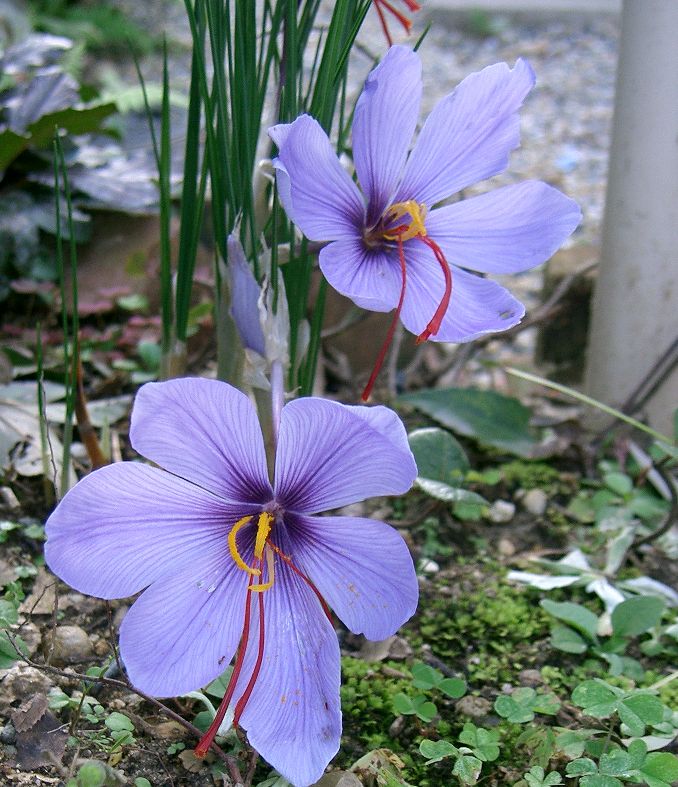 Saffron crocusCrocus sativus
The purple autumn flower whose red stigmas yield the spice saffron
🇨🇳 China and 1 more · Garden flower
Saffron crocusCrocus sativus
The purple autumn flower whose red stigmas yield the spice saffron
🇨🇳 China and 1 more · Garden flower
More from Greece
All the flowers of Greece TulipTulipa
Spring-blooming bulbs with showy, cup-shaped flowers in many colours
🇳🇱 Netherlands and 7 more · Wildflower
TulipTulipa
Spring-blooming bulbs with showy, cup-shaped flowers in many colours
🇳🇱 Netherlands and 7 more · Wildflower
 Eucalyptus
The tall, aromatic trees and shrubs known as gum trees or eucalypts
🇦🇺 Australia and 7 more · Flowering tree
Eucalyptus
The tall, aromatic trees and shrubs known as gum trees or eucalypts
🇦🇺 Australia and 7 more · Flowering tree
 Narcissus
Spring-flowering bulbs with trumpet-shaped blooms in white, yellow, and orange
🇬🇧 United Kingdom and 7 more · Wildflower
Narcissus
Spring-flowering bulbs with trumpet-shaped blooms in white, yellow, and orange
🇬🇧 United Kingdom and 7 more · Wildflower
 Bitter orangeCitrus × aurantium
The citrus tree behind Seville orange marmalade and Neroli oil
🇨🇳 China and 6 more · Flowering tree
Bitter orangeCitrus × aurantium
The citrus tree behind Seville orange marmalade and Neroli oil
🇨🇳 China and 6 more · Flowering tree