
Nazareth Iris
Iris bismarckiana, family Iridaceae
In its own language: סוסנה נצרתית / אִירוּס נָצְרָתִי / سوسنة الناصره
A rare mountain iris with veined pale flowers from Israel and Lebanon
Nazareth Iris is a perennial iris from rocky hills in Israel, Lebanon, Jordan, and Syria. Its large spring flowers have pale backgrounds marked with dark veins and a striking dark beard. It is endangered in the wild and protected in some reserves, but rarely grown in gardens due to its need for hot, dry summers.
- Large spring flowers with pale backgrounds and dark veins
- Native to rocky hills of Israel, Lebanon, Jordan, and Syria
- Endangered and protected in nature reserves
- Toxic if eaten or handled
- Symbol of Nof HaGalil city
What does Nazareth Iris look like?
Nazareth Iris forms small clumps with narrow, spreading underground stems. Its upright, sword-shaped leaves are bright green and can reach up to 50 cm long. Each stem, often taller than the leaves, holds a single large flower in spring. The flower’s base color is pale—yellow, cream, or white—overlaid with bold veins or spots in shades of purple, blue, or maroon. The outer petals show a dark patch and a line of short, dark hairs called the beard. The inner petals are lighter and rounder, also veined or spotted.
Where does Nazareth Iris come from?
This iris grows wild on rocky slopes and open scrubland in northern Israel and southern Lebanon, as well as parts of Syria and Jordan. It is most often found on limestone or basalt soils, sometimes at elevations up to 1,300 meters. The species was named after Prince Otto von Bismarck. Over time, botanists debated its classification, but today Iris bismarckiana is the accepted name. Its Arabic and Hebrew names both refer to Nazareth, the region where it is most closely associated.
When and how Nazareth Iris blooms
Nazareth Iris blooms in spring, usually March and April. It prefers very dry, hot summers and rocky soils. Propagation is possible by dividing the rhizomes or by seed, though seeds often need a period of cold before sprouting. The plant is difficult to grow outside its native climate, as it does not tolerate summer moisture well. It is best planted in autumn.


How Nazareth Iris is used
While mainly a wildflower, the Nazareth Iris has been planted in gardens and cemeteries in its native region. It is rarely seen in gardens elsewhere due to its specific needs. The plant is also linked to local identity, serving as a symbol for the city of Nof HaGalil. Its rhizome has been used in perfume. All parts are toxic if eaten and may irritate the skin.
Kinds of Nazareth Iris
Several cultivated forms exist, including 'Benjaminii', 'Nazarena', and 'Nazarena Thompsoni'. The species is closely related to other Oncocyclus irises like Iris susiana and Iris lortetii, differing mainly in flower color and rhizome type.
What Nazareth Iris means
The Nazareth Iris is endangered, threatened by habitat loss and competition from invasive plants. It is protected by law in Israel and grows in several nature reserves. The flower is a local emblem and sometimes confused with other irises in regional symbols. Conservation efforts include setting aside land and managing competing weeds.
Where Nazareth Iris is used and seen
 BouquetA creative arrangement of flowers, given or displayed for many occasions
 Hakone Botanical Garden of WetlandsA garden of wetland and alpine plants in Hakone, Japan
 Parc floral de ParisA botanical garden and flower park in the Bois de Vincennes, Paris
 Parc Floral de la SourceA large public garden in Orléans built around the source of the Loiret river
 KeukenhofA vast Dutch flower garden famous for its spring tulip displays
 KanzashiTraditional Japanese hair ornaments, often crafted as folded silk flowers
 HanafudaJapanese playing cards with flower designs used for traditional games
 History of flower arrangementHow arranging flowers became an art across cultures and centuries
Questions people ask about Nazareth Iris
Where does the Nazareth Iris come from?
It grows wild on rocky mountainsides in northern Israel, southern Lebanon, parts of Jordan, and Syria. Its name comes from the region of Nazareth in Israel.
What does the Nazareth Iris look like?
It has tall stems with a single large flower in spring. The flower is pale yellow, cream, or white, marked with bold purple, blue, or maroon veins and a dark patch and beard.
Is the Nazareth Iris poisonous?
Yes, like many irises, its leaves and rhizomes are toxic if eaten and can cause stomach upset or skin irritation.
How is the Nazareth Iris used?
It is mostly a wildflower but is sometimes grown in gardens and cemeteries in its native region. The rhizome has been used in perfume.
What does the Nazareth Iris symbolise?
It is a local emblem, especially for the city of Nof HaGalil, and represents the unique flora of its region.
Good reading and sources
- USDA Plants DatabaseUS Department of Agriculture, Article
- Plants of the World OnlineRoyal Botanic Gardens, Kew, Plant database
- Where it has been recordedGBIF, Plant database
- Sightings and photos by naturalistsiNaturalist, Plant database
- Iris bismarckiana on WikipediaEncyclopedia
- More photos on Wikimedia CommonsPhotos
- Wikidata recordOpen data
The facts on this page come from the Wikipedia article "Iris bismarckiana", written by its contributors and used under the CC BY-SA 4.0 licence, and from its Wikidata record (CC0). Phool rewrote the text in its own words, with AI assistance, and compares every page with the article to make sure no passage is copied. It may be reused under the same CC BY-SA 4.0 licence with a link back.
It may contain mistakes. It is not medical or foraging advice: many flowers are poisonous, and traditional uses are reported, not recommended. If something is wrong, tell us. Last refreshed 2026-10-03.
Others in the family Iridaceae
The whole family Gladiolus
Tall, showy flower spikes grown from corms, known as sword lilies
Gladiolus · Garden flower
Gladiolus
Tall, showy flower spikes grown from corms, known as sword lilies
Gladiolus · Garden flower
 Iris
A large group of perennial flowers with striking, six-lobed blooms
Iris · Wildflower
Iris
A large group of perennial flowers with striking, six-lobed blooms
Iris · Wildflower
 Crocus
Small corm-grown flowers in white, yellow, orange or purple
🇹🇷 Turkey and 7 more · Wildflower
Crocus
Small corm-grown flowers in white, yellow, orange or purple
🇹🇷 Turkey and 7 more · Wildflower
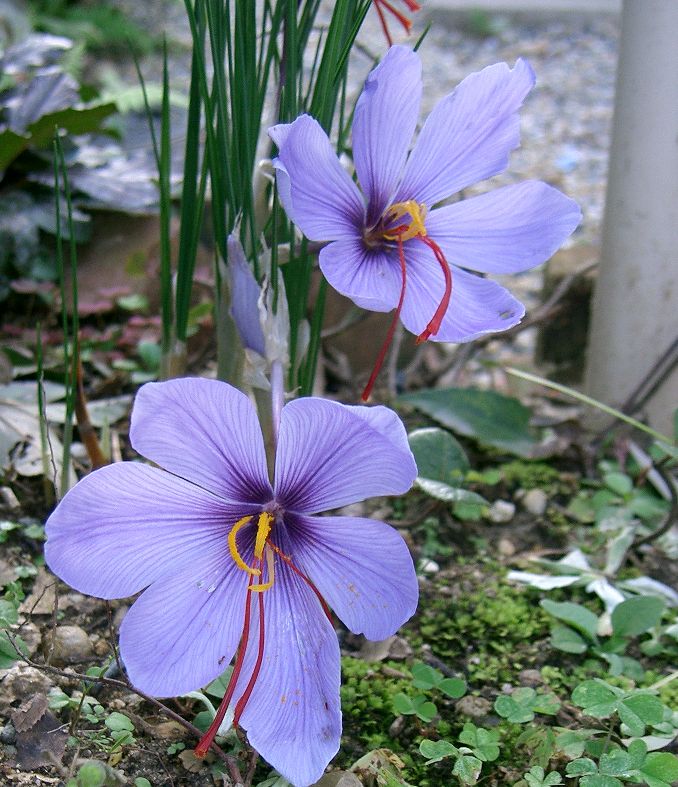 Saffron crocusCrocus sativus
The purple autumn flower whose red stigmas yield the spice saffron
🇨🇳 China and 1 more · Garden flower
Saffron crocusCrocus sativus
The purple autumn flower whose red stigmas yield the spice saffron
🇨🇳 China and 1 more · Garden flower
More from Israel
All the flowers of Israel PomegranatePunica granatum
A shrub with bright red flowers and a fruit full of edible seeds
🇮🇷 Iran and 9 more · Flowering shrub
PomegranatePunica granatum
A shrub with bright red flowers and a fruit full of edible seeds
🇮🇷 Iran and 9 more · Flowering shrub
 Bay laurelLaurus nobilis
Evergreen tree with aromatic leaves used as bay leaf in cooking
🇬🇷 Greece and 9 more · Flowering tree
Bay laurelLaurus nobilis
Evergreen tree with aromatic leaves used as bay leaf in cooking
🇬🇷 Greece and 9 more · Flowering tree
 Indian fig opuntiaOpuntia ficus-indica
A large, spiny cactus grown for its sweet fruit and edible pads
🇲🇽 Mexico and 7 more · Wildflower
Indian fig opuntiaOpuntia ficus-indica
A large, spiny cactus grown for its sweet fruit and edible pads
🇲🇽 Mexico and 7 more · Wildflower
 Orchis
A group of wild orchids with tuberous roots from Europe, North Africa and Asia
🇹🇷 Turkey and 7 more · Wildflower
Orchis
A group of wild orchids with tuberous roots from Europe, North Africa and Asia
🇹🇷 Turkey and 7 more · Wildflower