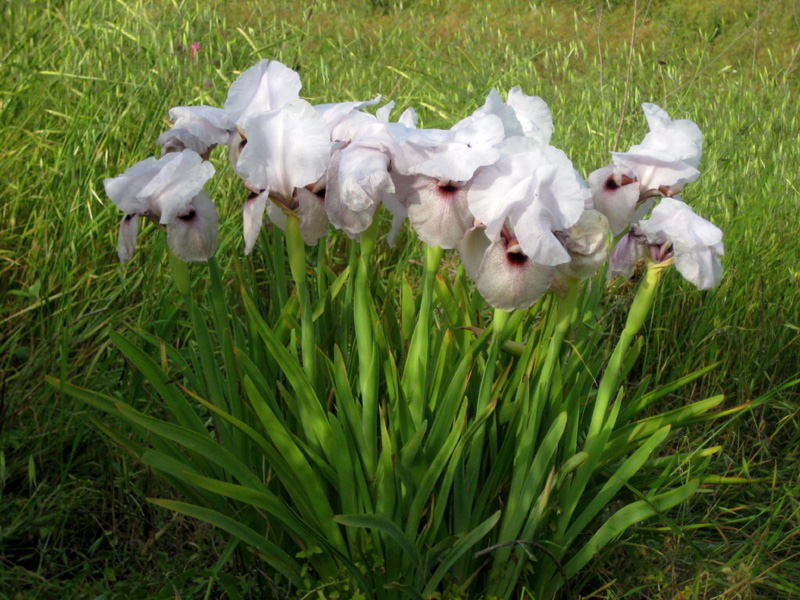
Iris lortetii
In its own language: אִירוּס הָדוּר
A rare pink-veined iris from rocky slopes in Israel, Lebanon, and Palestine
Iris lortetii is a striking iris with large, showy flowers in shades of pink, lilac, and white, veined and dotted with maroon. Native to rocky hills and shrublands of Israel, southern Lebanon, and Palestine, it blooms in late spring. Once widely collected for cut flowers, it is now endangered and protected.
- Large pink, lilac, or white flowers with maroon veins and dots
- Native to rocky hills of Israel, Lebanon, Palestine, and Syria
- Endangered and protected in Israel, with fewer than 10,000 plants
- Difficult to cultivate and rarely survives long in gardens
- Toxic if ingested; handling may cause skin irritation
What does Iris lortetii look like?
Iris lortetii grows from a short, fibrous rhizome and has straight, sword-shaped grey-green leaves that hide its flower stem. The plant reaches 30–50 cm tall and produces a single large flower, 7–9 cm across. Its blooms vary from white and lilac to pink and grey-purple, with maroon or pink veins and dots. The falls (outer petals) are marked with a deep maroon patch and a sparse, reddish or brown beard. After flowering, it forms a seed capsule.
Where does Iris lortetii come from?
This iris is native to rocky limestone slopes and shrublands in Israel, southern Lebanon, Palestine, and Syria. It was first collected in the Upper Galilee by Louis Charles Émile Lortet in 1880 and described in 1882. The species name honours Lortet. Its range includes Upper Galilee, Mount Gilboa, the Samarian mountains, and the Samarian desert. The plant is adapted to well-drained, stony soils and Mediterranean woodlands at 200–1,000 m altitude.
When and how Iris lortetii blooms
Iris lortetii blooms in late spring, mainly April and May. It prefers part shade to full sun and slightly acidic, sandy-clay soils. The plant is deciduous, disappearing in winter. It is difficult to cultivate, needing dry conditions during dormancy and moist soil while growing. Propagation is by seed or division, but seeds have a tough coat and need several months to germinate.


How Iris lortetii is used
Historically, Iris lortetii was collected for the cut flower trade and sold locally and exported to Europe, though cultivated plants rarely survived more than two seasons. It has also been used to decorate cemeteries. Today, it is protected in Israel and grown in gardens by enthusiasts. Its image appeared on an Israeli postage stamp in 1978 to promote wildflower conservation.
Kinds of Iris lortetii
The variety Iris lortetii var. samariae is found around Nablus and differs by having darker standards with brownish to purple veins. There is also a white-flowered cultivar, Iris lortetii 'alba'. These forms reflect the plant's variability in flower colour and pattern.
What Iris lortetii means
Iris lortetii is endangered, with fewer than 10,000 mature plants remaining and populations declining due to habitat loss and over-collection. It is protected by law in Israel, and conservation efforts include seed collection and replanting. The iris has become a symbol of wildflower protection and appears on Israeli stamps.
Where Iris lortetii is used and seen
 BouquetA creative arrangement of flowers, given or displayed for many occasions
 Hakone Botanical Garden of WetlandsA garden of wetland and alpine plants in Hakone, Japan
 Parc floral de ParisA botanical garden and flower park in the Bois de Vincennes, Paris
 Parc Floral de la SourceA large public garden in Orléans built around the source of the Loiret river
 KeukenhofA vast Dutch flower garden famous for its spring tulip displays
 KanzashiTraditional Japanese hair ornaments, often crafted as folded silk flowers
 HanafudaJapanese playing cards with flower designs used for traditional games
 History of flower arrangementHow arranging flowers became an art across cultures and centuries
Questions people ask about Iris lortetii
Where does Iris lortetii come from?
Iris lortetii is native to rocky limestone slopes and shrublands in Israel, southern Lebanon, Palestine, and Syria. It is especially found in regions like Upper Galilee, Mount Gilboa, and the Samarian mountains.
What does Iris lortetii look like?
It has straight grey-green leaves and a single large flower, 7–9 cm across, in shades of pink, lilac, white, or grey-purple, marked with maroon or pink veins and a deep maroon patch. The flower has a sparse reddish or brown beard.
Is Iris lortetii endangered?
Yes, it is considered endangered in Israel, with fewer than 10,000 mature plants. Its numbers have declined due to habitat loss and over-collection for the cut flower trade.
Is Iris lortetii toxic?
Like many irises, most parts of Iris lortetii are poisonous if eaten and can cause stomach pain and vomiting. Handling the plant may also cause skin irritation or allergic reactions.
How is Iris lortetii used?
It was once widely collected for cut flowers and used to decorate cemeteries. Today, it is mostly protected and grown in gardens by enthusiasts. Its image has been used to promote wildflower conservation.
Good reading and sources
- What wild plants can teach Chelsea designersThe Guardian, Article
- Iris lortetiiRoyal Horticultural Society, Article
- IUCN Red List of Threatened SpeciesIUCN Red List, Article
- Plants of the World OnlineRoyal Botanic Gardens, Kew, Plant database
- Where it has been recordedGBIF, Plant database
- Sightings and photos by naturalistsiNaturalist, Plant database
- Iris lortetii on WikipediaEncyclopedia
- More photos on Wikimedia CommonsPhotos
- Wikidata recordOpen data
The facts on this page come from the Wikipedia article "Iris lortetii", written by its contributors and used under the CC BY-SA 4.0 licence, and from its Wikidata record (CC0). Phool rewrote the text in its own words, with AI assistance, and compares every page with the article to make sure no passage is copied. It may be reused under the same CC BY-SA 4.0 licence with a link back.
It may contain mistakes. It is not medical or foraging advice: many flowers are poisonous, and traditional uses are reported, not recommended. If something is wrong, tell us. Last refreshed 2026-10-03.
Others in the family Iridaceae
The whole family Gladiolus
Tall, showy flower spikes grown from corms, known as sword lilies
Gladiolus · Garden flower
Gladiolus
Tall, showy flower spikes grown from corms, known as sword lilies
Gladiolus · Garden flower
 Iris
A large group of perennial flowers with striking, six-lobed blooms
Iris · Wildflower
Iris
A large group of perennial flowers with striking, six-lobed blooms
Iris · Wildflower
 Crocus
Small corm-grown flowers in white, yellow, orange or purple
🇹🇷 Turkey and 7 more · Wildflower
Crocus
Small corm-grown flowers in white, yellow, orange or purple
🇹🇷 Turkey and 7 more · Wildflower
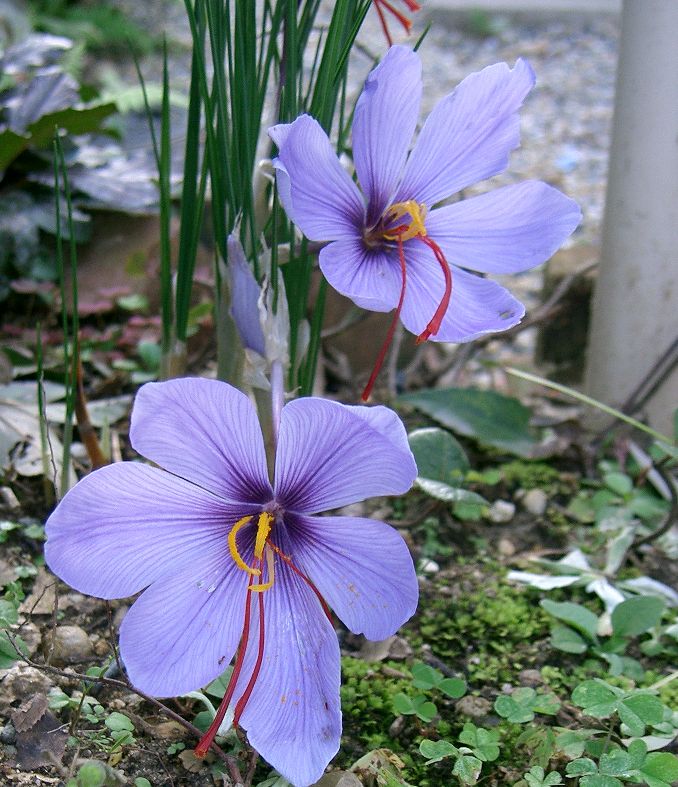 Saffron crocusCrocus sativus
The purple autumn flower whose red stigmas yield the spice saffron
🇨🇳 China and 1 more · Garden flower
Saffron crocusCrocus sativus
The purple autumn flower whose red stigmas yield the spice saffron
🇨🇳 China and 1 more · Garden flower
More from Israel
All the flowers of Israel PomegranatePunica granatum
A shrub with bright red flowers and a fruit full of edible seeds
🇮🇷 Iran and 9 more · Flowering shrub
PomegranatePunica granatum
A shrub with bright red flowers and a fruit full of edible seeds
🇮🇷 Iran and 9 more · Flowering shrub
 Bay laurelLaurus nobilis
Evergreen tree with aromatic leaves used as bay leaf in cooking
🇬🇷 Greece and 9 more · Flowering tree
Bay laurelLaurus nobilis
Evergreen tree with aromatic leaves used as bay leaf in cooking
🇬🇷 Greece and 9 more · Flowering tree
 Indian fig opuntiaOpuntia ficus-indica
A large, spiny cactus grown for its sweet fruit and edible pads
🇲🇽 Mexico and 7 more · Wildflower
Indian fig opuntiaOpuntia ficus-indica
A large, spiny cactus grown for its sweet fruit and edible pads
🇲🇽 Mexico and 7 more · Wildflower
 Orchis
A group of wild orchids with tuberous roots from Europe, North Africa and Asia
🇹🇷 Turkey and 7 more · Wildflower
Orchis
A group of wild orchids with tuberous roots from Europe, North Africa and Asia
🇹🇷 Turkey and 7 more · Wildflower