Iris afghanica
A rare mountain iris from Afghanistan with creamy yellow or white veined flowers
Iris afghanica is a perennial iris native to northeastern Afghanistan’s mountain slopes. It forms small tufts with slender bluish-green leaves and produces creamy yellow or white flowers veined with purple-brown, blooming in late spring to early summer. The plant is grown as an ornamental in temperate regions and is rare in cultivation.
- Native to Afghanistan’s rocky mountain slopes
- Flowers are creamy yellow or white with purple-brown veins
- Blooms from April to June in Europe
- Poisonous if ingested or handled
- Rare in cultivation, seen at Kew Gardens
What does Iris afghanica look like?
Iris afghanica is a small perennial plant that forms tufts up to 20 cm across. Its slender, bluish-green leaves can reach up to 30 cm long and are often sickle-shaped. The plant produces one or two flowers per stem, each 8–9 cm wide, in shades of creamy yellow or white with purple-brown veining and a central purple patch. The flowers have both large drooping sepals (falls) and upright petals (standards), with beards of greenish yellow or purple hairs. Plants at higher altitudes are smaller and deeper in colour, while those lower down are larger and paler.
Where does Iris afghanica come from?
This iris is native to the rocky mountain slopes of northeastern Afghanistan, especially around the Salang Pass, Balkh, and Zabul Provinces. It grows among boulders or on sunny slopes at altitudes from 1,500 to 3,300 meters. The species was first found in 1964 by Paul and Polly Furse and described as new in 1972. Its Latin name, afghanica, refers to Afghanistan, its country of origin. One source also notes its presence in Pakistan.
When and how Iris afghanica blooms
Iris afghanica blooms in late spring to early summer, from April to June in Europe. It prefers well-drained soils in sunny spots, replicating its natural habitat of hot, dry summers and cold winters. The plant is sensitive to moisture and does best in alpine houses or cold frames, especially in temperate regions. Propagation is by seed or division, with division best done in late summer.
How Iris afghanica is used
This iris is mainly grown as an ornamental plant in gardens, especially by collectors and in alpine plant collections. It is rare in cultivation, particularly in the United States, but can be seen in places like the Davies Alpine House at Kew Gardens. The plant is not used for food or medicine, and most parts are poisonous if eaten or handled.
Kinds of Iris afghanica
The appearance of Iris afghanica can vary with altitude: plants at higher elevations are smaller and have deeper colours, while those at lower elevations are larger and paler, sometimes with pure white standards. The species is part of the Regelia section of irises and is diploid with 22 chromosomes.
What Iris afghanica means
Iris afghanica is not tied to any particular symbolism, festival, or religious use in the sources. Its main significance lies in its rarity and its status as a plant native to Afghanistan’s mountains. The species has not been evaluated for the IUCN Red List, and its cultivation remains limited outside its native range.
Where Iris afghanica is used and seen
 BouquetA creative arrangement of flowers, given or displayed for many occasions
 Hakone Botanical Garden of WetlandsA garden of wetland and alpine plants in Hakone, Japan
 Parc floral de ParisA botanical garden and flower park in the Bois de Vincennes, Paris
 Parc Floral de la SourceA large public garden in Orléans built around the source of the Loiret river
 KeukenhofA vast Dutch flower garden famous for its spring tulip displays
 KanzashiTraditional Japanese hair ornaments, often crafted as folded silk flowers
 HanafudaJapanese playing cards with flower designs used for traditional games
 History of flower arrangementHow arranging flowers became an art across cultures and centuries
Questions people ask about Iris afghanica
Where does Iris afghanica come from?
Iris afghanica is native to northeastern Afghanistan, particularly in regions like the Salang Pass, Balkh, and Zabul Provinces. It grows on rocky mountain slopes at high altitudes.
What does Iris afghanica look like?
It forms small tufts with slender bluish-green leaves and produces one or two flowers per stem. The flowers are creamy yellow or white, veined with purple-brown, and have a central purple patch.
When does Iris afghanica flower?
In Europe, Iris afghanica blooms from April to June, which is late spring to early summer. The timing may vary in its native range.
Is Iris afghanica poisonous?
Yes, like many irises, most parts of Iris afghanica are poisonous if eaten and can cause stomach pain or vomiting. Handling the plant may also cause skin irritation.
How is Iris afghanica used?
It is grown as an ornamental plant in gardens, especially in alpine collections. It is rare in cultivation and not used for food or medicine.
Good reading and sources
- Iris afghanicaRoyal Horticultural Society, Article
- Plants of the World OnlineRoyal Botanic Gardens, Kew, Plant database
- Where it has been recordedGBIF, Plant database
- Sightings and photos by naturalistsiNaturalist, Plant database
The facts on this page come from the Wikipedia article "Iris afghanica", written by its contributors and used under the CC BY-SA 4.0 licence, and from its Wikidata record (CC0). Phool rewrote the text in its own words, with AI assistance, and compares every page with the article to make sure no passage is copied. It may be reused under the same CC BY-SA 4.0 licence with a link back.
It may contain mistakes. It is not medical or foraging advice: many flowers are poisonous, and traditional uses are reported, not recommended. If something is wrong, tell us. Last refreshed 2026-10-03.
Others in the family Iridaceae
The whole family Gladiolus
Tall, showy flower spikes grown from corms, known as sword lilies
Gladiolus · Garden flower
Gladiolus
Tall, showy flower spikes grown from corms, known as sword lilies
Gladiolus · Garden flower
 Iris
A large group of perennial flowers with striking, six-lobed blooms
Iris · Wildflower
Iris
A large group of perennial flowers with striking, six-lobed blooms
Iris · Wildflower
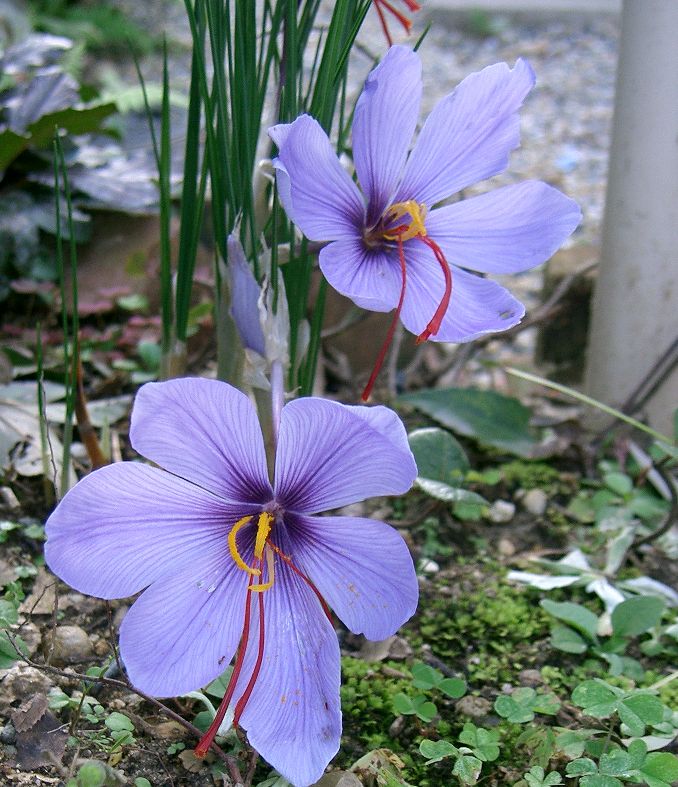 Saffron crocusCrocus sativus
The purple autumn flower whose red stigmas yield the spice saffron
🇨🇳 China and 1 more · Garden flower
Iris damascena
A rare white and purple iris found only on a Syrian mountain
🇸🇾 Syria · Wildflower
Saffron crocusCrocus sativus
The purple autumn flower whose red stigmas yield the spice saffron
🇨🇳 China and 1 more · Garden flower
Iris damascena
A rare white and purple iris found only on a Syrian mountain
🇸🇾 Syria · Wildflower
More from Afghanistan
All the flowers of Afghanistan PomegranatePunica granatum
A shrub with bright red flowers and a fruit full of edible seeds
🇮🇷 Iran and 9 more · Flowering shrub
PomegranatePunica granatum
A shrub with bright red flowers and a fruit full of edible seeds
🇮🇷 Iran and 9 more · Flowering shrub
 FennelFoeniculum vulgare
A tall, aromatic herb with feathery leaves and yellow umbels, used for food and spice
🇨🇳 China and 7 more · Herb or useful flower
FennelFoeniculum vulgare
A tall, aromatic herb with feathery leaves and yellow umbels, used for food and spice
🇨🇳 China and 7 more · Herb or useful flower
 Crocus
Small corm-grown flowers in white, yellow, orange or purple
🇹🇷 Turkey and 7 more · Wildflower
Crocus
Small corm-grown flowers in white, yellow, orange or purple
🇹🇷 Turkey and 7 more · Wildflower
 Datura
A group of trumpet-shaped, highly toxic flowering plants in the nightshade family
🇲🇽 Mexico and 7 more · Wildflower
Datura
A group of trumpet-shaped, highly toxic flowering plants in the nightshade family
🇲🇽 Mexico and 7 more · Wildflower