
Petra iris
Iris petrana, family Iridaceae
In its own language: איריס הנגב
A rare desert iris with deep burgundy to nearly black spring flowers
The Petra iris is a small desert iris native to southern Jordan and the Negev in Israel. Its large, dark flowers bloom above grey-green sword-like leaves in early spring, ranging from burgundy to deep violet. Now endangered in the wild, it is protected in reserves and known for its striking, almost black blooms.
- Blooms in early spring with deep burgundy to nearly black flowers
- Native to the deserts of southern Jordan and Israel's Negev region
- Endangered in the wild and protected in Israeli reserves
- Flowers have a distinctive dark 'beard' on the petals
- All parts of the plant are poisonous if ingested
What does Petra iris look like?
Petra iris is a compact perennial with a small brown rhizome and waxy, sword-shaped grey-green leaves that form low tufts up to 25 cm tall. Its flower stalks rise above the foliage, bearing large blooms 5–7 cm across. The flowers are deep shades of burgundy, brown, or purple, sometimes appearing almost black. Each flower has three large outer petals (falls) with a nearly black patch and a row of orange, yellow, or dark-tipped hairs called the beard, plus three upright inner petals (standards) with dark veining.
Where does Petra iris come from?
This iris grows wild in the sandy deserts and loess plains of southern Jordan and the Negev region of Israel, often near Tafilah and Yeruham. It was first described in 1933 from plants found between Ma'an, Syria, and Amman. The species is named after Petra, the ancient city in Jordan. Over time, its populations have declined due to habitat loss and grazing, and it is now protected in places like the Yeruham Iris Nature Reserve.
When and how Petra iris blooms
Petra iris blooms from February to April, after the spring rains. It thrives in well-drained sandy soils and desert margins, preferring dry conditions, especially in summer. The plant can be grown from seed or by dividing its rhizomes. After flowering, it produces seed capsules whose seeds are dispersed by wind and collected by ants, which are attracted to the fleshy coating on the seeds.


How Petra iris is used
This iris is admired for its unusual dark flowers and is sometimes grown in gardens with suitable dry conditions. In the wild, it is a symbol of the desert landscape and is protected as an endangered species in Israel. All parts of the plant are poisonous if eaten and can cause skin irritation, so it is not used for food or medicine.
Kinds of Petra iris
The Petra iris is sometimes confused with Iris nigricans, and populations in the Negev and around Yeruham were once thought to be a separate species (Iris hieruchamensis), but are now considered the same. Its flower color can vary from deep burgundy to dark violet, with some appearing nearly black depending on light.
What Petra iris means
The Petra iris is a regional emblem of the desert areas where it grows and is listed as endangered in Israel. It is protected in reserves like the Yeruham Iris Nature Reserve. The species is not on the IUCN Red List, but local conservation efforts aim to preserve its unique desert habitat and striking flowers.
Where Petra iris is used and seen
 BouquetA creative arrangement of flowers, given or displayed for many occasions
 Hakone Botanical Garden of WetlandsA garden of wetland and alpine plants in Hakone, Japan
 Parc floral de ParisA botanical garden and flower park in the Bois de Vincennes, Paris
 Parc Floral de la SourceA large public garden in Orléans built around the source of the Loiret river
 KeukenhofA vast Dutch flower garden famous for its spring tulip displays
 KanzashiTraditional Japanese hair ornaments, often crafted as folded silk flowers
 HanafudaJapanese playing cards with flower designs used for traditional games
 History of flower arrangementHow arranging flowers became an art across cultures and centuries
Questions people ask about Petra iris
Where does the Petra iris come from?
The Petra iris is native to the sandy deserts of southern Jordan and the Negev region of Israel, especially near Tafilah and Yeruham. It grows in desert margins and stabilized sand fields.
What does the Petra iris look like?
It is a small plant with grey-green sword-like leaves and large flowers in deep shades of burgundy, brown, or purple. The flowers can appear almost black and have a dark patch and a row of colored hairs on the petals.
Is the Petra iris poisonous?
Yes, like many irises, most parts of the Petra iris are poisonous if eaten and can cause stomach pain and vomiting. Handling the plant may also cause skin irritation or allergic reactions.
Why is the Petra iris endangered?
Its populations have declined due to wildflower picking, uncontrolled grazing, and habitat destruction from development. It is now protected in reserves, especially in Israel, to help conserve the species.
What does the Petra iris symbolise?
The Petra iris is a symbol of the desert regions where it grows and is valued for its rare, dark flowers. It serves as a regional emblem and is protected as an endangered species in Israel.
Good reading and sources
- Plants of the World OnlineRoyal Botanic Gardens, Kew, Plant database
- Where it has been recordedGBIF, Plant database
- Sightings and photos by naturalistsiNaturalist, Plant database
The facts on this page come from the Wikipedia article "Iris petrana", written by its contributors and used under the CC BY-SA 4.0 licence, and from its Wikidata record (CC0). Phool rewrote the text in its own words, with AI assistance, and compares every page with the article to make sure no passage is copied. It may be reused under the same CC BY-SA 4.0 licence with a link back.
It may contain mistakes. It is not medical or foraging advice: many flowers are poisonous, and traditional uses are reported, not recommended. If something is wrong, tell us. Last refreshed 2026-10-03.
Others in the family Iridaceae
The whole family Gladiolus
Tall, showy flower spikes grown from corms, known as sword lilies
Gladiolus · Garden flower
Gladiolus
Tall, showy flower spikes grown from corms, known as sword lilies
Gladiolus · Garden flower
 Iris
A large group of perennial flowers with striking, six-lobed blooms
Iris · Wildflower
Iris
A large group of perennial flowers with striking, six-lobed blooms
Iris · Wildflower
 Crocus
Small corm-grown flowers in white, yellow, orange or purple
🇹🇷 Turkey and 7 more · Wildflower
Crocus
Small corm-grown flowers in white, yellow, orange or purple
🇹🇷 Turkey and 7 more · Wildflower
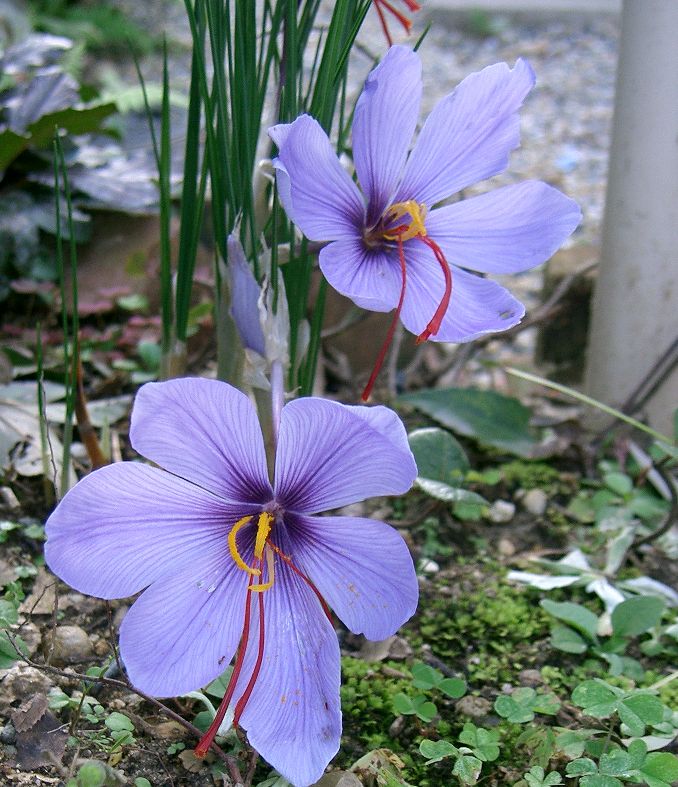 Saffron crocusCrocus sativus
The purple autumn flower whose red stigmas yield the spice saffron
🇨🇳 China and 1 more · Garden flower
Saffron crocusCrocus sativus
The purple autumn flower whose red stigmas yield the spice saffron
🇨🇳 China and 1 more · Garden flower
More from Jordan
All the flowers of Jordan Gilboa IrisIris haynei
A rare deep purple iris from the hills of Israel and Palestine
🇮🇱 Israel and 2 more · Wildflower
Gilboa IrisIris haynei
A rare deep purple iris from the hills of Israel and Palestine
🇮🇱 Israel and 2 more · Wildflower
 Nazareth IrisIris bismarckiana
A rare mountain iris with veined pale flowers from Israel and Lebanon
🇮🇱 Israel and 3 more · Wildflower
Nazareth IrisIris bismarckiana
A rare mountain iris with veined pale flowers from Israel and Lebanon
🇮🇱 Israel and 3 more · Wildflower
 Eryngium
A spiny-leaved plant with blue or white flower heads, grown in gardens and used in cooking
🇲🇽 Mexico and 7 more · Wildflower
Eryngium
A spiny-leaved plant with blue or white flower heads, grown in gardens and used in cooking
🇲🇽 Mexico and 7 more · Wildflower
 Place
Ajloun Forest Reserve
A woodland nature reserve in northern Jordan with rare plants and wildlife
Ajloun, 🇯🇴 Jordan · Bloom site
Place
Ajloun Forest Reserve
A woodland nature reserve in northern Jordan with rare plants and wildlife
Ajloun, 🇯🇴 Jordan · Bloom site