
Spanish iris
Iris xiphium, family Iridaceae
A Mediterranean iris with blue, yellow, or white spring flowers
Spanish iris is a bulbous plant from the Iberian Peninsula and nearby Mediterranean regions. It grows tall, with slender grey-green leaves and flowers in late spring, showing blue, violet, white, or yellow blooms. Florists value it for its vivid colours, and gardeners grow several named varieties.
- Native to Spain and Portugal, also found in North Africa and southern Europe
- Flowers in late spring with blue, violet, white, or yellow blooms
- Leaves appear in autumn and die back after flowering
- Popular with florists for its colour range
- Several named varieties include all-yellow and deep blue forms
What does Spanish iris look like?
Spanish iris grows from a bulb, reaching up to 80 cm tall. Its leaves are narrow, greyish-green, and appear in autumn, growing up to 70 cm before dying back after flowering. The flowers, about 6 cm across, come in blue, violet, white, or yellow, with some varieties showing all-yellow or golden brown shades. The blooms are not as large as some related irises, but are valued for their clear colours.
Where does Spanish iris come from?
This iris is native to Spain and Portugal, but is also found in Corsica, southwest France, southern Italy, Algeria, and Tunisia. Over time, it has become a popular garden plant in other parts of Europe. Its name refers to its sword-shaped leaves, and it is sometimes called the xiphium iris. Gardeners and florists have selected and named several forms for their colour and hardiness.
When and how Spanish iris blooms
The plant is grown from bulbs, which are planted in well-drained, light soil in a sheltered spot. Leaves appear in autumn and last through winter and spring. Flowering usually happens in May and June. After blooming, the leaves die back. It is hardy in much of Europe, but autumn frosts can damage the foliage in colder areas.
How Spanish iris is used
Spanish iris is grown in gardens for its spring flowers and is also used by florists for arrangements, thanks to its bright and varied colours. Several varieties are cultivated for different flower colours, making it a favourite for both home gardens and cut flower displays.
Kinds of Spanish iris
There are several named cultivars, such as 'Blue Angel' (mid blue), 'Golden Harvest' (deep yellow), 'Queen Wilhelmina' (white), and 'Bronze Queen' (golden brown). The variety 'lusitanica' has all-yellow flowers. Dutch iris, a well-known hybrid, comes from crossing Iris xiphium with Iris tingitana.
What Spanish iris means
Spanish iris is appreciated for its colourful spring display and is a staple in Mediterranean gardens. Florists use it for its striking colour combinations. While not a national emblem, it is well known among gardeners and flower enthusiasts in its native and neighbouring regions.
Where Spanish iris is used and seen
 BouquetA creative arrangement of flowers, given or displayed for many occasions
 The Daffodil FestivalPierce County’s spring parade and daffodil celebration since 1934
 Hakone Botanical Garden of WetlandsA garden of wetland and alpine plants in Hakone, Japan
 Parc floral de ParisA botanical garden and flower park in the Bois de Vincennes, Paris
 Parc Floral de la SourceA large public garden in Orléans built around the source of the Loiret river
 KeukenhofA vast Dutch flower garden famous for its spring tulip displays
 KanzashiTraditional Japanese hair ornaments, often crafted as folded silk flowers
 HanafudaJapanese playing cards with flower designs used for traditional games
Questions people ask about Spanish iris
Where does the Spanish iris come from?
Spanish iris is native to Spain and Portugal, but it also grows in parts of France, Italy, Corsica, Algeria, and Tunisia.
What does the Spanish iris look like?
It grows up to 80 cm tall, with narrow grey-green leaves and flowers about 6 cm wide in blue, violet, white, or yellow.
When does the Spanish iris flower?
It usually blooms in May and June, with leaves appearing in autumn and dying back after flowering.
How is the Spanish iris used?
Gardeners grow it for its colourful spring flowers, and florists use it in arrangements for its vivid hues.
Are there different types of Spanish iris?
Yes, there are several named varieties, including forms with all-yellow, deep blue, or white flowers, and hybrids like Dutch iris.
Good reading and sources
- Encyclopaedia BritannicaArticle
- USDA Plants DatabaseUS Department of Agriculture, Article
- IUCN Red List of Threatened SpeciesIUCN Red List, Article
- Iris xiphiumRoyal Horticultural Society, Article
- Plants of the World OnlineRoyal Botanic Gardens, Kew, Plant database
- Where it has been recordedGBIF, Plant database
- Sightings and photos by naturalistsiNaturalist, Plant database
The facts on this page come from the Wikipedia article "Iris xiphium", written by its contributors and used under the CC BY-SA 4.0 licence, and from its Wikidata record (CC0). Phool rewrote the text in its own words, with AI assistance, and compares every page with the article to make sure no passage is copied. It may be reused under the same CC BY-SA 4.0 licence with a link back.
It may contain mistakes. It is not medical or foraging advice: many flowers are poisonous, and traditional uses are reported, not recommended. If something is wrong, tell us. Last refreshed 2026-10-03.
Others in the family Iridaceae
The whole family Gladiolus
Tall, showy flower spikes grown from corms, known as sword lilies
Gladiolus · Garden flower
Gladiolus
Tall, showy flower spikes grown from corms, known as sword lilies
Gladiolus · Garden flower
 Iris
A large group of perennial flowers with striking, six-lobed blooms
Iris · Wildflower
Iris
A large group of perennial flowers with striking, six-lobed blooms
Iris · Wildflower
 Crocus
Small corm-grown flowers in white, yellow, orange or purple
🇹🇷 Turkey and 7 more · Wildflower
Crocus
Small corm-grown flowers in white, yellow, orange or purple
🇹🇷 Turkey and 7 more · Wildflower
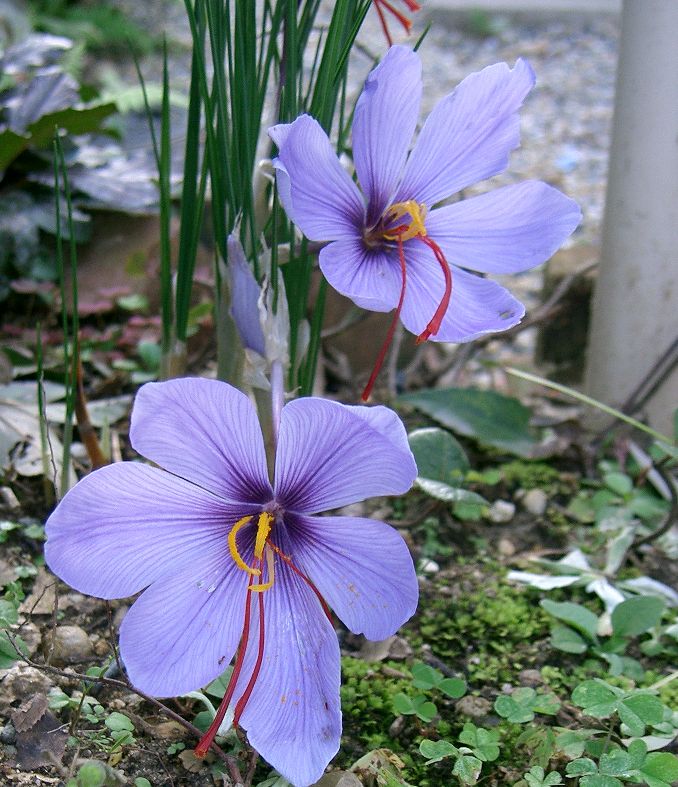 Saffron crocusCrocus sativus
The purple autumn flower whose red stigmas yield the spice saffron
🇨🇳 China and 1 more · Garden flower
Saffron crocusCrocus sativus
The purple autumn flower whose red stigmas yield the spice saffron
🇨🇳 China and 1 more · Garden flower
More from Spain
All the flowers of Spain PeachPrunus persica
A flowering fruit tree from China, grown for its pink blossoms and sweet fruit
🇨🇳 China and 7 more · Flowering tree
PeachPrunus persica
A flowering fruit tree from China, grown for its pink blossoms and sweet fruit
🇨🇳 China and 7 more · Flowering tree
 AlmondPrunus amygdalus
A Mediterranean tree grown for its fragrant spring flowers and edible seeds
🇮🇷 Iran and 6 more · Flowering tree
AlmondPrunus amygdalus
A Mediterranean tree grown for its fragrant spring flowers and edible seeds
🇮🇷 Iran and 6 more · Flowering tree
 ApricotPrunus armeniaca
A small fruit tree with early white to pink blossoms and golden-orange fruit
🇨🇳 China and 6 more · Flowering tree
ApricotPrunus armeniaca
A small fruit tree with early white to pink blossoms and golden-orange fruit
🇨🇳 China and 6 more · Flowering tree
 RosemarySalvia rosmarinus
A fragrant evergreen shrub with needle-like leaves and purple, blue, or white flowers
🇪🇸 Spain and 5 more · Flowering shrub
RosemarySalvia rosmarinus
A fragrant evergreen shrub with needle-like leaves and purple, blue, or white flowers
🇪🇸 Spain and 5 more · Flowering shrub