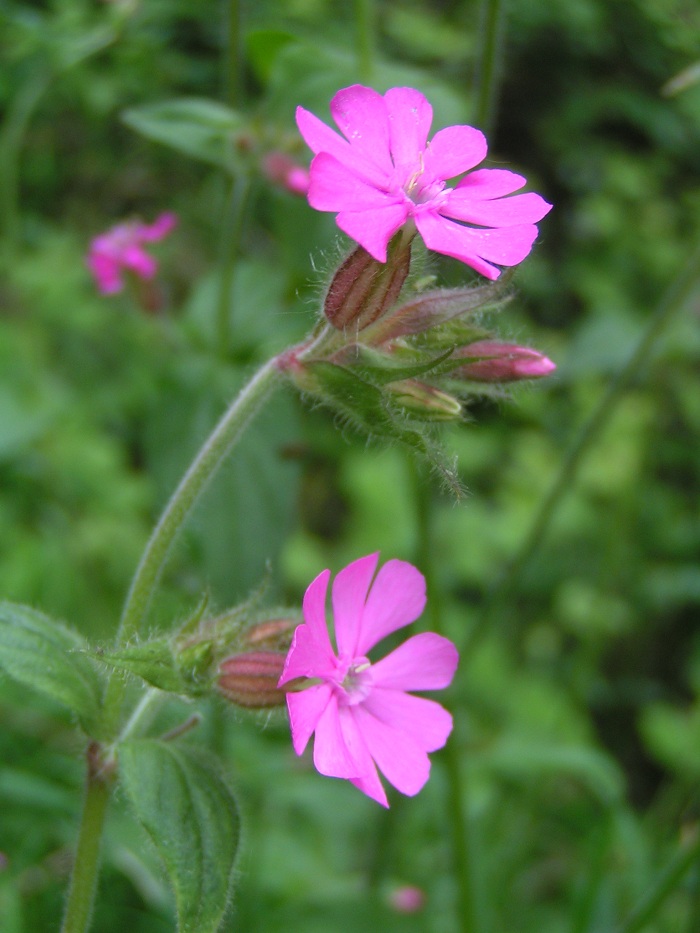
Red campion
Silene dioica, family Caryophyllaceae
A wild pink-red flower of woods and roadsides in northern and central Europe
Red campion is a perennial or biennial plant with pink to red flowers, found wild in northern and central Europe. It grows in woodlands and along roadsides, and is sometimes planted in gardens for its bright blooms. Its leaves and stems are hairy and sticky, and its flowers appear from late spring to autumn.
- Flowers are pink to red and bloom from May to October
- Male and female flowers grow on separate plants
- Common in woodlands and roadsides in northern Europe
- Young leaves and flowers are edible after cooking
- Linked to folklore and Catholic tradition on the Isle of Man
What does Red campion look like?
Red campion grows up to 90 cm tall, with branching, hairy stems and deep green leaves arranged in pairs. The leaves are oval and pointed, with a soft, sticky texture. Its flowers, which lack scent, are a strong pink to red shade, each with five deeply notched petals and an urn-shaped base. Male and female flowers grow on separate plants, and the plant produces small capsules filled with seeds.
Where does Red campion come from?
This plant is originally from northern and central parts of Europe, where it is widespread in the wild. It is especially common in the British Isles, including the Isle of Man and Northern Ireland, but less so in other parts of Ireland. Over time, red campion has also been introduced to places like Iceland, Canada, the United States, and Argentina. It thrives in damp, neutral soils, often along woodland edges, roadsides, and rocky slopes.
When and how Red campion blooms
Red campion blooms from late spring through autumn, with flowers appearing from May to October. It prefers moist, non-acidic soils and partial shade but can also grow in open, rocky places. The plant can be grown from seed and is sometimes used in perennial garden borders. There are cultivated varieties, such as 'Firefly', which has double, hot pink flowers.


How Red campion is used
People grow red campion for its colourful flowers in gardens and borders. The young leaves and flowers can be eaten after cooking or blanching to reduce bitterness. In the past, it was recommended in herbal traditions for various ailments. On the Isle of Man, local custom discourages picking the flower, and in Catholic tradition, it is linked to the Jesuit martyr Edmund Campion.
Kinds of Red campion
Red campion can hybridise with white campion (Silene latifolia), producing plants with paler pink flowers and features between the two parents. The garden variety 'Firefly' is known for its double, bright pink blooms and deep green leaves.
What Red campion means
On the Isle of Man, red campion is called the 'fairy flower', and there is a belief against picking it. In Catholic circles, it is associated with Edmund Campion. The plant is also important for wildlife, attracting bees, butterflies, and moths, though it can be affected by a fungal disease called anther-smut.
Where Red campion is used and seen

Questions people ask about Red campion
Where does red campion come from?
Red campion is native to northern and central Europe, especially common in the British Isles. It has also been introduced to places like Iceland, Canada, the US, and Argentina.
What does red campion look like?
It is a hairy, branching plant up to 90 cm tall, with deep green, pointed leaves and unscented, bright pink to red flowers that have five deeply notched petals.
How is red campion used?
Red campion is grown in gardens for its flowers. The young leaves and flowers can be eaten after cooking, and it has been used in traditional herbal remedies.
What does red campion symbolise?
On the Isle of Man, it is called the 'fairy flower' and is tied to local beliefs. In Catholic tradition, it is associated with the martyr Edmund Campion.
Does red campion attract wildlife?
Yes, its flowers are visited by bees, butterflies, and moths, and it plays a role in supporting these insects in its native habitats.
Good reading and sources
- USDA Plants DatabaseUS Department of Agriculture, Article
- Silene dioicaRoyal Horticultural Society, Article
- Plants of the World OnlineRoyal Botanic Gardens, Kew, Plant database
- Where it has been recordedGBIF, Plant database
- Sightings and photos by naturalistsiNaturalist, Plant database
- Silene dioica on WikipediaEncyclopedia
- More photos on Wikimedia CommonsPhotos
- Wikidata recordOpen data
The facts on this page come from the Wikipedia article "Silene dioica", written by its contributors and used under the CC BY-SA 4.0 licence, and from its Wikidata record (CC0). Phool rewrote the text in its own words, with AI assistance, and compares every page with the article to make sure no passage is copied. It may be reused under the same CC BY-SA 4.0 licence with a link back.
It may contain mistakes. It is not medical or foraging advice: many flowers are poisonous, and traditional uses are reported, not recommended. If something is wrong, tell us. Last refreshed 2026-10-03.
Others in the family Caryophyllaceae
The whole family Dianthus
A group of frilled, often pink, flowers grown in gardens and bouquets worldwide
Dianthus · Wildflower
CarnationDianthus caryophyllus
A fragrant flower with ruffled petals, grown worldwide for decoration and meaning
🇨🇳 China and 7 more · Garden flower
Dianthus
A group of frilled, often pink, flowers grown in gardens and bouquets worldwide
Dianthus · Wildflower
CarnationDianthus caryophyllus
A fragrant flower with ruffled petals, grown worldwide for decoration and meaning
🇨🇳 China and 7 more · Garden flower
 Fringed pinkDianthus superbus
A wild pink flower with deeply fringed petals and a sweet scent
🇫🇷 France and 6 more · Wildflower
Fringed pinkDianthus superbus
A wild pink flower with deeply fringed petals and a sweet scent
🇫🇷 France and 6 more · Wildflower
 Ragged-robinSilene flos-cuculi
A wild pink flower with deeply cut petals and a ragged look
Silene flos-cuculi · Wildflower
Ragged-robinSilene flos-cuculi
A wild pink flower with deeply cut petals and a ragged look
Silene flos-cuculi · Wildflower
More from Ireland
All the flowers of Ireland Common flaxLinum usitatissimum
The slender blue-flowered plant grown for linen and linseed
🇨🇳 China and 7 more · Wildflower
Common flaxLinum usitatissimum
The slender blue-flowered plant grown for linen and linseed
🇨🇳 China and 7 more · Wildflower
 HawthornCrataegus
A thorny shrub or tree with white or pink spring flowers and small edible fruits
🇮🇪 Ireland and 7 more · Wildflower
HawthornCrataegus
A thorny shrub or tree with white or pink spring flowers and small edible fruits
🇮🇪 Ireland and 7 more · Wildflower
 Lily-of-the-valleyConvallaria majalis
A woodland plant with sweet-scented white bell flowers in late spring
🇫🇮 Finland and 4 more · Wildflower
Lily-of-the-valleyConvallaria majalis
A woodland plant with sweet-scented white bell flowers in late spring
🇫🇮 Finland and 4 more · Wildflower
 RapeseedBrassica napus
A yellow-flowered crop grown for its oil-rich seeds and protein meal
🇨🇳 China and 7 more · Wildflower
RapeseedBrassica napus
A yellow-flowered crop grown for its oil-rich seeds and protein meal
🇨🇳 China and 7 more · Wildflower