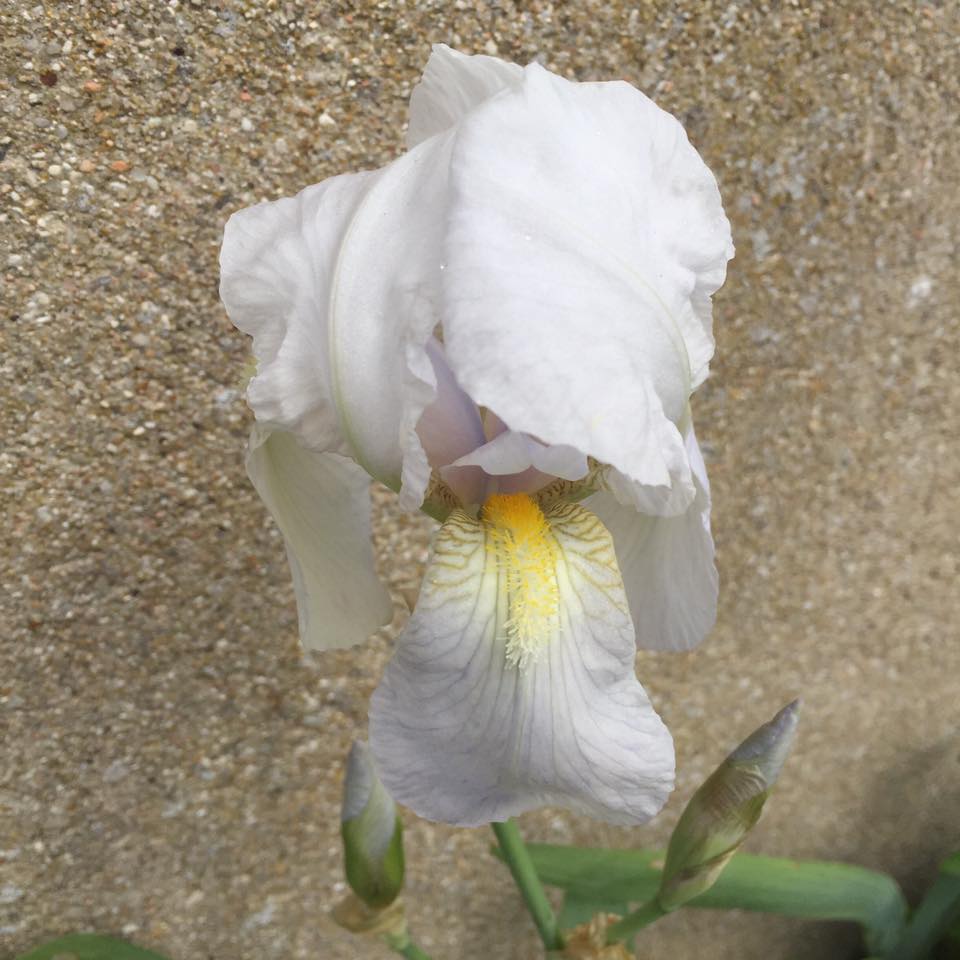
Iris florentina
A white, violet-scented iris grown for orris root and as a grave flower
Iris florentina is a perennial iris with white to pale blue flowers and a strong violet scent, native to southern and central Europe and widely grown in gardens and cemeteries. Its rhizome is used to make orris root for perfumes and powders, and the plant is linked to the fleur-de-lis symbol.
- Flowers are white, sometimes tinged with blue or lavender
- Rhizome is used to make orris root for perfumes
- Strong violet scent from both flowers and rhizome
- Traditionally planted on graves in Muslim regions
- Linked to the fleur-de-lis symbol
What does Iris florentina look like?
Iris florentina is a tall, rhizomatous perennial with sword-shaped grey-green leaves and branched stems. Its large, fragrant flowers are mostly white, sometimes tinged with pale blue or lavender, and have a yellow or orange beard on the outer petals. The flowers can reach up to 25 cm across and bloom in spring or early summer. The rhizome is thick and violet-scented, forming dense clumps over time.
Where does Iris florentina come from?
Native to central and southern Europe, especially Italy and France, Iris florentina has been cultivated since ancient times. It may have originated in the Middle East, with early depictions in Egypt around 1400 BC. The plant was introduced to Spain and later spread across Europe. Its name refers to Florence, and it has long been associated with that city. Over centuries, it has been grown for its ornamental value and for orris root.
When and how Iris florentina blooms
The plant blooms in spring or early summer, producing flowers from rhizomes planted shallowly in well-drained, sunny spots. It tolerates a range of soils, from loam to sandy or rocky ground, and can withstand cold winters if kept dry. Propagation is by dividing the rhizomes after flowering, trimming damaged parts, and replanting the sections. It is grown in gardens, borders, and sometimes naturalized along roadsides and old fields.


How Iris florentina is used
Iris florentina is planted on graves in Muslim regions and used as an ornamental in gardens worldwide. Its violet-scented rhizome is harvested to make orris root, a key ingredient in perfumes, powders, and toiletries. Traditionally, it was also used as an expectorant and decongestant. The flower is linked to the fleur-de-lis, a symbol in European heraldry. The plant is toxic if eaten and may cause skin irritation.
Kinds of Iris florentina
Several cultivars exist, such as 'Alba', 'Blue Zua', 'Florentina purpurea', and 'New Orleans' (with light grey flowers). Iris florentina is sometimes treated as a white-flowered form of Iris × germanica, and orris root is also produced from Iris germanica and Iris pallida. The plant has been given the Royal Horticultural Society's Award of Garden Merit.
What Iris florentina means
Iris florentina is closely tied to the fleur-de-lis, an emblem of Florence and French royalty. In Muslim regions, it is planted on graves as a sign of remembrance. The plant is not legally protected and has declined in parts of its naturalized range. Its long history in gardens and perfumery has made it a symbol of purity and elegance in European culture.
Where Iris florentina is used and seen
 BouquetA creative arrangement of flowers, given or displayed for many occasions
 The Daffodil FestivalPierce County’s spring parade and daffodil celebration since 1934
 Hakone Botanical Garden of WetlandsA garden of wetland and alpine plants in Hakone, Japan
 Parc floral de ParisA botanical garden and flower park in the Bois de Vincennes, Paris
 Parc Floral de la SourceA large public garden in Orléans built around the source of the Loiret river
 KeukenhofA vast Dutch flower garden famous for its spring tulip displays
 KanzashiTraditional Japanese hair ornaments, often crafted as folded silk flowers
 HanafudaJapanese playing cards with flower designs used for traditional games
Questions people ask about Iris florentina
Where does Iris florentina come from?
Iris florentina is native to central and southern Europe, especially Italy and France, and has been cultivated since ancient times. It has also naturalized in parts of the Middle East, North Africa, and Asia.
What does Iris florentina look like?
It has tall, branched stems with sword-shaped leaves and large, fragrant flowers that are mostly white, sometimes tinged with pale blue or lavender. The flowers have a yellow or orange beard and a strong violet scent.
What is orris root and how is it related to this iris?
Orris root is a fragrant substance made from the rhizomes of Iris florentina, as well as Iris germanica and Iris pallida. It is used in perfumes, powders, and toiletries for its violet-like scent.
Is Iris florentina poisonous?
Yes, like many irises, most parts of Iris florentina are toxic if ingested and can cause stomach pain or vomiting. Handling the plant may also cause skin irritation or allergic reactions.
What does Iris florentina symbolise?
The flower is commonly linked to the fleur-de-lis, a symbol of Florence and French royalty, and is used as a grave flower in Muslim regions.
Good reading and sources
- Iris 'Florentina' (IB/TB)Royal Horticultural Society, Article
- USDA Plants DatabaseUS Department of Agriculture, Article
- Plants of the World OnlineRoyal Botanic Gardens, Kew, Plant database
- Where it has been recordedGBIF, Plant database
- Iris florentina on WikipediaEncyclopedia
- More photos on Wikimedia CommonsPhotos
- Wikidata recordOpen data
The facts on this page come from the Wikipedia article "Iris florentina", written by its contributors and used under the CC BY-SA 4.0 licence, and from its Wikidata record (CC0). Phool rewrote the text in its own words, with AI assistance, and compares every page with the article to make sure no passage is copied. It may be reused under the same CC BY-SA 4.0 licence with a link back.
It may contain mistakes. It is not medical or foraging advice: many flowers are poisonous, and traditional uses are reported, not recommended. If something is wrong, tell us. Last refreshed 2026-10-03.
Others in the family Iridaceae
The whole family Gladiolus
Tall, showy flower spikes grown from corms, known as sword lilies
Gladiolus · Garden flower
Gladiolus
Tall, showy flower spikes grown from corms, known as sword lilies
Gladiolus · Garden flower
 Iris
A large group of perennial flowers with striking, six-lobed blooms
Iris · Wildflower
Iris
A large group of perennial flowers with striking, six-lobed blooms
Iris · Wildflower
 Crocus
Small corm-grown flowers in white, yellow, orange or purple
🇹🇷 Turkey and 7 more · Wildflower
Crocus
Small corm-grown flowers in white, yellow, orange or purple
🇹🇷 Turkey and 7 more · Wildflower
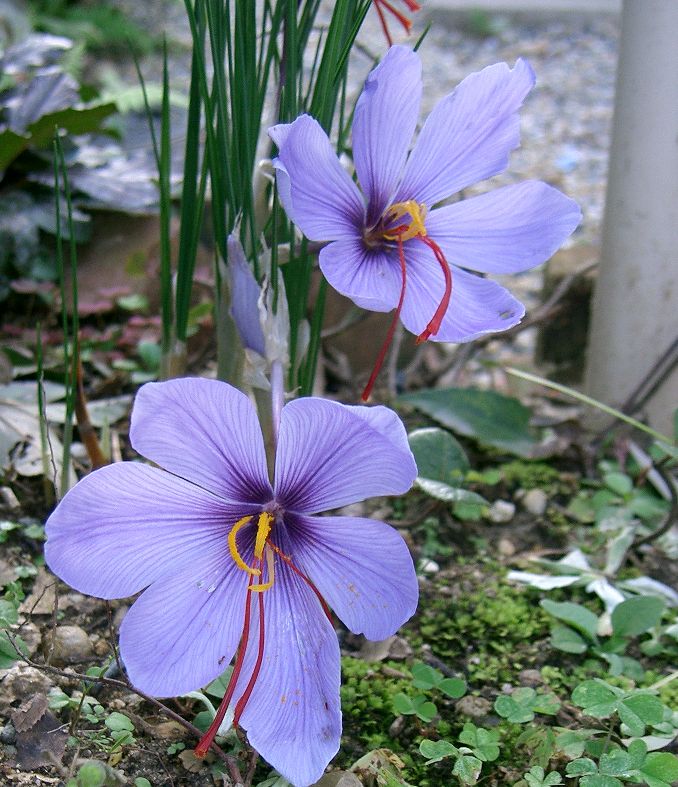 Saffron crocusCrocus sativus
The purple autumn flower whose red stigmas yield the spice saffron
🇨🇳 China and 1 more · Garden flower
Saffron crocusCrocus sativus
The purple autumn flower whose red stigmas yield the spice saffron
🇨🇳 China and 1 more · Garden flower
More from Italy
All the flowers of Italy PeachPrunus persica
A flowering fruit tree from China, grown for its pink blossoms and sweet fruit
🇨🇳 China and 7 more · Flowering tree
PeachPrunus persica
A flowering fruit tree from China, grown for its pink blossoms and sweet fruit
🇨🇳 China and 7 more · Flowering tree
 AlmondPrunus amygdalus
A Mediterranean tree grown for its fragrant spring flowers and edible seeds
🇮🇷 Iran and 6 more · Flowering tree
AlmondPrunus amygdalus
A Mediterranean tree grown for its fragrant spring flowers and edible seeds
🇮🇷 Iran and 6 more · Flowering tree
 Chrysanthemum菊花
Autumn-blooming flower with thousands of varieties, cherished in East Asia and beyond
🇨🇳 China and 6 more · Wildflower
Chrysanthemum菊花
Autumn-blooming flower with thousands of varieties, cherished in East Asia and beyond
🇨🇳 China and 6 more · Wildflower
 Wild cherryPrunus avium
A tall flowering tree native to Europe, grown for its sweet fruit and spring blossom
🇮🇹 Italy and 6 more · Flowering tree
Wild cherryPrunus avium
A tall flowering tree native to Europe, grown for its sweet fruit and spring blossom
🇮🇹 Italy and 6 more · Flowering tree