
Black Iris
Iris nigricans, family Iridaceae
The blackish-purple national flower of Jordan
The Black Iris (Iris nigricans) is a rare flowering plant native to Jordan, where it is the national flower. Its large, blackish-purple blooms stand out on short plants with curved leaves, and it grows best in sunny spots with well-drained soil.
- Endemic to Jordan and found nowhere else in the wild
- Large blackish-purple flowers up to 15 cm wide
- National flower and symbol of Jordan
- Needs full sun and sharp drainage to thrive
- Listed as an endangered species
What does Black Iris look like?
Iris nigricans is a perennial plant that grows up to 35 cm tall. Its most striking feature is its large, blackish-purple flowers, which measure 12 to 15 cm across. The petals are broad and the leaves curve backward, giving the plant a distinctive look. The flowers appear on sturdy stems above the recurved, sword-shaped leaves.
Where does Black Iris come from?
This iris is found only in Jordan, making it endemic to the country. It thrives in areas with direct sunlight and soil that drains quickly. Over time, it has become a symbol of Jordan, and its limited range has contributed to its endangered status. The species is sometimes confused with other black-flowered irises native to the region.
When and how Black Iris blooms
The Black Iris blooms in the wild in sunny, well-drained locations. It is grown in gardens by planting rhizomes in soil that does not retain water. The plant needs full sunlight and is sensitive to excess moisture, which can harm its roots. It does not require much care beyond these conditions.

How Black Iris is used
Iris nigricans is most valued as the national flower of Jordan and is grown in gardens for its unusual color. Its image is used as a symbol of the country. Because it is endangered, wild plants are protected, and cultivation is encouraged to help preserve the species.
Kinds of Black Iris
Several other irises grow in Jordan, including Iris atrofusca and Iris petrana, which also have black flowers and are often mistaken for Iris nigricans. Other native irises in the region display a range of colors, from light blue to white with black spots.
What Black Iris means
The Black Iris holds special meaning in Jordan as a national emblem. Its rarity and unique color have made it a symbol of the country's natural heritage. Conservation efforts focus on protecting this species and its relatives, many of which are also endangered.
Where Black Iris is used and seen
 The Daffodil FestivalPierce County’s spring parade and daffodil celebration since 1934
 Hakone Botanical Garden of WetlandsA garden of wetland and alpine plants in Hakone, Japan
 Parc floral de ParisA botanical garden and flower park in the Bois de Vincennes, Paris
 Parc Floral de la SourceA large public garden in Orléans built around the source of the Loiret river
 KeukenhofA vast Dutch flower garden famous for its spring tulip displays
 KanzashiTraditional Japanese hair ornaments, often crafted as folded silk flowers
 HanafudaJapanese playing cards with flower designs used for traditional games
 BouquetA creative arrangement of flowers, given or displayed for many occasions
Questions people ask about Black Iris
Where does the Black Iris come from?
The Black Iris (Iris nigricans) is native only to Jordan, where it grows in the wild and is also cultivated in gardens.
What does the Black Iris look like?
It has large, blackish-purple flowers measuring 12–15 cm across, with curved leaves and a short stem about 35 cm tall.
Why is the Black Iris important in Jordan?
It is the national flower of Jordan and serves as a symbol of the country's natural heritage.
Is the Black Iris endangered?
Yes, Iris nigricans is considered endangered due to its limited range and threats to its natural habitat.
Are there other black-flowered irises in Jordan?
Yes, several other irises with black flowers, such as Iris atrofusca and Iris petrana, are also native to Jordan.
Good reading and sources
- IUCN Red List of Threatened SpeciesIUCN Red List, Article
- Plants of the World OnlineRoyal Botanic Gardens, Kew, Plant database
- Where it has been recordedGBIF, Plant database
- Sightings and photos by naturalistsiNaturalist, Plant database
- Iris nigricans on WikipediaEncyclopedia
- More photos on Wikimedia CommonsPhotos
- Wikidata recordOpen data
The facts on this page come from the Wikipedia article "Iris nigricans", written by its contributors and used under the CC BY-SA 4.0 licence, and from its Wikidata record (CC0). Phool rewrote the text in its own words, with AI assistance, and compares every page with the article to make sure no passage is copied. It may be reused under the same CC BY-SA 4.0 licence with a link back.
It may contain mistakes. It is not medical or foraging advice: many flowers are poisonous, and traditional uses are reported, not recommended. If something is wrong, tell us. Last refreshed 2026-10-03.
Others in the family Iridaceae
The whole family Gladiolus
Tall, showy flower spikes grown from corms, known as sword lilies
Gladiolus · Garden flower
Gladiolus
Tall, showy flower spikes grown from corms, known as sword lilies
Gladiolus · Garden flower
 Iris
A large group of perennial flowers with striking, six-lobed blooms
Iris · Wildflower
Iris
A large group of perennial flowers with striking, six-lobed blooms
Iris · Wildflower
 Crocus
Small corm-grown flowers in white, yellow, orange or purple
🇹🇷 Turkey and 7 more · Wildflower
Crocus
Small corm-grown flowers in white, yellow, orange or purple
🇹🇷 Turkey and 7 more · Wildflower
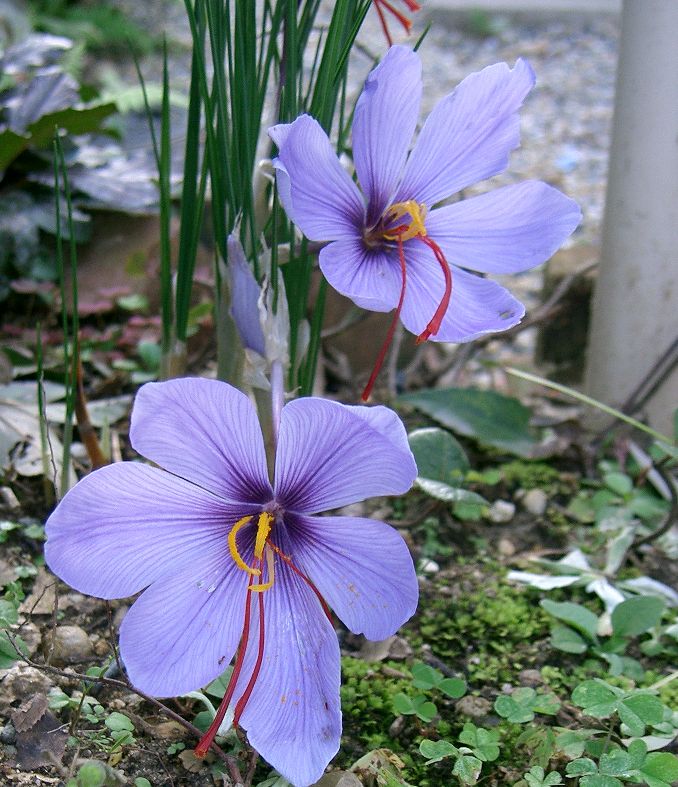 Saffron crocusCrocus sativus
The purple autumn flower whose red stigmas yield the spice saffron
🇨🇳 China and 1 more · Garden flower
Saffron crocusCrocus sativus
The purple autumn flower whose red stigmas yield the spice saffron
🇨🇳 China and 1 more · Garden flower
More from Jordan
All the flowers of Jordan Petra irisIris petrana
A rare desert iris with deep burgundy to nearly black spring flowers
🇯🇴 Jordan and 2 more · Wildflower
Petra irisIris petrana
A rare desert iris with deep burgundy to nearly black spring flowers
🇯🇴 Jordan and 2 more · Wildflower
 Gilboa IrisIris haynei
A rare deep purple iris from the hills of Israel and Palestine
🇮🇱 Israel and 2 more · Wildflower
Gilboa IrisIris haynei
A rare deep purple iris from the hills of Israel and Palestine
🇮🇱 Israel and 2 more · Wildflower
 Nazareth IrisIris bismarckiana
A rare mountain iris with veined pale flowers from Israel and Lebanon
🇮🇱 Israel and 3 more · Wildflower
Nazareth IrisIris bismarckiana
A rare mountain iris with veined pale flowers from Israel and Lebanon
🇮🇱 Israel and 3 more · Wildflower
 Eryngium
A spiny-leaved plant with blue or white flower heads, grown in gardens and used in cooking
🇲🇽 Mexico and 7 more · Wildflower
Eryngium
A spiny-leaved plant with blue or white flower heads, grown in gardens and used in cooking
🇲🇽 Mexico and 7 more · Wildflower