
Iris unguicularis
A winter-blooming iris with lilac or purple flowers and evergreen leaves
Iris unguicularis, or Algerian iris, is a perennial plant with slender, grassy leaves and fragrant lilac or purple blooms that show yellow markings. It is found in parts of North Africa and the eastern Mediterranean, and is grown in gardens for its winter and early spring flowers.
- Blooms in winter and early spring with scented lilac or purple flowers
- Native to North Africa and the eastern Mediterranean
- Leaves are evergreen and grass-like
- The cultivar 'Mary Barnard' has won a garden award
- Rhizomes contain compounds studied for medicinal uses
What does Iris unguicularis look like?
Iris unguicularis grows from a rhizome and forms clumps of narrow, evergreen leaves that resemble grass. The plant reaches about 30 cm in height. Its flowers are pale lilac or purple, each with a yellow stripe on the lower petals, and appear on long, slender tubes. The blooms are strongly scented and often open in the colder months, bringing colour and fragrance to gardens when few other plants are in flower.
Where does Iris unguicularis come from?
This iris is native to regions in North Africa and the eastern Mediterranean, including Algeria, Tunisia, Greece, Turkey, and parts of Syria. It has been grown in gardens beyond its native area because of its ability to flower in winter. Over time, gardeners have selected various forms for their gardens, including a white-flowered 'Alba' and a smaller subspecies from Crete. The cultivar 'Mary Barnard' has received recognition for its garden performance.
When and how Iris unguicularis blooms
The plant blooms from late autumn through early spring, producing flowers even in cool weather. It grows from underground rhizomes, which spread to form dense clumps. Gardeners often plant it in well-drained soil in sunny spots. It is usually grown from divisions of the rhizome rather than from seed, as this is the most reliable way to maintain its characteristics.

How Iris unguicularis is used
Iris unguicularis is valued in gardens for its early and fragrant flowers. The blooms are sometimes picked for indoor display, especially when little else is available in winter. The plant has also been studied for its chemical compounds, as its rhizome contains substances of interest in traditional medicine.
Kinds of Iris unguicularis
Several forms of Iris unguicularis are grown, including the white-flowered 'Alba' and the dwarf subspecies cretensis. The cultivar 'Mary Barnard' is notable for its performance in gardens and has been awarded by horticultural societies. These selections offer different flower colours and plant sizes.
What Iris unguicularis means
Gardeners appreciate this iris for its ability to flower in the colder months, making it a favourite for winter interest. While not tied to specific festivals or religious practices, it is recognized for its ornamental value. Its chemical makeup has drawn attention in medicinal research, but it is mainly grown for its beauty and scent.
Where Iris unguicularis is used and seen
 BouquetA creative arrangement of flowers, given or displayed for many occasions
 The Daffodil FestivalPierce County’s spring parade and daffodil celebration since 1934
 Hakone Botanical Garden of WetlandsA garden of wetland and alpine plants in Hakone, Japan
 Parc floral de ParisA botanical garden and flower park in the Bois de Vincennes, Paris
 Parc Floral de la SourceA large public garden in Orléans built around the source of the Loiret river
 KeukenhofA vast Dutch flower garden famous for its spring tulip displays
 KanzashiTraditional Japanese hair ornaments, often crafted as folded silk flowers
 HanafudaJapanese playing cards with flower designs used for traditional games
Questions people ask about Iris unguicularis
Where does Iris unguicularis come from?
This iris is native to North Africa and the eastern Mediterranean, including Algeria, Tunisia, Greece, Turkey, and western Syria.
What does the Algerian iris look like?
It has narrow, evergreen leaves and produces pale lilac or purple flowers with a yellow stripe on the lower petals. The flowers are fragrant and appear on long tubes.
When does Iris unguicularis flower?
Its blooms open in winter and early spring, often when few other plants are flowering.
How is this iris used?
It is mainly grown in gardens for its winter flowers and scent. The rhizome has also been studied for its chemical compounds in traditional medicine.
Are there different types of Iris unguicularis?
Yes, there are several forms, including the white 'Alba', the dwarf subspecies cretensis, and the award-winning 'Mary Barnard'.
Good reading and sources
- Iris unguicularis 'Mary Barnard'Royal Horticultural Society, Article
- Plants of the World OnlineRoyal Botanic Gardens, Kew, Plant database
- Where it has been recordedGBIF, Plant database
- Sightings and photos by naturalistsiNaturalist, Plant database
- Iris unguicularis on WikipediaEncyclopedia
- More photos on Wikimedia CommonsPhotos
- Wikidata recordOpen data
The facts on this page come from the Wikipedia article "Iris unguicularis", written by its contributors and used under the CC BY-SA 4.0 licence, and from its Wikidata record (CC0). Phool rewrote the text in its own words, with AI assistance, and compares every page with the article to make sure no passage is copied. It may be reused under the same CC BY-SA 4.0 licence with a link back.
It may contain mistakes. It is not medical or foraging advice: many flowers are poisonous, and traditional uses are reported, not recommended. If something is wrong, tell us. Last refreshed 2026-10-03.
Others in the family Iridaceae
The whole family Gladiolus
Tall, showy flower spikes grown from corms, known as sword lilies
Gladiolus · Garden flower
Gladiolus
Tall, showy flower spikes grown from corms, known as sword lilies
Gladiolus · Garden flower
 Iris
A large group of perennial flowers with striking, six-lobed blooms
Iris · Wildflower
Iris
A large group of perennial flowers with striking, six-lobed blooms
Iris · Wildflower
 Crocus
Small corm-grown flowers in white, yellow, orange or purple
🇹🇷 Turkey and 7 more · Wildflower
Crocus
Small corm-grown flowers in white, yellow, orange or purple
🇹🇷 Turkey and 7 more · Wildflower
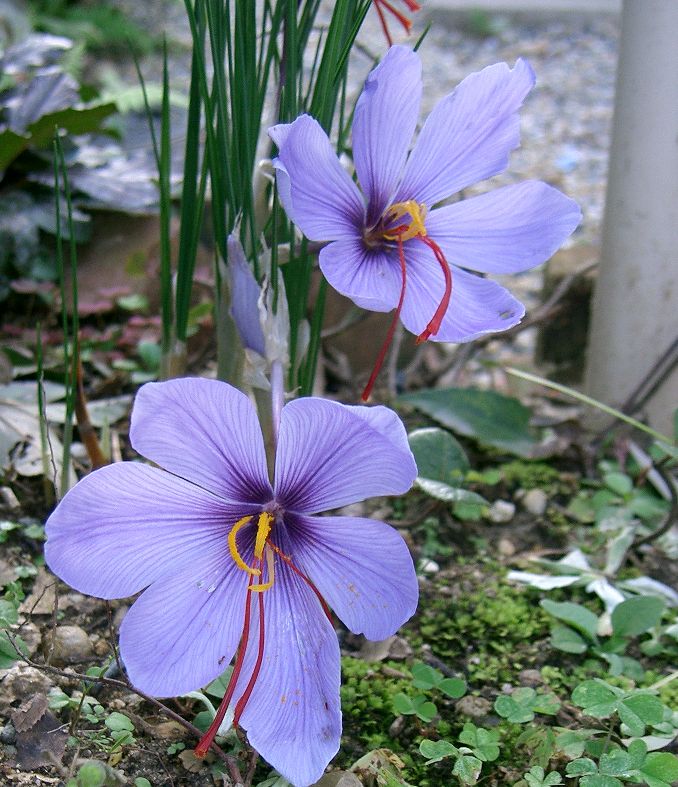 Saffron crocusCrocus sativus
The purple autumn flower whose red stigmas yield the spice saffron
🇨🇳 China and 1 more · Garden flower
Saffron crocusCrocus sativus
The purple autumn flower whose red stigmas yield the spice saffron
🇨🇳 China and 1 more · Garden flower
More from Algeria
All the flowers of Algeria Common poppyPapaver rhoeas
The vivid red wildflower of fields and remembrance
🇨🇳 China and 7 more · Wildflower
Common poppyPapaver rhoeas
The vivid red wildflower of fields and remembrance
🇨🇳 China and 7 more · Wildflower
 PeonyPaeonia
Large spring flowers in pink, red, white, yellow and purple, grown in gardens worldwide
🇨🇳 China and 7 more · Wildflower
PeonyPaeonia
Large spring flowers in pink, red, white, yellow and purple, grown in gardens worldwide
🇨🇳 China and 7 more · Wildflower
 Sweet VioletViola odorata
A scented violet with edible leaves and flowers, native to Eurasia
🇨🇳 China and 7 more · Wildflower
Sweet VioletViola odorata
A scented violet with edible leaves and flowers, native to Eurasia
🇨🇳 China and 7 more · Wildflower
 White Water-lilyNymphaea alba
A floating white flower of ponds and lakes across Europe and Asia
🇸🇪 Sweden and 5 more · Wildflower
White Water-lilyNymphaea alba
A floating white flower of ponds and lakes across Europe and Asia
🇸🇪 Sweden and 5 more · Wildflower